web analytics

Tag: Reviews

  • #34 album of 2013 – Phantom Head by the Scaramanga Six

    Artist: the Scaramanga Six

    Album: Phantom Head

    Phantom Head, by the British band Scaramanga Six (who currently are in fact a sextet), is an energetic album of sinister-for-the-fun-of-it bar-band rock. It reminds me of the leaner-poppier side of ’70s Blue Oyster Cult (the Career of Evil/ Harvester of Scaramanga_Six_Phantom_HeadEyes/ Debbie Denise side), or of Thin Lizzy’s twin-guitar rock if they’d sung from the perspectives of dangerous psychopaths-in-training. Or of the Who if they’d been Judas Priest fans, but wanted to make sure everyone was in on the joke. For a current comparison, imagine a lighter-on-their-feet Queens of the Stone Age, more likely to play a tango (They Put You on a Pedestal) than slide near heavy metal.
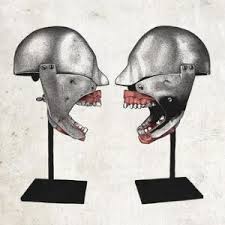
    My impression from reading about them is that Scaramanga Six used to be weirder, associates of the happily ridiculous progressive-punk-New Wave band the Cardiacs. Steve Albini’s production seems to straighten them out here, although you can still hear little touches like the extended 7/4-time bridge of I am the Rain; the sudden 7-beat measure twice inserted near the end of Blunt Force Trauma; We are the Blind‘s snaky 6/4, aggressive weird guitar solo, and grand piano breakdown; or the rare occasions Steven and Paul Morricone break out their saxophones. I should check their earlier work out; I bet I’ll like it. But Phantom Head is a record for jumping up and down to, and its dedication to groove is its essence.

    The lead vocalist — Steven Morricone, I believe — is a very good singer. His voice is strong, smooth, flexible, and good at crooning unlikely dark melodies; he can also suddenly shout, or intone through a megaphone, without losing elegance. Paul Morricone and Julia Arnaz are versatile guitarists, able to play anything from the ’70s anthemics of the Bristol Butcher to the Pixies rock’n’roll of Twist the Knife to the percussive blare of the Cardinal to the restrained slow build of the organ-heavy It’s Just a Matter of Time. (Their role in the dark almost-disco precision of the Spider is minor next to that of the rhythm section.) Phantom Head is not a deep record, and if I took it at all seriously I’d be appalled by the consistently pro-murder lyrics (not to mention the customer-service instructions that open the bell-tolling We are the Blind). What’s actually obvious is that Scaramanga Six want me to rock out and have a good time, minor key and all. I like them because I have the same goals quite often.

    – Brian Block

    To see the rest of our favorites, visit our Favorite Albums of 2013 page!

  • #35 album of 2013 – People by Burning Hell

    #35 album of 2013 – People by Burning Hell

    Artist: the Burning Hell

    Album: People

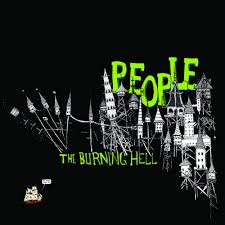
    Canada’s the Burning Hell are still described on their own website as “the alter-ego of ukelele player and all-purpose nerd Matthias Kom”, which made sense as of their 2011 masterpiece Flux Capacitor. As of 2013’s louder, more rock-centric People, it Burning_Hell_Peoplemakes better sense to refer to Kom as a guitarist, but the essential idea holds true: as pleasant as the old-time swing of their sax and clarinet is (where still applicable), the Burning Hell‘s songs revolve around the words, and Kom’s dry, speaking-melodically tenor voice. He tells stories: some autobiographical, some fictional. But even if we can largely tell which are which, it would be unfair to impose such structure on him.

    Grown-Ups, a slow-burning rocker that brings Neil Young’s Americana out towards Pearl Jam or Live without the teensiest hint of melodrama, serenely opens the album by recalling “You were a Nazi hunter/ I was a Cockney punter/ We used to meet on some rainy English street/ You’d be looking sharp, I’d be in a dirty old jumper/ Despite our different social stations/ Despite my lack of vocation/ I’d find you some piece of crucial information”. This is, of course, entirely of a piece with “We used to take photographs in graveyards/ back when we were little goth idiots/ We used to smoke hash before math class/ Everybody did it”. What it’s not of a piece with is “I got the invitation, it’s on the fridge/ beside the picture of you and your kids”. So the song becomes a polite ducking out, rejecting the invitation because “By the time you read this” … an exciting prologue that is never expanded on. By the time you read this, something will have happened: fill in your guesses here. Just don’t make it ordinary: don’t blemish the memory.

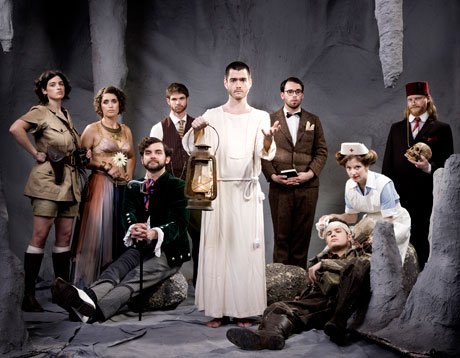
    Amateur Rappers is virtually pop-punk, barreling forward eagerly, with one sinister clarinet-led detour into klezmer. Kom’s delivery remains calm, though, stand-up comedy edging at times towards white-guy rap flow (with clarinetist Ariel Sharrat adding sing-song melody for the chorus). It’s about knock-knock jokes, founding a really fun religious cult, finding happiness the wake of apocalypse, theburninghelland how “parenting is the last refuge of the scoundrel”. Holidaymakers, jaunty and pre-rock and swingin’ with woodwinds and rhythm guitar, is a 1st-person-plural narrative in which our heroes have too much fun noticing the world’s little sensory details to get out of the way of an onrushing train, so then they must plead to St. Peter for a chance at reincarnation because they don’t want to be dead and have to miss everything. Wallflowers, acoustic early rock’n’roll (American Graffiti soundtrack plus clarinet and female “ahh-ahh-ahh” backing), is an intentionally awkward/ goofy flirting song, but still again sweetly caught up in details: “I like the way your pants are the same colours/ as the colours of the band around your hat … That sparkle in your eye shines/ like a shiny diamond in a diamond ring/ and like a crow, don’t you know/ I’m helpless around shiny things”.

    Realists and Industrialists, although pleasant as band performances by Burning Hell, represent the downside of Matthias Kom’s slackness, their stories shrugging their way towards generic c’est-la-vie morals like “It is what it is”, “You are what you are and I am what I am”, and “It takes all kinds of people to make a world”. Barbarians is much more fun, a 7-minute narrative where the band speeds up and slows down, rocks fiery and backs into eerie xylophone, shows a sense of guitar drama that often reminds me the Doors’ the End (but at other times of something much more playful), and invents a myth about Vikings, magic trees, Loki, and how destiny likes to play mythical heroes for suckers.

    People isn’t necessarily about *real* people, but then, it generally is. It’s just about us when we’re off-duty. And it bops along with just the right amount of energy that you can dance to it like a person of any age, whether you want to essay a Charleston, a Twist, a very gentle mosh, or me and my 7-year-old twisting my raincoat into a hundred unlikely shapes as our shared partner-dance prop. Which is an act of parenting, thus scoundrelhood. But I think Kom would get it anyway.

    – Brian Block

    To see the rest of our favorites, visit our Favorite Albums of 2013 page!

    (Amazon does not carry the Burning Hell‘s People, but you can buy it at Burning Hell’s bandcamp site, and the band themselves keep 80% of the money you spend there, because bandcamp.com are lovely that way.)

  • #36 album of 2013 – Jumbie in the Jukebox by Kobo Town

    Artist: Kobo Town

    Album: Jumbie in the Jukebox

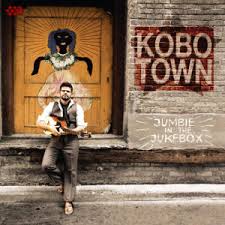
    If you’d asked me a year ago if I like calypso music, there’s a fair chance I’d’ve said “Yes”. At which point you could’ve asked me what calypso albums I owned, and I’d’ve paused, blushed, and given you the following full list: the Essential Harry Belafonte. Even Kobo Town - Jumbie in the Jukeboxthere, I’d’ve had to admit that my fondness for Harry Belafonte stems less from the album (which is indeed very fine) than from his human rights activism, his sense of humor, and especially his singing of perhaps the Muppet Show‘s two greatest musical numbers: their funny skit-centric take on the Banana Boat Song (Day-O) and his solemn, intense, charismatic performance of Turn the World Around. Calypso is distinguished by its swaying, Caribbean-feeling rhythms, its openness to congas and bongos and steel pans and cowbells and Spanish guitar, its horn sections with their own swaying rhythms, and … well, for those of us who are totally inexpert, by singers with thick Trinidad accents. And now, thanks to Kobo Town‘s Jumbie in the Jukebox (which means “spooky and/or amusing dead person haunting a machine that plays songs from a menu when you give it money”) it’s distinguished by being a genre I own *two* albums in. Of what must be the highest Average Quality Per Album for any genre in my collection.

    Drew Gonsalves, Kobo Town‘s Canadian-by-way-of-Trinidad singer /songwriter/ guitarist, has a limber, lilting voice with pretty good singing range and the agile rhythmic half-melodic sense of an excellent rapper. He also has a strong social conscience, writing protest songs rooted in stories of individual people. Mr. Monday is a schizophrenic who lost his family when his mental illness arrived and now collects bottles in order to dance with them awhile before recycling them. Joe the Paranoiac might be listening all day to Rush Limbaugh or Alex Jones, to Fox News or the John and Ken Show, but he finds his meaning in bizarre rumors, surely deserves pity for the ways he’s manipulated, and would be easy to sympathize with if he wasn’t a 50/50 shot to report you as evil to the appropriate agencies. Half of the Houses recounts what happens to a town when everyone who wants to make a decent living (Gonsalves included) has fled far away — which doesn’t mean they don’t miss each other. Indeed, Diego Martin remembers his goodbye to his hometown.

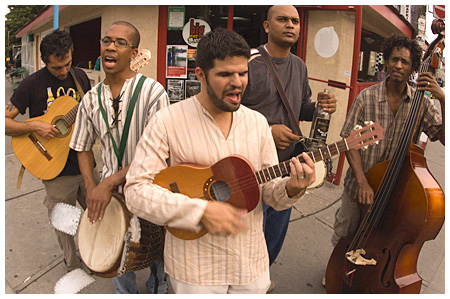
    Road to Fyzabad moved beyond personal perspective, but not by accident: it recounts a worker uprising that had power only because *many* individuals put aside their background and racial differences to stand up for a chance to retain the wealth they all worked each day to create. (The uprising was only defeated because *many* individuals put aside similar differences to gun them KoboTowndown together as British Royal Marines.) The War Between Is and Ought is mythical; the Call is mystical; Tick Tock Goes the Clock is both. The music tends to be unfailingly pleasant — even as Is and Ought “each rained fire down on field and town/ to prove the other wrong”, the trumpet and guitar each get especially nice and imaginative solos, while Tick Tock‘s apocalypse is a head-bobbing, shaker-driven dance song with squawky guitar. Postcard Poverty‘s delightfully acrobatic chorus is about a Western tourist visiting the ghetto in search of stories to tell. It’s not that Gonsalves isn’t angry, or cynical about his country’s status as a “petroleum paradise” (with one of the highest GDP-per-capita economies in the world, yet little electricity outside the cities, few paved rural roads, and regular water shortages). But the Caribbean nations had centuries of being slave-majority populations, and while that’s a horrible existence — one of being robbed for a living — there comes a point, after the crushing peaks of planting season and before the worst of the harvest, when even a slave invents a time and some reasons to smile and dance.

    What Kobo Town‘s Jumbie in the Jukebox reminds me of, more than anything, is the last few Bob Marley albums, Exodus and Survival and Uprising. Gonsalves is actually a better lyricist than Marley, more specific and a better sketcher of character, and the differences between reggae and calypso (or Trinidad vs Jamaica accents) are, to my ears, more subtle than the overlaps. I wouldn’t rate Jumbie in the Jukebox quite equal with Survival at the moment; possibly because its horn section is sparser, less emphatic (although Gonsalves’s excellent guitar work is a counter-argument). Possibly because where Gonsalves’s voice is slightly lower and smoother, Marley’s still had an unmatched passion. Or then again, possibly just because I’ve known the songs on Survival for more than twenty years. Which someday, I hope, will be true of Jumbie as well.

    – Brian Block

    To see the rest of our favorites, visit our Favorite Albums of 2013 page!