Artist: Babe the Blue Ox
Album: Guilty
Babe the Blue Ox were an interesting 1990s rock trio from New York City that I liked even before they recorded their masterpiece, and then in 1998 they did, and then they stopped making new songs together for fifteen years, though I believe they still played 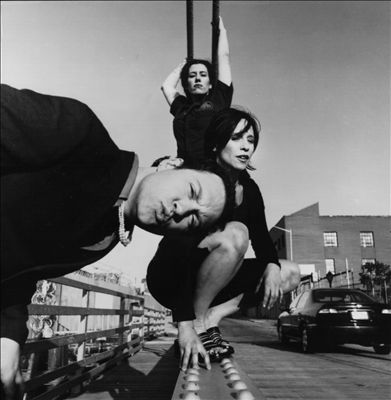 concerts every New Year’s Eve. Tim Thomas played strong, angular guitar riffs and sang (with limited melodic range) sometimes in a theatrically gruff, sultry bass voice, and sometimes in a thin indie-rock tenor. Rose Thomson, his wife, played strong, angular bass riffs and sung sometimes with a Kim Deal yelp, sometimes with a fragile but pretty alto. Hanna Fox played drums — nothing even slightly showy, but she managed to play through tricky stop/ starts, tempo changes, and the occasional odd time signature — and added fragile singing of her own. Lyrically they switched among an appealing vulnerability (all of them), working-class concerns (all of them), a stagey machismo (Tim’s), and bursts of goofiness. (Those of you who already know the history can skip to the asterisks below.)
For me Babe the Blue Ox‘s signature early song was the absurdly ambitious Booty (from [BOX], ’93), which in 3:16 squeezed in a 6/8 art-funk riff; Thomas growling things like “a baptism of jism/ through the prism of isms” and “the slime and the soup can’t recoup/ the pretended intention of looking astute”; a screamed call-and-response knock-knock joke over blues-metal in 6/8; a glorious “the poooooowwwwwer of love is the power of booty” bridge sung like a country music duo pulled abruptly off their anti-psychotic medication; another bridge with a completely unrelated rhythm and riff; the original riff returned with Tim and Rosalie singing giddily side-by-side; and then the monster’s knock-knock joke returning as an exit. Most [BOX] songs had a more normal number of elements, but just as skewed and potentially abrasive, and prone to more lyrics like “It musta been a trauma in the drama of the puberty./ At 30, this dirty dude should know enough to humor me./ Back off, buddy, and give me my appendages./ Smoke another sucker’s bone and keep your fingers offa me”.
Their ’96 album People was still strange but more straightforward, and then came ’98 and the Way We Were. Major label record company behavior was, at the time, mystifying on a daily basis; every big record company would pay to record and release about six times as many albums as they had the budget to promote, thereby guaranteeing that they’d lose money on most of their records. The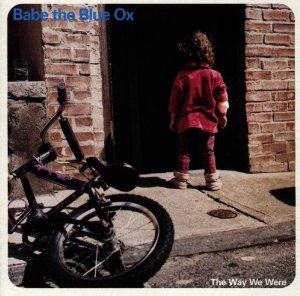 Way We Were was a classic victim of this approach: without losing any of their personality, Babe the Blue Ox had made a great record that wasn’t radical by ’90s rock standards at all. It should have been huge. Tattoo‘s insinuating 7/4 bass line, slow-burn buildup, and telegraphic lyrics should have become a hit for the same good reasons the Toadies’ Possum Kingdom did, especially since it didn’t saddle itself with the latter’s “do you wanna die?” coda. Plan B‘s spastically pounding bass would have been a Rage Against The Machine highlight, and I’m optimistic enough to think the melodic, rhythmically off-beat duet vocals — Tim Thomas as the deep-voiced macho man doing laundry in these redefined times, Rose Thomson singing perky and sweet — could have been an advantage, not disadvantage, commercially. Basketball used the same vocal alternation and harmony in pretty, wistful form over music that defines “a good beat, and you can dance to it” as well as anything else I’ve heard. Sheila was like Pearl Jam evoking the Joshua Tree in the same way that Black Hole Sun was Soundgarden’s homage to Revolver. I’m Not Listening attached a Connells-like chiming guitar hook to its pop-punk momentum. My Baby and Me was skeletal electric blues, Bad to the Bone for romantics. RCA’s failure to promote it — after forwarding Babe the tens or hundreds of thousands to dollars to make it, and getting something *much* more commercial than could have been expected — was stupidity that would seem unparalleled if it hadn’t been industry standard. I learned of the Way We Were‘s existence the day I found it in a $2 bin.
*********
And so, fifteen years later, they self-released Guilty, realizing it would be a lot more cost-effective to not promote their album by themselves instead of having experts not promote it. They sound older, quieter, and subtler; that said, the exceptions are absolutely peak-form. Dragging the Joneses, a song about envying people who are rich/ brilliant/ beautiful, has multiple musical sections based on different fierce, unsettling riffs, Tim and Rose playing together like two kickass bassists one of whom simply happens to have a couple of extra guitar strings; even when it gets dreamy and prettily harmonized, it retains clear undercurrents of being ready to attack you in your sleep now. N.O.W. and God’s Hands are as percussive and scratchy  and wiry as anything way back on [BOX] — the former funky-weird like the Jon Spencer Blues Explosion, the latter heavy but nimble like the Pixies pretending to be Soundgarden pretending to have some clue how to play a waltz. Tim’s higher, non-growly voice has improved a lot in 20 years, more confident and firm, with an actor’s presence: it’s become his primary singing style.
But N.O.W. leads into Innumeracy, which works that wiry guitar, junkyard percussion, and tenor singing into more of a folk storyteller setting with close harmonies (even the one-minute explosion of guitar noise and time-signature switches still leaves that noise a towering backdrop to the passionate duo vocals, after which everything settles down). Rose’s Mal Madre (“bad mother”) is anxious like a Breeders song, but scaled far down in volume, the instruments all but dropping out for half-a-minute in the middle. Estate Planning, fragile and folk-harmonized, is built on rubbery found-sound loops.
I-35 and Self-Evident are love songs, and their vocal harmonies, their complex interplay among Tim’s guitar and Rose’s bass (neither of them using any of rock’s standard distortion), are as worthy an expression of long-term lovestruck togetherness as any words could be. Hanna’s drums too: she may not be part of the marriage, but two-plus decades in a band with no one leaving is still pretty special. Babe the Blue Ox often remind me of bands they never used to: Television’s calm and precise guitar arrangements. Belly (Feed the Tree/ Super-connected)’s ability to synthesize indie rock with vague-yet-lovely country music leanings. Ida’s quiet intensity and slow builds (Ida’s Daniel Littleton produced Guilty and added some guitar). Not to mention any band that turns two highly imperfect singers, one per standard sex, into a magical combination. They used to do that a little; they do it a lot now. It was a good idea then; since there’s more of it, it’s even better now.
– Brian Block
To see the rest of our favorites, visit our Favorite Albums of 2013 page!
[AMAZONPRODUCTS asin=”B00B515UN0″]