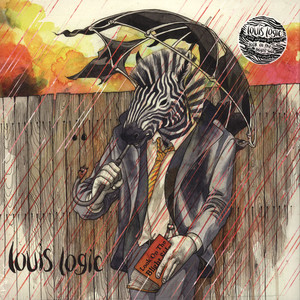
Artist: Louis Logic
Album: Look on the Blight Side
The year 2012 — which is, I agree, not the one I’m reviewing currently — was to me a year of extraordinary flowering in hip-hop. That’s not a proper belief among the true hip-hop fans I know, who hold that hip-hop’s Best Year Ever cannot possibly be any year 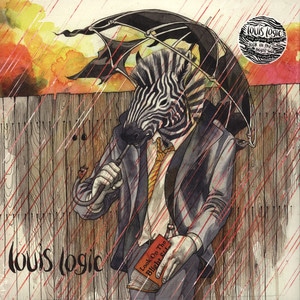 after 1995. But I am a false hip-hop fan, or at least an odd one, and hip-hop — despite a pioneering exception or three — didn’t develop its equivalent of the “alternative rock” scene, full of outsider questionings and over-educated wordplay and sonic experimentalism and a rejection of macho posturing, until after that. So that my 2012 could feature, all in prime form, Aesop Rock‘s hilariously encrypted emotional gut-punches; Flobots‘ smart activism, self-questioning, and live-band inventiveness; BBU‘s college-radical bratty charm and retro catchiness; Killer Mike‘s elevation of gangsta-rap to something perceptive enough to threaten beyond its own immediate (and beleaguered) neighborhood; Justinus Primitive‘s hypnotic, mystical welcoming-outsider pride; and Macklemore’s playful, good-natured mild subversions at the borders of his genre’s mainstream.
So I’m disappointed to agree, for 2013, with the critical consensus that the year’s best hip-hop album, coming up later, was primarily about the expensive clothes, expensive cars, and unpaid groupies of (and, not in any way contradicting these, the near-slavery-like racial oppression of) Kanye West. I also enjoyed the Underachievers’ sonically playful, energetically rapped Indigoism, but I won’t be reviewing it: its assembled samples weren’t *quite* inventive enough to obscure for me the fact that it’s another rap album about getting high and using (a dull array of) naughty words. So late in the year I asked my friend Kyle to recommend some unlike alternatives, and he came up with a couple of good ones that snuck their way onto the list. At #44, then, I have an album with a good chance of appealing to many among you who don’t enjoy hip-hop, in general, at all.
Louis “Logic” Dorley is, on the one hand, a perky rapper with a quick tongue and a carnival-barker solicitousness that reminds me of early Eminem. Yet he’s also, at least as often, a pleasant singer drawn to lovely layered harmonies that can, as on Don’t Care, feel like psychedelia and classic doo-wop at the same time. Louis Logic‘s Look on the Blight Side is also a rare entry (like Flobots or Subtle) in the no-samples-only-live-instruments school of hip-hop. That doesn’t mean you’ll mistake it for a chamber orchestra — synthesizers are the favorite instrument here, often pushed along by heavily syncopated real drums. But it means the generally cheerful fairground atmosphere (Louis is surely a big fan of Being for the Benefit of Mr. Kite) is slightly adding to the array of sounds from which the rest of the music world can steal. I honor that, as I honor the woozy 3/4 time of the Joke’s on You; the harmonica and Dixieland horns and 3/4 time again on They Don’t Make ’em Like They Used To (and, in a more chaotic 6/8, Big Fish Eat the Little Fish); the simple-but-catchy piano hook of Look on the Blight Side.
About the lyrics, the simplest things to note are that he’s a social observer with a large vocabulary, clever rhymes, and — a serious outlier in his genre — opinions that I’d expect to read in liberal blogs and cranky Atlantic-style magazine features. He hates mass  media’s presentations of women (“It’s sad that it’s glamorous to have the chicks/ with the ugliest damages in front of these cameras./ How many shows do you know boast underfed famine-ists?”) and how they reverberate in the broader culture (“Staring at some foolhardy parent who hardly cares a/ bit if her kid ever does school if she wins some darn tiara”). He sees the scam-based aspects of capitalism, from the invention of products like bottled water (“It kills me that you pay so much for stuff the sky spills free”), to how industry long since invented “planned obsolescence”, with extensive government-corporate collusion, because there’s money in replacing junk. He challenges God’s motives in killing off all His characters in the end (“It’s not required, but he’s actually enjoying the work./ Spoiler alert… the story’s gonna end with him burying the boy in the dirt”).
He’s perhaps less a skeptic of progress than just nostalgic (“Remember when a truthful togetherness was crucial?” Really? Are we remembering Catcher in the Rye, the Great Gatsby, or the Spanish Inquisition?). But whether or not “We’re all synthetic provisional lovers wrapped and stuffed in styrofoam”, he’s correct to note that school shootings used to be near-nonexistent, there used to be fewer TV programs about “meritless heiresses”, and that “But is anyone happier? Did you find enrichment?” is harder to answer with certainty than it should be, when happiness’s pursuit is why we’re stealing all those resources from our grandkids.
As much as I like this album’s rejection of hip-hop stereotypes, I wish it gave a clearer sense of Louis Logic as a person (or persona). I like music’s political to be personal too: Midnight Oil’s warm welcomes to the struggle, New Model Army’s embrace of the depressed romance of inevitable defeat, Carter the Unstoppable Sex Machine’s bleeding-heart empathy and determination to ward off the darkness with bleak but hilarious puns. The Coup offer brashness, shoplifting, and Communist ideology; Sage Francis offers density of detail and preposterous self-aggrandizement; Propagandhi offer poetry, intense self-questioning, devotion to their friends, and a sly sense of humor; Decomposure pleasantly admits both despair and being too lazy to fight properly anyway. Louis “Logic” Dorley slips into roles, but seems comfortable judging us from above, even when singing about his desire for romance over casual sex. So Chip Off the Old Blog and Big Fish Eat the Little Fish can’t sound to me like he’s satirizing a bully from inside the role — which I hope is the idea — when they sound like he’s being one. “Sedatives and whiskey are so passé./ You’re a class A butthead who should be living in an ashtray./ Say that the world ends today in a whirlwind./ Would a fibber like you admit in high school, you had a made up Canadian girlfriend?/ Pssshht… as if you had anyone fooled!/ Everyone knew you were never that cool” sounds like standard rap shit-talking. In which case “you’re a guy hiding far too much Venus for a Martian” does too, and how does that fit his critique of gender roles?
Dorley *says* Big Fish is a satire of homophobia; I wish the album itself made it clearer. Still, Look on the Blight Side is good-natured, as well as agile, tuneful, a little bit trippy, and thoughtful. I’m sorta downgrading it for being less neurotic than the artists from one paragraph ago. This says nothing about me, of course. Blight Side is better than 15 or 20 or 30 other quite worthwhile albums I heard from 2013, but less good than 43 others: that’s simple numerical data. To question it would be illogical.
– Brian Block
To see the rest of our favorites, visit our Favorite Albums of 2013 page!
[AMAZONPRODUCTS asin=”B00FGH79II”]
 collaborations with Springsteen’s E Street Band, perky New Wave synth-pop, and — as her voice got deeper and richer — into roots-rock and blues. Starlight shows her still venturing, now into jazz-pop that sounds like the work of an extremely impressive late night combo … except that apparently she played every instrument herself. (Presumably using lots of overdubs, although it’s an even better story if she played the whole thing live using six extra robot arms. I think I’ll leap the album up about thirty ranks if I discover that’s the case.)