web analytics

Tag: Reviews

  • #19 album of 2013 – Yetchalal by Ukandanz

    #19 album of 2013 – Yetchalal by Ukandanz

    Artist: Ukandanz

    Album: Yetchalal

    The band name Ukandanz can be pronounced as “You can danz” (“dance”), thus I pronounce it that way. They’re a French band (sax, bass, guitar, drums) that plays loud, highly energetic Ethiopian-style pop music sung by immigrant Asnake Guebreyes, so I have Ukandanz-Yetchalalno idea if I’m pronouncing it correctly, or what the name might in fact mean. But I *can* dance, and the music on Yetchalal makes me want to, and now this review has a cheap hook, so there.
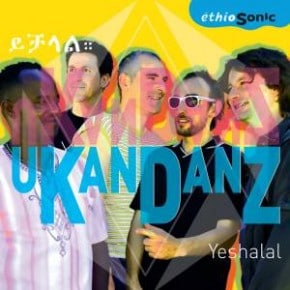
    The strangeness levels on Yetchalal, to Western-trained ears, vary quite a bit. Belomi Benna is Ukandanz at their most catchy and straightforward: bopping along in 4/4 time, with simple call-and-response vocal hooks and a horn section not that far away from Dixieland jazz. Wub Nat could be taken as a variant on ’90s indie guitar rock: some of it based on a choppy percussive 6/4 bass riff Soundgarden could’ve authored on an inventive day, other sections built on dreamy floating guitar closer to Ride or Swervedriver — all of it made unfamiliar only by the very busy and complicated horn sections, and by Guebreyes’s lithe, ululating, wiggly voice and exceptional breath control. Tezalegn Yetentu‘s guitar, bass, and drum work start at punk-pop, then spend the rest of the song not far from Led Zeppelin doing one of their Mideast-inflected epic buildups; Lionel Martin’s horn blasts here are simple and rousing, and shouldn’t scare anyone who’s ever heard a marching band (unless they were stomped over and crushed bone-by-bone by said marching band, in which case, ouch!, but I was just trying to use a sonic comparison).

    Addis Abeba Bete slides on very slippery rhythms, but the bass guitar is set for blasting out of car speakers, and Guebreyes’s smoothest, lowest singing and the saxophone’s sway are probably damned seductive until the song accelerates into double-time. Semmenawerq pushes the drummer Guilhem Meier forward for his best showcase, while Ben Lecomte’s bass tolls like doom, or just an insane clock. Aykedashem Lebe is the most ominous, heaviest song here (and quite possibly my favorite), but Martin’s sax still slips a folk-dance feel into the otherwise tense action-adventure setting. Then again, the bassline of the dreamy Senadere feels almost disco. Or at least it does after nine previous Ukandanz songs have already stretched my musical horizons — and until it climaxes as a fierce guitar rave-up.

    Last year I suggested that the Debo Band’s self-titled debut, also Ethiopian-styled, had become my favorite African-pop album. I can still recommend it happily, but the superlative is no longer true; Yetchalal has walked away with that title. Both bands seem equally talented, and I can express the differences in neutral, objective terms: Yetchalal is faster, denser, trickier, and louder than Debo Band, and Asnake Guebreyes’s singing, though smooth, is high-intensity where Bruck Tesfaye’s voice is calmer, more studied. You might prefer either; but those differences translate in *my* head as “Yetchalal is better, better, better, and better, and also the singer is better”. My interest in “World Music” began, a few years ago, with a certain level of artifice: of trying new things in the belief that trying new things is a Good Thing To Do. The novelty hasn’t worn off yet, but the artifice is gone; it’s just fun now.

    – Brian Block

    To see the rest of our favorites, visit our Favorite Albums of 2013 page!

  • #20 album of 2013 – Play with Fire by Reign of Kindo

    #20 album of 2013 – Play with Fire by Reign of Kindo

    Artist: Reign of Kindo

    Album: Play with Fire

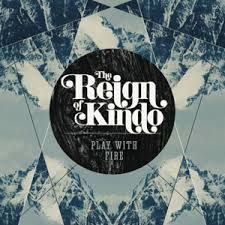
    The songs I embed with a review are always, I figure, better than nothing, but they range from “desperately-grabbed only YouTube evidence this artist exists” to “an illustration of one of the several approaches the artist uses” to “just right”. In the case of Reign of Kindo‘s Play Reign of Kindo_Play with Firewith Fire, I’ve got the latter: not only is the Hero, the Saint, the Tyrant, and the Terrorist my favorite song here, but its five minutes tour Reign of Kindo‘s varied strengths. I mention this because whether the song intrigues you, at least some, would be objective data for you. While I find myself more aware than usual of how the comparison points I choose for an artist can paint very different pictures.

    For example. They’re an agile piano-pop band with smart philosophical lyrics, jazz leanings, and fluent crooning by Joseph Secchiaroli. Their second album This is What Happens, in my top ten of a musically wonderful 2010, showed a particular flair for lovely ballads and a comfort with off-kilter time signatures. Play with Fire, album #3, is more consistently fiery and gives the band more chances to show off, still in pop-song format. I can fairly compare them to Ben Folds, say (both his balladry and his early jazzy showing-off) — with a bit of the Dave Brubeck Quartet’s calm ensemble fluency, and some of Stevie Wonder’s melody-writing quirks. Obviously, an album that’s hip and reputable.

    But the first comparisons I thought of for Play with Fire included, well, Barry Manilow (mostly At the Copa, a great song, but I was still all “Barry Manilow?”). Also Sting’s solo career — Fortress around Your Heart, All This Time, Seven Days — if we took away his synthetic production, focused on what his jazz sidemen bring, and gave him a lower, more conventionally pretty voice. The album’s one serious misstep for me, Impossible World, sounds exactly like music from a Carnival Cruise Line ad. And the dynamics and structure of the uncharacteristically lust-driven Feeling in the Night feel like a musical exploration of what hair-metal power balladry would have been, had it been a form of jazz centered in 5/4 and 7/4 time. (No, no, that’s a good thing.)

    More often Reign of Kindo‘s lyrics are reflective. Christianity is central to their background, which they have mixed feelings about. My favorite song from This is What Happens, the gorgeous Comfort in the Orchestration, was about the desire to believe in a benevolent masterplan — your own if possible, a Creator’s as an unreliable backup source of hope once you realized “you’re not in control”. The same album finished with Psalm, its last lines being “I need a miracle”, but was an original and evocative use of the “sing to God as if you’re singing to a girl” trick, admitting “Ten thousand reasons I don’t give You time … I understand if You’ve had a change in plans, because You don’t need me the way I need You”.

    Play with Fire is less concerned with God, more with the people who claim to represent Him. It starts “I’ve been told I’m evil, born into this world of sin from the day I left my mother’s womb. I’ve been told I’m fallen, that my nature is untrue, they say ‘You need God’s Reign of Kindo_bandforgiveness, son, or you’ll burn in hell with everyone’. I kindly ask them why; I may have caught them by surprise, but I know they’ll think of something… blind faith is blindness just the same, it can justify the cruelest claims”. Dust builds a Book of Common Prayer passage (“ashes to ashes, dust to dust”) into “We once were children building castles in the sand/ we’d smash them back into the land/ we’d call it all good fun./ Now we build them big and tall/ We weep and cry each time they fall… We try so hard to leave a mark/ we end up mostly leaving scars”. The Man, the Wood, and the Stone is a fable that ends the album with its title: the man who first discovers a reliable way to make fire is eager to show everyone else how he did it, but “the priests and the preachers, they heard of this man… and conspired to end him in secret… and taught ‘Man is evil, he must do as the law requires, and he must never, ever play with fire’”. As literal pre-history it’s nonsense; as a song about power and ideology today, it’s potent.

    Impossible World is a love song, Help It is an eloquent song about dancing, Romancing a Stranger is about being an incompetent suitor, I Hate Music is an attack on pop radio. I’ve already mentioned the please-have-sex-with-me song; Play with Fire is only sometimes earnest, and the playing is often, even usually, joyful. But when Secchiaroli tells us “My notebook’s a sight/ Every sentence I write/ is swiftly crossed out before long”, he’s easy to believe. I didn’t cross out some comparisons Reign of Kindo might have preferred me to. But look, there’s the embedded video, letting the band make its case for itself.

    – Brian Block

    To see the rest of our favorites, visit our Favorite Albums of 2013 page!

  • #21 album of 2013 – No Blues by Los Campesinos!

    #21 album of 2013 – No Blues by Los Campesinos!

    Artist: Los Campesinos!

    Album: No Blues

    Los Campesinos!, unlike the majority of the bands I review here, are well-known to, and well-loved by, rock critics and the music blogging community. They sell pretty well too, at least in their native U.K. This makes sense. While a certain percentage of the music I like is outright weird and difficult, I think most of it is blocked from mass popularity by a couple of simple differences between my taste and mass taste. One: most people prefer pop songs about love and lust and loss and romantic confusion, while I keep falling for songs about the childhood neuroses of Alexander the Great; or the psychology and economics of working low-wage crap jobs; or D.I.Y. science experiments investigating the nature of light; or how many puns the songwriter can make regarding an imagined sexual fetish centered on minerals. Two: these days pop music — the share of it that isn’t about robotically pitch-corrected dance tunes — rewards a singing style of untutored enthusiasm, while I often prefer Broadway standards of vocal training and/or comic timing. Los Campesinos!, and the gloriously romantic racket they make, are firmly on the side of the public in both cases.

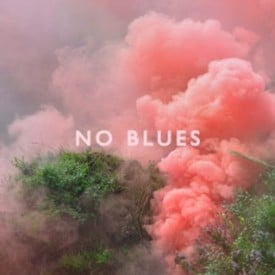
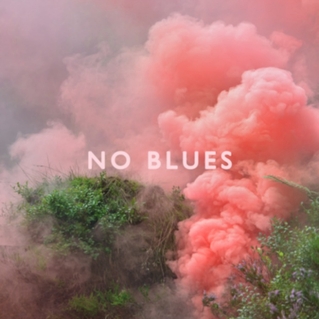
    No Blues — their sixth-ish album from 2007 to the present, and their most varied and mature, which shouldn’t be nearly mature enough to worry anyone — starts with softly ringing synthesizer and Gareth Campesinos’s twee-yet-vigorous alto singing its chorus: “Knees knocking and blood flowing, so/ I want you to know that I want to”. The full (and lovely) seven-piece sound kicks in almost at once: monotone synth in a “choir” keypad setting, percussive piano, thick guitar sounds, regularly pulsing slow drumrolls. That chorus could be a mass hit; so could the verses’ theme, a longing for a female friend to be his girlfriend. “She says ‘If you’re unhappy, then you’ve gotta find the cure’./ Well, I prescribe me one more beer. Beyond that I am unsure./ May not be be-all and end-all; in my defense, she is the whole./ I’ve thrown my goalkeeper forward; she’s catenaccio”. Catenaccio is a defense-first soccer formation; great metaphor, at least for listeners like me who look up words on Wikipedia. I love the way the register shifts between populism — “As I saw God in the bathroom, I baptized him in sick” — and prep school vocab — “embraced him in the cistern and said ‘C’est la mort! Enough of this’”.

    I love too how even though his relationship wishes are not met, his friend can speak in terms reminiscent of You and Me Against the World or NIN’s We’re in This Together. “Later she said something that stuck hard in my mind: ‘We are their Capel Celyn, they’ve got to keep their slippers dry’”. Capel Celyn was a village flooded to make a dam for Liverpool factories; this song (For Flotsam) is gorgeous *and* hyper-enthusiastic *and* poetically inspired *and* teaches me random facts that Gareth thinks I should know. I’m a sucker for it, and I’m delighted to be nowhere near alone in this.

    As for my opinions about the rest of the album, the upside is that I think there’s at least two other songs just as great (What Death Leaves Behind and Avocado, Baby), and every song here has, at least, pretty music with a few good lines. Downside: while I’m happy with the introduction of variety to Los Campesinos!‘s sound — in the past, they’ve sorely tested my limits on how much clattering maximalism I need at once — the variety mostly consists of some of the songs being slower. All the Campesinos play at almost all times: the a-capella group chant “Ex-boyfriend, give us a song” on the bridge of Glue Me is startling. And while they’ve refined their abilities over the years, they have yet to show an interest in toying with other styles. The synth player loves long-held droney notes, the drummer loves vigorous deep-sounding drumrolls, the guitarists love a midpoint between fast ’80s jangle-pop and thick mid-90s shoegaze, and that’s what they do.

    Similar story with the words: Gareth writes about his few favorite themes. Death, and the fear of death, are the big ones I haven’t mentioned yet: “I was the first match struck at the first cremation./ You are my shallow grave, I’ll tend you as a sexton./ If you’re the casket door that’s being slammed upon me,/ I’ll be a plague cross painted on your naked body/… Why must I lie awake, from dusk until the morning/ through fear of being impaled upon an errant mattress spring?” Perhaps the perfect constellation of his concerns comes at the end of the 4th song, using a word for “empty grave marking an unrecovered dead body” that I’d earlier learned from a This Heat song: “I shimmy up the cenotaph, regale with my melancholy./ Two words on my headstone, please, don’t need name or date, just ‘Sad Story’. They boast of poets on their side, but what use will they be if this comes to a fight?/ I glance along the length of pew and all that I can think’s I want to undress you.” Fear of death, sadness, poetry, religion, sex, longing, and oh yeah, the Smiths: the song is called Cemetery Gaits. No Blues deserves to be someone’s favorite album.

    Not mine, no. I’m not much of a romantic; I’m too literal to be a poet; I deal with death by emotional avoidance (and doing my mom’s shopping, and playing Scrabble with her, while she’s still hanging in there). But I recognize great writing. The music doesn’t sound like anyone else, either, especially not with Gareth’s voice pushing things along. It sounds really good. I hope Gareth gets past some of his depression. It shouldn’t kill his muse; it should just free him to write about soccer more directly.

    – Brian Block

    To see the rest of our favorites, visit our Favorite Albums of 2013 page!