web analytics

Tag: Reviews

  • #16 album of 2013 – Multipurpose Trap by Birds and Buildings

    #16 album of 2013 – Multipurpose Trap by Birds and Buildings

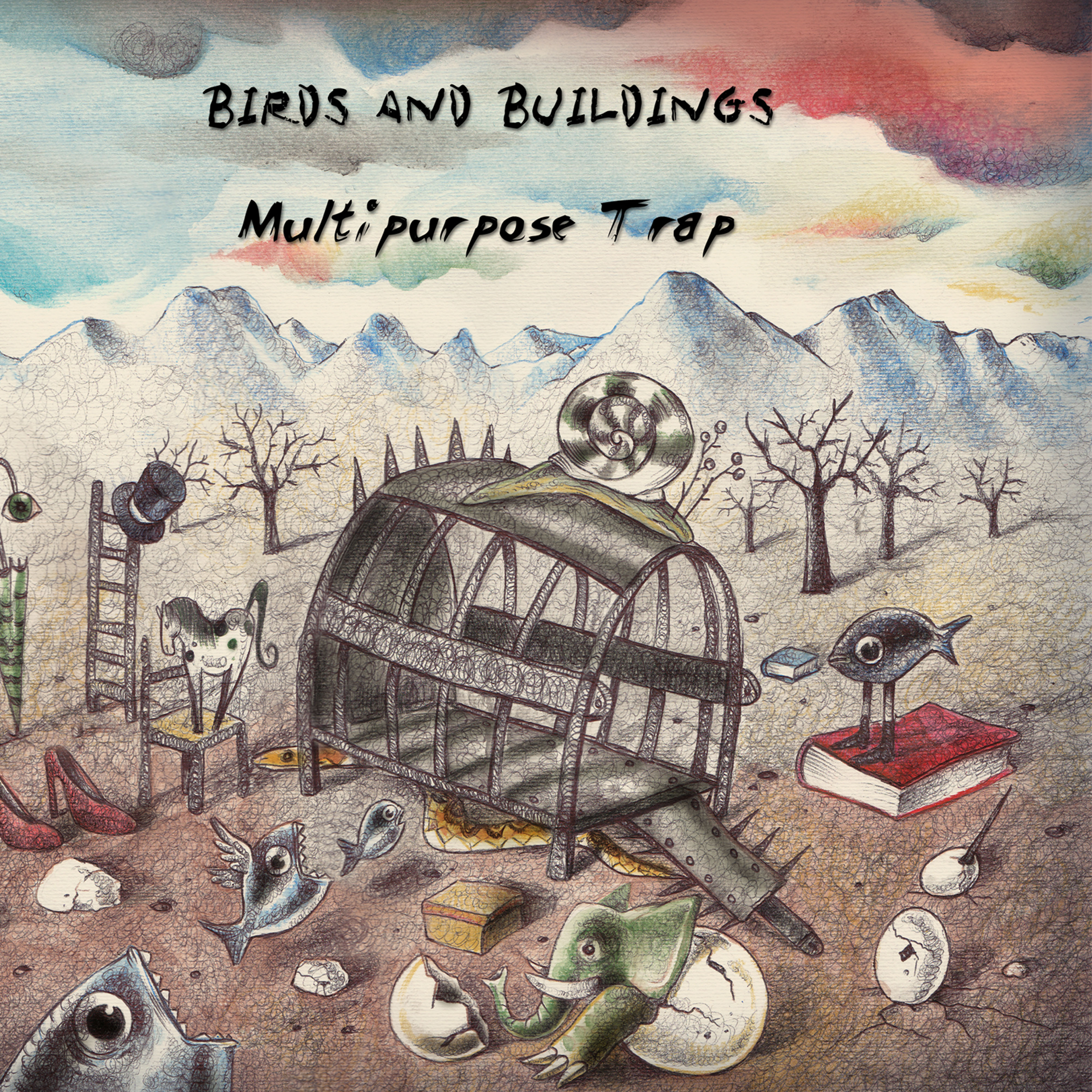
    Artist: Birds and Buildings

    Album: Multipurpose Trap

    Birds and Buildings classify their second album Multipurpose Trap as “jazz-rock, progressive-rock, zeuhl, rock in opposition”, which seems about right for those of you who’ll understand all that. If you’re stuck after jazz-rock, that’s still a useful starting point, and I’m happy to MultipurposeTrapadd that King Crimson (’70s and ’80s versions both) seems like a significant influence. Their music is mostly high-energy; their five-piece lineup includes a trumpeter, a violinist, and a sax/flute/clarinet player along with guitars and keyboard. Maybe 85% of each song, on average, is instrumental passages, which I have a prejudice against. My favorite albums are usually ones where I love the singer and/or the lyrics, and the few vocals here — which are certainly nicely done — are either vague mutterings that happen to take place on musical notes, or brief telegraphic melodies that hop large odd intervals. But there’s too many interesting things going on instrumentally for me to complain. Instead of vocal hooks we get keyboard hooks or saxophone hooks, often blatantly catchy ones. And if the time signatures have 3, 5, or 6 beats per measure as often than 4, they feel entirely natural and bouncy about it.
    Multipurpose Trap’s shorter songs, from 2 to 6 minutes, are generally the poppiest, for a jazz/ prog/ zeuhl definition of “pop”. Horse-Shaped Cloud feels carnivalesque; the Dumb Fish goes between a Mission Impossible sinister chase feel and a more open-minded world’s conception of “peppy jingle”. Miracle Pigeon is partly a folk dance for Eastern Europeans with widely varying numbers of legs, partly an emergency summons to town square by their robotic overlords and Valkyrie guards. East is Fort Orthodox is slower, grander, eerier, the most Court of the Crimson King-feeling track (but also the one with the most prominent vocals and prettiest violin playing). Secret Crevice feels like one of Miles Davis’s most aggressive jazz-rock lineups simultaneously taking the piss out of opera and movie fight-scenes.

    Tragic Penguin, at 7 minutes, introduces itself as slow and mystical and lofty, with glittering sustained Chick Corea-like keyboards, high droning woodwinds, and bass lines built on playing the same note or chord several times in a row before moving. When it speeds up, and adds brief vocals, it feels more like a Frank Zappa piece, but still a basically grand and pretty one. Catapult is 10 minutes of adrenaline, cartoon chase sequences interrupted by moments where the instruments corner each other, and stomp around in intimidating poses, before one of them spots a chance to make a break for it and start the chase anew through different terrain. Abominable Pelican comes across in parts as a pleasant brainwashing attempt by happy mystical nutters, and in parts as the grand quasi-symphonic jazz that washes over them during their worship rituals.

    It turns out, then, that while part of why I love music with words is that I want to sing along with those words, another part is simply that vocals are a convenient tool for providing *personality*. Sometimes they sing and sometimes they don’t, but Birds and Buildings always have plenty of that.

    – Brian Block

    To see the rest of our favorites, visit our Favorite Albums of 2013 page!

  • #17 album of 2013 – Magic Trix by Xenia Rubinos

    Artist: Xenia Rubinos

    Album: Magic Trix

    Xenia Rubinos’s debut album Magic Trix lays out its niftiest tactics quickly — many of them within the five minutes of its opening song Help.  Her lilting voice, which by later in the album will suggest to me Bjork as a rowdy young NYC Latina, starts out cautiously by itself, picking its way up scales like Little Engine up a big hill: “My name is Rosa/ I live under Xenia-Magicthe bridge/ I live under the tree/ I do magic tricks for money. Whoo!” A distorted organ-like electronic keyboard comes in, as do drums, both jarringly percussive and both refusing to emphasize the beats you’ve learned to expect; her voice doubled, she sings of Rosa third person (she now “will raise your dead for money”). The keyboard is replaced by a syncopated, traditionally funky bass (although the drums are still spastic punctuation), and Xenia transforms into a soul singer (“I didn’t want to end up like this way/ I was just trying to do good for myself and my two kids”). As the ingredients bounce off each other in different combinations, they change, intensify; the off-center drums get more thunderous, an organ solo sends frightening CGI-enhanced tremors through the buildings of the land, her soul singing gets more urgent, and breezy handclaps lighten things until the sheer robotic speed of them gets weird. The songs ends soft and lilting like it began, but the keyboard and drums stay softly with her, unsure if they’re ready to leave her alone again.

    Ultima, the second song, has swagger; it also, at the ingredients level, introduces jubilant nonsense vocal loops, a conventional 4/4 hip-hop beat, and confident breathy Spanish rapping. Her singing portions are pitched somewhere between birdsong and cheerful lullaby. The drumming still uses unconventional timing, and late in the song there’s a buzzing electronic organ solo in 5/4 time.  Hair Receding wrings darkness and drama from Help’s basic elements by programming its organ to a cathedral grandeur, and pushing Rubinos’s voice into minor keys at the very bottom of her range. Pan y Cafe makes the case that her voice is interesting enough to enjoy having it rhythmically yell at you in different rhythms over deranged marching-band percussion, which works for its 1:48 length anyway. Los Mangopaunos compresses her 15/8 rhythms, sneaky-loud percussion, and beeping multi-layer keyboards into a catchy 2:48 single, with a happy synth-flute hook and vocals like excited gossip. When You Come slows a fast record down to a mid tempo 6/8, and pares down the instrumentation a bit to treat us to multi-Rubinos vocal harmonies. And Let’s Go Out risks slowing down the organ and drums to a thudding, echoey crawl.

    This is the point in the countdown where I’m looking for excuses to choose which perfectly delightful albums can’t be in the top ten. In the case of Magic Trix, I have “I can’t make out very many of the lyrics, though they seem to be interesting. And after inventing a completely new, manically fragile style of progressive-New-Wave-hip-hop-salsa-rock in her first two songs, she just keeps mining the same brand new territory. Plus she slows the music down at the end, which is hardly ever a thing I’d suggest”. If those seem like actual reasons not to give Xenia Rubinos a full try-out, you’re a harsher judge than I.

    – Brian Block

    To see the rest of our favorites, visit our Favorite Albums of 2013 page!

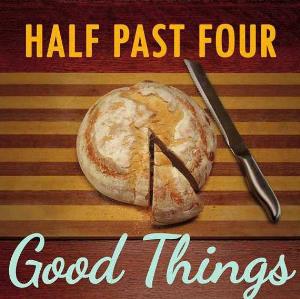
  • #18 album of 2013 – Good Things by Half Past Four

    Artist: Half Past Four

    Album: Good Things

    The logic of belatedly reviving my best-of-2013 countdown on Thanksgiving weekend — after having left it too often neglected in a 2014 that’s been dominated for me by my mother’s fatal cancer, which has left me busier, less-helped, and sadder HP4 - Good Thingsthan usual — is that I personally tend to write music reviews in the spirit of giving thanks, a spirit I’d like to get back into.

    As an extra incentive, given which album I had waiting at #18, Thanksgiving is also a holiday about immigration. Or at least, some of my Facebook friends treat it that way, passing on cartoons and sly jokes about the original Thanksgiving fest being one where white Europeans were the undocumented aliens who didn’t speak the language. I find the politics of this dubious. Thanksgiving is if anything the worst case scenario, where you reach out to the undocumented and they kill most of you with plague, shoot enough of the survivors to quell further resistance, and steal your land and herd you into grim “reservations”. I prefer to focus on basically every subsequent example of American immigration instead. Like the welcome provided to my mom’s ancestors, supporters of Bonnie Prince Charlie’s failed Scottish revolution against the English crown, who were allowed to emigrate to the colonies instead of being executed. Or to the more fortunate of my dad’s Jewish ancestors, who decided to put as much space as possible between themselves and the pogroms, instead of waiting around to die, however bravely, in the Warsaw Resistance against Hitler’s death camps.

    Welcoming my family didn’t lead to anything extraordinary for the United States, but it led to a lot of positive ordinariness: a large, productive scattering of city planners, teachers, librarians, nurses, classical musicians, cryptographers, and other people notable for not burning the country down and destroying civilization forever. Multiply them out and you get enough immigrants to supply one of the richest, most diverse, most creative societies the world has ever known. Whereas a lot of the financial sector we can still blame on descendants of the Mayflower crew.

    Starting in the 1980s, the United States has undergone one of its periodic eras of treating immigrants with deeper suspicion and fewer social services, so perhaps for that reason, or perhaps by coincidence, the core members of Half Past Four — bassist Dmitry Lesov, keyboardist Iggy Kurtzman, and guitarist Constantin Necrasov — found themselves leaving the former USSR, as boys or college students in the mid-to-late 1990s, and moving to Toronto, Canada instead. I won’t imply the U.S. made a tragic error in not recruiting them first; you can buy their two albums, including 2013’s Good Things, quite easily here, and nowhere near enough people have done so yet to much impact the trade deficit.

    In doing so, you’ll get what sounds like a glossy ‘80s hard rock band, with a smooth, soulful, supple-voiced female (Canadian) singer who calls herself Kyree Vibrant. Except I don’t know of any actual ‘80s hard rock albums as musically interesting as Good Things, because Half Past Four keep crossing you up. There’s all the jazz chordings, some as pretty as a Stevie Wonder or Steely Dan record and others more unnerving like King Crimson. There’s riffs that, however glossy, are too heavy to have made the radio before Metallica became superstars in 1991. There’s the casual use of piano and 7/8 time on the title track. Rise breaks into surf-rock midway through the song. Spin the Girl is joyously cuckoo, a heavy-metal Broadway folk dance at a crazed waltz-of-death pace. Fate’s verses are piano-centered and in 9/4 time, but Necrasov’s guitar work still makes them sound like Pink Floyd somehow. The Earth ends the album centered around a 5/8-time sprint — and later a 7/4 stomp — that’s heavier than even the 1980s version of Metallica, as well as (this part is easier to achieve) more operatic.

    I still think it will aid Half Past Four appreciation if you enjoy the commercial primes of Van Halen and Guns’n’Roses and Bon Jovi, at least their singles. But hey, time was when that music was illegal, back in the USSR. One assumes it was sought out, on average, by the especially curious. And it’s the nature of the especially curious, and their offspring, to tamper heavily with the things they love.

    – Brian Block

    To see the rest of our favorites, visit our Favorite Albums of 2013 page!