web analytics

Category: Reviews

music-and-concert-reviews-you-wont-see-anywhere-else

  • #10 album of 2012 – Queen of the Wave by Pepe Deluxe

    Artist: Pepe Deluxe

    Album: Queen of the Wave

    Queen of the Wave, the fourth album (but first for me) by the Finnish band Pepe Deluxe, is an unlikely combination of two things. It’s a slick modern album of disco-informed dance-pop. It’s also a ludicrously ambitious and overstuffed progressive-rock story album. It’s assembled from dozens of pepe_deluxe_queen_waveinstruments: some as old as harp, harmonium, harpsichord, and clavinet; some random and exotic; some as retro-modern as an attempt to collect every form of organ (keyboard, not bodily part) from mini-Moog to Hammond to Farfisa to pipe organ to Mellotron to an organ carved from giant stalactites. There’s also more than a dozen vocalists here playing different parts, each of them charismatic. I love Queen of the Wave most for being a brilliant success as dance-pop. Its success is simply informed and enhanced by the overreach.
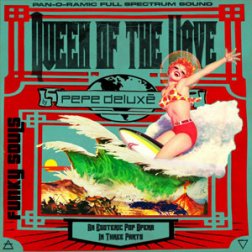
    I’ll detail the first five songs to illustrate. Queenswave opens with folky acoustic guitar, synth-drones, a wide variety of birdcalls, and solemn vocals, adding Jethro-Tull-styled flute (played with tongue) and maracas, then drums and metallophone and a second vocalist and a steadily more insistent beat. Then comes harp, joined by buzzy electric guitar that then essays a classic funk-rock solo, circling back in the end to Tull-as-dance-band territory. A Night and Day gets compared to old James Bond theme songs, with funky shuffling drums and bass, lean retro guitar production, whooshing and sirening background noises, and soulful but commanding female vocals. It also has a spectacular a-capella breakdown and a fast-paced strafing keyboard melody, both of which keep the dance rhythm firm. Go Supersonic is similar, adding to the soul singer the second and third obviously-different female vocalists (one cooing, one domineering and operatic). There’s a cheerleading insistence to its choruses, impatiently tugging along its gentler verses and bridge. Temple of the Unfed Fire is a variant on the disco idea that anyone can like classical church music if you put it over a good enough dance beat, though as with most tracks here, the drumming is by humans, and very good indeed. Contain Thyself is folky in singing and instrumentation (here’s that harpsichord! here’s a subtle nod towards Irish reel! here’s more tongue-flute! here’s vocal counterpoint equally worthy of Bach or ’60s girl-group pop!), yet easily absorbs a massive drum-and-organ break.

    The second half is just as good. The ultra-danceable Grave Prophecy  and the Storm arguably travel farther afield than anything I’ve written about, My Flaming Thirst is calmer and more elegant while still eccentric, and the solemn Riders of the First Ark may be the catchiest track here. I mentioned there’s an over-arching story … well, uh, it’s about heroes and villains at the end of the lost continent of Atlantis, and “Let me tell you of a tale that’s true” is the first invitation the album gives you. The drowning of the last unicorns is here too. This took, for me, some getting used to.

    Atlantis was, of course, imaginary — conjured from nothing as a hypothetical in a Socrates dialogue — and one of my early influences on How To Think was a man named Martin Gardner, best known for creating advanced-math puzzles at Scientific American but also fond of making logic-puzzle books for kids. Gardner was pro-whimsy — in his puzzles, in his adoration (passed on to me) of Alice in Wonderland — but he was a fierce, hyper-earnest opponent of pseudoscience: tales of Roswell aliens and psychic powers and healing crystals that people actually believe. Atlantis, apparently, is something millions of people take seriously; Pepe Deluxe might, for all I know, be among them. From childhood I’ve been conditioned to find Queen of the Wave‘s lyrics painful.

    pepe_deluxe_bearIn practice, they’re not great, but I’m admitting their Atlantis tale has some resonance. Advanced human civilization drowned at the peak of its glory, taking beloved species with it; is there no familiar ring to that? Human civilization emerged in the Iraqi/ Israeli “Fertile Crescent”: we over-farmed it and turned it into desert. Greek and Latin civilization emerged in lush, fertile areas that became steadily less so. Easter Island civilization was advanced enough to destroy every tree, and itself, in the process of building impressive statues. Unicorns strike me as a mushroom-fueled vision of rhinoceri, but woolly mammoths and saber-tooth tigers and giant herds of buffalo were real, and huntable, until they were gone.

    Global-warming denialists sometimes lead with pure falsehood — claims that “global warming stopped in 1998” (no, the last sixteen years are the sixteen hottest on record, give or take a year or two depending how you measure), or that there have been hotter periods since the rise of cities (based on, to pick a literal example that’s been passed around on right-wing sites, measurements at a single point 500 feet under the ice in Greenland). But some of the things they say are, narrowly, true. Human pre-history had slightly warmer periods than today: true (although check again in 2030). Earth life in general had *much* warmer periods than today: also true. Warmer temperatures, in the abstract, are good for plant growth: sure, which is why, when Svante Arrhenius brilliantly discovered the process of man-made global warming way back in 1896, he wanted people to speed it along on purpose.

    All of which misses the point. The rate of change we’re putting our climate through is much faster than even the starts and ends of the ice ages, and our civilization, animals, and plants aren’t adapted for rapid warming. A couple degrees Fahrenheit increase doesn’t sound like much, and for most purposes it isn’t, but it’s been enough to multiply the number of extreme-high temperature days that can decimate a season’s crops. It’s been enough, since warmer air holds more water vapor, to create heavier storms and longer droughts. It’s been enough to trick the life cycles of plants, so they start growing six weeks early and get felled by snap freezes. It’s been enough to start drying out our rain-forest trees, making them vulnerable to massive fires that level everything for miles, because even though evolution *can* make trees for hotter jungles, it *hasn’t had time to*.

    Then, of course, there’s been the melting and cracking of the polar ice sheets: a process we don’t fully understand yet, which has kept occurring faster than the scientists’ models. Melted ice becomes ocean water. More ocean water leads to higher sea levels. Higher sea levels lead to floods. More than half of the biggest cities in the world live close enough to the coast to be at risk. When the floods come, will Queen of the Wave be a smart enough album to serve as our eulogy? Not by itself, no. But it’ll be on topic, unlike our political discourse (although at least Finland is part of Europe’s moderately useful cap-and-trade carbon policy). And it will be much, much, much more fun accompaniment for swimming across the dance floor.

    – Brian Block

    To see the rest of our favorites, visit our Favorite Albums of 2012 page!
     

  • #11 album of 2012 – Noctourniquet by Mars Volta

    Artist: Mars Volta

    Album: Noctourniquet

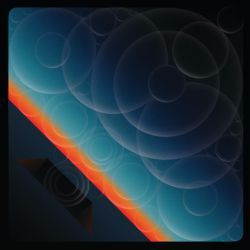
    I’ll start with a quick review for those already familiar with Mars Volta. Noctourniquet (their sixth album) is their first with song lengths averaging under five minutes, jettisoning the lengthy solos and ambient excursions. Its dark lyrics are, on average, the least obscure / most randomly mars_volta_noctourniqueteffective of their career. Its drumming, with new drummer Deantoni Parks, is a bit more straightforward, sometimes pounding home the various time signatures instead of fracturing them. And the new layers of synthesizers, often pleasant, also sometimes add a level of batshit abrasiveness that I’m delighted to have in such concise doses.

    For everyone else, I already dropped some clues, but let me fill in the picture more. Noctourniquet in many ways strikes me as a much weirder, geekier (and at 64 minutes, shorter) version of Smashing Pumpkins’ Mellon Collie and the Infinite Sadness. Guitarist Omar Rodriguez-Lopez doesn’t play everything on the album as Billy Corgan did on his, but he’s reputed to be a dictator to the top-notch players he employs. Singer/ lyricist Cedric Bixler-Zavala has, like Corgan, a voice that’s flexible but high-pitched; where Corgan’s was often tinged with an adolescent whine, Bixler-Zavala’s is more prone to the whine of an artificially intelligent dentist’s drill that wants you to understand it doesn’t like you. Both singers can convey their melodies, though, and Bixler-Zavala has also begun, on many tracks, to sound like the more recent, mellow, gravitas-possessing version of Rush’s Geddy Lee.

    When I pick some individual tracks to describe, one of my motives is to help you choose, in this YouTube/ iTunes age, a place to start exploring if you’re not ready to plunge in right away. Noctourniquet, like Mellon Collie, divides neatly into harsher and prettier songs (although Mars Volta never quite play the difference straight). Want to start at the aggressive end? The Whip Hand reminds me of the most fiercely and erratically writhing Nine Inch Nails tracks (March of the Pigs, the Becoming), except with Reznor’s voice replaced by that of a heavily-echoed arena rock singer. Its “I am a land mine! Don’t step on me!” bridge risks being the most off-putting moment on the album for you, but you may well be impressed by how little you’re inclined to doubt the sentiment. (Unlike my Autocorrect, which tried to turn it into “I am a land line”.) Dyslexicon is like one of Rush’s more straightforward rock tracks being strafed by video-game weaponry, haunted by singing poltergeists, and subjected to occasional wobbling. The Malkin Jewel is like a restrained rock translation of the bizarro-land blues of Captain Beefheart, although Bixler-Zavala also reveals a new, gruff, threateningly conversational singing style in the verses, leading up to the chorus where “All the traps in the cellar go clickety-clack, cuz you know I always set them for you/ And all the rats in the cellar form a vermin of steps, yeah, you know they’re gonna take me to you”.

    Pretty tracks include Aegis, thoughtful and massive, maybe equal parts Arcade Fire, Spiritualized, Catherine Wheel, and giant drum collection falling down the stairs, which launches into a slamming riff-rock chorus in 3/4 time. Lapochka is at once the closest they’ve ever ventured towards laptop-pop, and the most they’ve sounded like Shine On You Crazy Diamond-era Pink Floyd. In Absentia skitters and echoes across the nave of the church while you wait in the atrium; it’s part power ballad, part Giorgio Moroder Eurodisco, part maybe a hymnal re-capturing of In-a-Gadda-de-Vida. Imago, folk guitar plus long-held synthesizer notes and intuitive intrusions of thumping drums, highlights Bixler-Zavala’s least guarded singing, plain and a bit unsteady but easy to like. Zed and Two Naughts (fancy way of saying “zoo”) is an ambitiously constructed, soaring rock anthem.

    Noctourniquet is easily my favorite Mars Volta record. They’ve always played well and had interesting ideas, but this is their album of songs, and I for one am fond of songs — especially when I feel they’re squeezing an especially wide range of interesting ideas into them. It could as logically be some Mars Volta fan’s least favorite. If there’s a track here you don’t like, it’ll be over in a few minutes. Perhaps that feels like cheating; I understand.

    – Brian Block

    To see the rest of our favorites, visit our Favorite Albums of 2012 page!

     

  • #12 album of 2012 – Nightflight by Kate Miller-Heidke

    Artist: Kate Miller-Heidke

    Album: Nightflight

    Kate Miller-Heidke entered my life with her second album, Curiouser, one of my two favorite albums of 2010. Witty and tuneful, danceable and good-natured, sung both prettily and expressively by a woman unafraid to make brief, surprising use of her opera training, it was for me the greatest Kate_miller_heidke_nightflightalbum of mainstream chart-pop since … well, ever. The Beatles’ best albums were mainstream only because the mainstream ran to catch up with them; Curiouser was in a category with early Madonna, Cyndi Lauper, Kylie Minogue, or Lady Gaga, except far more personal and more musical. Also smarter, but not in an intellectual or intimidating way. Miller-Heidke simply proved smart enough to story-tell a heartbreaking apology to a boy she’d once been mean to (Caught in a Crowd); completely take down a pickup artist (God’s Gift to Women); tell a gossipy friend to step off (I Like You Better When You’re Not Around); write a catchy dance song about her awkward self-consciousness while dancing (Can’t Shake It); find disheveled glee in a despairing protest song about apathy (Politics in Space); and relate novel post-relationship stresses in the age of Facebook (Are You Fucking Kidding Me?). Curiouser peaked at #2 on the album chart in her native Australia, and included a #1 single (the slow, yearning Last Day on Earth).

    She’s released two albums since, each of which changed direction a bit. Liberty Bell (2011, known in Australia by the better title Fatty Gets a Stylist) went heavy on the synthetic dance-pop; I found it disappointing, though my young sons adore it and have helped bring me ’round. Nightflight is altered in a different way: like Robyn Hitchcock’s gorgeous but surprising Perspex Island, it’s not witty or clever, nor does it aim to be. It’s a lovely mainstream pop record, but earnest, and the people it most sounds like to me could have been stars but weren’t: Sinead Lohan and Heather Nova (part of the “Wait, is this pop or does this go on 120 Minutes?” confusion of the mid-90s), Brooke Fraser and Katie Herzig (Christian Contemporary singers of the present day). Much as I like those four, though, I prefer Nightflight to any of their records. Quite a few Australians seem to agree.

    When I review mainstream pop, it can be hard to explain what makes it special. I can point to little details of construction, sure. Piano-based anthem Ride This Feeling‘s chorus is delayed, building anticipation, by a dramatic pre-chorus dialogue between hair-metal power chords and near a-capella singing. The verse melody on the ominous Sarah builds towards the chorus but then slows and spirals inwards, again changing the chorus’s impact; the arrangement makes good use of sawing strings, timpani, bell-like piano, and background opera notes. Nightflight is a piano ballad in 4/4, but its best parts integrate the rolling propulsion of 3/4 by emphasizing the first, fourth, and seventh of every eight beats (the bridge), or actually combining the time signatures (the chorus). On the bridge of the Tiger Inside Will Eat the Child, Miller-Heidke‘s wordless voice pipes like a pennywhistle. I’ll Change Your Mind isn’t far from Taylor Swift’s Red, but has another good chorus-delaying tactic: some thinking-aloud lyrics to a repeating chord that refuses to resolve. Beautiful Darling is a Joshua Tree-alike, and those tremolo-and-delay-pedaled guitars and sharp echoed drums don’t need to be new details to be really good ones. (The lovely faux-aboriginal vocal hook is more like Enigma.) The acoustic guitar on the Devil Wears a Suit, minor-key Irish folk, unsettles by putting the beat before or behind where you expect.

    I can point to lyrics, too. Sarah is a well-told story of a friend disappearing at a Ben Folds concert they attended together. Nightflight is about a life built on long-distance travel: “Oh ladies and gentlemen, keep your luggage with you at all times/ I’m 35 hours and three bad movies away/ and if one more person coughs on me, I’m gonna punch them in the face/ Well not really, I’ll just hold my breath as always”. I’ll Change Your Mind is an account of one-way love: “You’re no stranger to 3 a.m./ You call me just because you can/ Cuz you know I’ll come/ Cuz you know I’m helpless…. I know you’re using me for comfort and for company/ I’m using you too, to feed my fantasy”. In the Dark mourns a father by sitting in the now-unneeded car he taught her to drive in. Fire and Iron‘s account of old love has vivid details like “You tried to impress me by rolling a smoke/ Your hands were shaking and the paper broke/ I played it cool and I took a drag/ Coughed like the kid on the Panadol ad”. But sometimes the most ordinary details hit me, like the little apology in “I woke up this morning, made a pot of coffee/ went out onto the stairs to sit in the sun/ I haven’t been myself, I know I haven’t been much fun/ But I woke up this morning, and the air felt different”.

    Ultimately, I’m not sure how much of my reaction is down to those details. There is one truly unusual-sounding highlight here, the desolate Humiliation (cello, tugging/ echoing vocals, In the Air Tonight-style drums, little synth buzzes and Pink Floyd whirs, bits of opera, and the glistening guitar-or-is-it-harp riff that holds it all together). Otherwise, most of these songs have choruses that, sonically, any leading song-factory writer (Linda Perry, Max Martin, Bruno Mars) might’ve written for any given starlet or girl group or boy band. Except … now and then those folks write *really good* choruses. Here’s an album with at least half-a-dozen of those, plus two or three more in the folkie mode, and the restraint not to bludgeon them into your head with repetition. They also have abnormally excellent singing. Plus lyrics with a likable individual’s thoughts behind them, and I’m told she’s still hilarious in concert. But maybe I’m just pretending the choruses wouldn’t be enough.

    – Brian Block

    To see the rest of our favorites, visit our Favorite Albums of 2012 page!