web analytics

Category: Reviews

music-and-concert-reviews-you-wont-see-anywhere-else

  • #13 album of 2012 – Trouble with Machines by District 97

    Artist: District 97

    Album: Trouble with Machines

    District 97 are a Chicago band of four varyingly dorky-looking male rock musicians, all quite skilled; a not-at-all-dorky-looking woman named Leslie Hunt who joined the band after being a top-10 finalist on American Idol; and a cellist, Katinka Kleijn, talented enough to do solos for the district_97_troubleChicago Symphony Orchestra. That lineup concept is why I tried them out in the first place. Say what you like about American Idol (in my case, “I’ve never watched it”), Kelly Clarkson made it clear early on that it’s a fine machine for the discovery of singing talent, stretchable beyond any musics that the show itself — from what I’m told — would demonstrate. For example! While I’ve ranked District 97’s Trouble with Machines slightly above Rush’s Clockwork Angels, what I’d emphasize is that they’re comparable. If you’re a fan of one, I think there’s a good 75% chance you could end up a fan of the other.
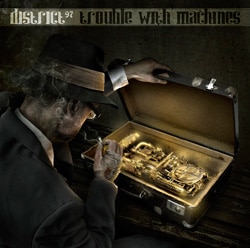
    On a broad level, both albums are full of ambitious, multi-segmented, quasi-metal songs that rock out. District 97 even attempted an album-long story on their excellent 2010 debut Hybrid Child, although this time they restrict that impulse to the individual 10-minute story-songs the Perfect Young Man and the Thief. Micro-level similarities include near-identical drumming styles (drummer Jonathan Schang is even District 97‘s primary composer); bass to some extent (Patrick Mulcahy often matches Geddy Lee’s more aggressive tones, though at other times he’ll essay a Metallica chug, spacious and staccato math-rock, or punk-pop simplicity, instead of Lee’s funk or melodic leads); and some tuneful heavy-metal guitar solos (Jim Tashijian’s being shinier and more ’80s rapid-fire than Alex Lifeson’s). Both albums also are full of angular vocal melodies, although where Lee’s tunes on Clockwork Angels often felt unfinished and wandering to me, Hunt’s on Trouble with Machines are clearly odd on purpose, making precision leaps over chasms. She’s got more than enough charisma to sell them, at least to me.

    Rob Clearfield’s keyboards have a flashiness, and a hookiness, that fits far better with the Rush (or Yes) of thirty years ago. So, too, do the frequent time-signature switches here. Back and Forth and the Perfect Young Man feel especially like hybrids of Rush old and new. The lean, slippery Who Cares? is its own beast: Tashijian’s limber, non-distorted guitar reminds me of his acoustic-based side band Treehouse, and Hunt’s singing is at points more yearning, more bitter, and more taunting than progressive rock in general is known for. Open Your Eyes, the single in 4/4 time, has a catchy Pat Benatar-like directness (although still a fairly unusual melody). The Actual Color — melodically and rhythmically the bizarrest song on Trouble with Machines — has nonetheless a dramatic and emotional heft that reminds me of Queen’s later records. Read Your Mind opens with a nifty, elegant minute-long demonstration of various tricks cellist Kleijn learned in conservatory; the song as a whole is at once the most Clockwork Angels-like track here, and the one most influenced, in its slower, more drawn-out moments, by chamber music and by the synth-jazz-pop early-80s works of Joe Jackson (Steppin’ Out) and Donald Fagen (New Frontier). Final track the Thief makes me admit I’m being silly not having brought up Dream Theater before. It’s song-like enough and often gentle enough to be on Images and Words, but with group-playing segments fiery and jaw-dropping enough for … how did Dream Theater let Rush beat them to the song title an Exercise in Self-Indulgence anyway? Don’t give me that “They weren’t born in time” excuse; temporal immobility is for losers. Anyway, there’s enough song on the Thief that the instrumental parts enhance it rather than upstage it.

    Like those other bands, District 97 try to sing about lives well or poorly led. Unlike those other bands, District 97 do so by centering on personal relationships: flirtations, cliques, seductions, breakups, encouragements, marriages, children, illnesses. In the broader context of pop music that’s conservative; in progressive rock, it’s almost radical. Right now the lyrics need work, I’d say: they sustain a narrative *or* scatter a few good lines, but not both. This album is high on my list for how great it sounds. There’s potential for something deeper next time. I’ll be listening.

    – Brian Block

    To see the rest of our favorites, visit our Favorite Albums of 2012 page!
     

  • #14 album of 2012 – Paralytic Stalks by Of Montreal

    Artist: Of Montreal

    Album: Paralytic Stalks

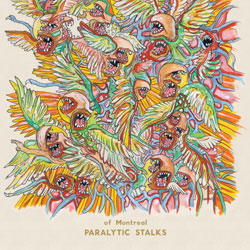
    Perhaps it’s because the real ending of the Beatles was so disappointing — four men who’d pushed each other to brilliance got tired of doing so, released a spotty final record, and spread outward to fairly ordinary musical careers — but sometimes I’ll see a new and unrelated record as if it of_montreal_paralytic_stalkswere an alternate Choose Your Own Adventure of the Beatles’ story. Of Montreal’s Paralytic Stalks, for example, is the version where John and Paul and George and Ringo go ahead and loathe each other, but express it in bitter lyrics and a deepening creative tension where they’re ever more inclined each year to reach in and screw with each other’s songs, yanking them back and forth in increasingly unlikely directions. Without ever messing up their best melodies. Oh, and they’ve kept doing this long enough to be as influenced by disco and Parliament/ Funkadelic as by modernist orchestral music… although Sgt. Pepper and Abbey Road remain in sight and in mind at most times.

    In reality, Of Montreal are a shifting collective led by an American named Kevin Barnes. They began playing giggly psychedelic folk, developed a leftist political edge, then tightened their sound to make a couple of ebullient but professional pop records, Satanic Panic in the Attic (’04) and the Sunlandic Twins (’05), both of which sound more than a little like the Magical Mystery Tour re-done with drum machines, synthesizers, and funky electronic bass. Barnes sold one of his catchiest songs, Wraith Pinned to the Mist and Other Games, to Outback Steakhouse for rewriting with jingle lyrics, a tribute to commercialized gluttony which sits quite poorly with attacks on the greed of politicians. So after a few defensive and snotty interviews, he started writing about topics he could bring sincerity (and redeeming sly humor) to, like his favorite drugs and sex acts. The songs over several albums got less catchy and more complex, which often is a trade I’m happy with, but which in this case mostly lost me. I may or may not have been influenced by the time I waited 2+ hours past Of Montreal’s scheduled stage appearance at Gate City Noise before they showed up, stoned out of their minds and barely able to half-remember their songs … but not, I assume, rejecting that night’s paycheck either.

    Paralytic Stalks is a triumph, though. On the one hand, it’s overstuffed and bursting with some of my favorite melodies Of Montreal have ever recorded. On another hand, it’s as expressively vicious (outwardly and inwardly) a set of relationship lyrics as I’ve ever seen, which also makes its periodic stumbles towards truce and redemption more powerful. On a third hand — Paralytic Stalks being a deformed creature with many non-standard body parts — it combines Barnes’s long-established interests in psychedelia, pop, funk, cabaret, and disco with a brand new interest in strings and flutes, long droning tone clusters, and outbreaks of free-jazz orchestration. All of which are used with the expressionist power of a Edvard Munch painting, and are reined in to bring a form of peace.

    The poppiest moments make sense to explore first. Spiteful Intervention is the obvious single, even with dissonant strings and harpsichord peeking around the edges and rickety drums collapsing in the background. Beginning with dramatic narration-singing — “It’s fucking sad that we need a tragedy to occur to gain a fresh perspective in our lives/ Nothing happens for a reason, there’s no use pretending, you know the sad truth as well as I” — it moves into lilting sing-song over ’80s dance-pop. Then it launches into the acrobatic chorus melody: “I spend my waking hours haunting my own life/ I made the one I love start crying tonight/ and it felt good! Still, there must be some more elegant solution”. The melody spins its own memorable variations and continues: “Lately all I can produce is psychotic vitriol/ that really should fill me with guilt”. The backup singing supports a mood like the mad laughter before a breakdown. Yet it’s the catchiest thing — and if quite exaggerated from the worst things I’ve ever felt (so far) about anyone I loved, it’s recognizably vivid.

    Dour Parentage, riding in on massed flutes and echoey drums, is top-notch experimental Stevie Wonder with modern recording technology.  We Will Commit Wolf Murder is a pretty ’80s dance tune and love song, chopped and screwed: the vocal production and instrumental arrangements changing almost every line, and the sentiments along the line of “Someone’s terrorized my psyche to get even/ Lately you’re the only human I believe in” and “I’m considered ugly from every angle/ You’re the only beauty I don’t want to strangle”. Malefic Dowery is genteel pre-rock drawing-room pop, with a bit of hymnal a-capella, about how “Now I feel that you’re provoking me with your fidelity/ that your loyalty and affections are somehow a vulpine act of hostility/ Now we’re a bore, we’re afternoon TV”. It’s sort of a love song too.

    The long tracks, 7 to 13 minutes, are the ones with the thorniest passages. I don’t find ’em difficult — my Dad was (among other things) a minor-but-talented modernist composer who played me Bartok and Penderecki when I visited him — but for those of you who do, I’ll point out simply that the weird classicisms aren’t a gimmick; they’re *used*, in a surprisingly straightforward way. The songs start with hummable melodies (especially Wintered Debts, like Paul McCartney and Marvin Gaye getting together to taunt you personally, and Authentic Pyrrhic Remission, soulful and sunny). They move into weird tonalities, slowly-evolving repetitions, and aggressive dynamics when the lyrics get, well, even more desperate than usual. They return to pleasant tunes (not the same as they began with) in search of partial resolutions. I’d hate to marry someone like Kevin Barnes; well, that isn’t news. There are nights — not too many, but some — when I’d hate to marry someone like me either. Paralytic Stalks is a masterful evocation of that. Not bad for such good pop songs.

    – Brian Block

    To see the rest of our favorites, visit our Favorite Albums of 2012 page!
     

  • #15 album of 2012 – Clockwork Angels by Rush

    Artist: Rush

    Album: Clockwork Angels

    Rush — singer/ bassist Geddy Lee, guitarist Alex Lifeson, and lyricist/ drum collector Neal Peart — have made albums since 1974, which I think warrants a bit of background for newcomers, until that set of asterisks below. There’s a constant element of Rushness to their sound, but they’ve rush_clockwork_angelsgone through some large stylistic changes. They began as a shrieky hard-rock band. At first ripping off Led Zeppelin and Black Sabbath stomps, they quickly evolved towards 13/8 time signatures, drum solos, album-long stories, and Ayn Randist political fables delivered with the cockiness of defiant 15-year-olds. Keyboards and glossier guitar production entered their sound with 1980’s Permanent Waves, and for three years they had a series of massive (in my opinion terrific) hits. The Spirit of Radio stitched twiddly slow-evolving synth intros from the Who, lyrics modified from Simon & Garfunkel, and a bridge from 3rd-hand rumors of reggae into a grand anthem. Free Will, Red Barchetta, Limelight, and Subdivisions made classic-rock staples out of shifting time signatures. Tom Sawyer made 4/4 towering and novel.

    1982-87 saw their songs getting icier, more synthetic and abstract. But Lee’s voice started to deepen and refine, and by Presto (’89) and Roll the Bones (’91) Rush were a pop band: capable of dazzling riffs, capable of out-playing your favorite band and proud of it, but a pop band, melodic and graceful. Peart, the former lyricist of such lecture-like fantasies as the Temples of Syrinx and By-Tor and the Snow Dog, wrote sensitively about teenage insecurity, a suicidal friend, the improbable events involved in any two lovers finding each other, and how “I’m not one with a sense of proportion … I’m just improvising … I radiate more heat than light”.

    Then they gave up the synthesizers and became, I would argue, a sort of heavy metal band. Metal or not, they made two albums of thundering, riff-intensive, densely layered pop songs: most notably Counterparts (’93), almost a theme album about the challenges of learning empathy, an apology for youthful Ayn Rand worship without naming her. But then came a multi-year hiatus when Neal Peart’s wife and daughter died within a year’s span. On his return (for Vapor Trails (’02)), his lyrics were vaguer, more evasive — for which I blame him not at all. The band’s music was leaner and fiercer: the riffs aggressive, the solos rare, the “tunes” more like bluesy meandering.

    ******

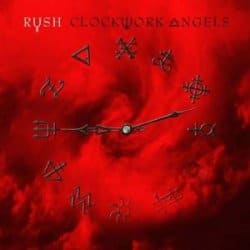
    In 2012, following two albums of that, came Clockwork Angels. It has been widely hailed as their best record since their glory days, usually meaning 1977-81. I’ll agree, if I’m allowed to define their glory days as 1989-93. Produced by Nick Raskulinecz — a Grammy winner known for work with modern-rock radio bands like the Foo Fighters, Evanescence, and the Deftones — it’s 66 minutes of loud, impeccably polished and up-to-date power-trio rock songs that, if rather uniform in the grand scheme of things, do an excellent job calling attention to the details of individual performances. (Vapor Trails fought awful, blurry production: professionalism has its uses.) Atmospheric synthesizer and delay-pedaled, tremolo-pedaled guitars set dramatic openings for many songs, and those synths (and perhaps actual bowed strings a couple of times?) do more background service during the songs proper than in any Rush album for 20 years. All attention, however, is centered on guitar/ bass/ drums. Lifeson’s solos are back; they’re tuneful enough. Geddy Lee’s bass playing — his agile quick-fingered runs, his little turns towards funk or spaciness, and his sheer attempts to crush you — may be the most impressive it’s ever been, which means it’s pretty near as impressive as *anyone* has ever been. Neal Peart still takes, and talks about, his drum lessons, and while he’s omnipresent here, he finds a wide if subtle variety of ways to push the songs along.

    Most of the vocal melodies still seem, to me, wandering and interchangeable, but the many-segmented Clockwork Angels itself puts together several soaring ones, and both Brought Up to Believe and the Wreckers are quite hummable. As for a more typical track here like the Anarchist, I hum the bass and guitar parts, and those synthesized-strings faux-snake-charmer bits. I’ve learned that while melody is central for me, and the vocals are where I first turn for it, I’m happy to find good wordless ones; Rush‘s Clockwork Angels strews ’em throughout. Lee’s bass playing can be foreground for me; his singing can be background, in which context it’s strong, flexible, and pleasant.

    Which will be a “Wait? What?” claim for many fans, because Clockwork Angels is a story album. It’s a philosophical quest in a steampunk universe, in the course of which our narrator leaves his childhood small-town still half-believing in a planned, properly-slotted order for everyone. He experiences awe at his capitol city’s (yes) clockwork angels, “Celestial machinery” that “Span the sky in clockwork arcs, hint at more than we can see”; but he’s restless. He joins a carnival, falls in love, loses love, searches for gold, is captured by pirates. He disdains pre-destination and has failed at individual glory; his final conclusions are in favor of forgiveness and trying to lead a small, kind, worthy life focused on the personal choices he can control. It’s a far better story than Peart was writing in the 1970s, certainly.

    If he was a good enough writer for it, who knows how high I’d’ve ranked this record? But if you’re going to create a different world, teach us what it’s like to believe in it. William Kotzwinkle’s wonderful the Ants Who Took Away Time, a picture-heavy book that my 6- and 4-year-olds adore, conjures a clockwork universe with humor and absurdity but utter commitment. Ray Bradbury and Dean Koontz and Genevieve Valentine and Erin Morgenstern and even Doctor Who have made carnivals seductive, magical, and spooky. Treasure hunts and pirates have been fantasy staples for centuries. Peart’s narrator gives us little sense of the appeal of any of this. In particular, since you and I and everyone around us believes it’s our job to find our own way — even the fundamentalist Christian browsing the self-help section and paying a dating site to help “find God’s match for you” does — I would love to have a song from *inside* the belief that wisely-programmed machines will put us on our correct course. Instead we just get the rejection of it. We’re told it’s a journey for the narrator, but it’s sure as heck easy for us.

    So I’m not here, ultimately, for the words (though they’re well above average, don’t get me wrong). Clockwork Angels is, to me, 2012’s most potent demonstration of the power and melody a guitar, bass, and drum set can bring. I write about rock music; you can assume I appreciate that sort of thing.

    – Brian Block

    To see the rest of our favorites, visit our Favorite Albums of 2012 page!