web analytics

Author: brian

  • #29 album of 2013 – Same Trailer, Different Park by Kacey Musgraves

    #29 album of 2013 – Same Trailer, Different Park by Kacey Musgraves

    Artist: Kacey Musgraves

    Album: Same Trailer, Different Park

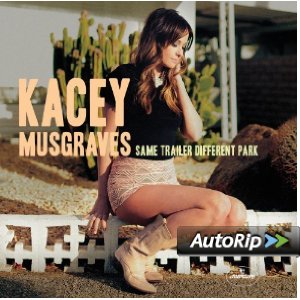
    Kacey Musgraves‘s debut Same Trailer, Different Park is my favorite country music album in a decade or so. Its status at #29 on this list qualifies that enthusiasm, I realize, but it’s real enthusiasm: she’s a talented songwriter who sings with a forceful, flexible Kacey Musgraves Same Trailer Different Parkalto drawl. Same Trailer is at least my favorite country record since Son Volt’s Okemah and the Melody of Riot (2005), if that isn’t too loud and blaring to count as country; it certainly pales behind Wilco’s stunning 2002 Yankee Hotel Foxtrot, but when I cited YHF on Facebook as my favorite country album ever, I was quickly and repeatedly informed that it isn’t country music, no matter the obvious underlying nature of Kamera or Jesus, Etc or Poor Places, because the arrangements are so weird. Which means the last country album I liked more than this was Amy Rigby’s the Sugar Tree, all the way back in 2000, and that’s a far better comparison anyway.
    That exclusiveness of country music’s definitions — the quick exile beyond its borders for deviation, the resulting predictable melodies and chords and guitar/ drums/ bass/ sometimes-harmonica arrangements — is why it’s a small part of my diet. But it remains, at its best, an accessible and melodic home for good writers to sing what they want to say. Same Trailer, Different Park uses the same middle-of-the-road structures as other fine writers like Rigby or Mary Chapin Carpenter or Loretta Lynn or, in his more modest-scaled songs, Brad Paisley. (As opposed to the hair-metal-inflected work of Shania Twain; the loud, ultra-compressed production of Miranda Lambert; or the gloomy sparseness of Gillian Welch and of Son Volt albums like Straightaways.) I won’t say much about the song-to-song musical variation: the raw blues-rock energy of Blowin’ Smoke is a nice treat, the jug-band sing-song cadence of Stupid is fun, Silver Lining has *way* too much steel guitar for my tastes, the banjo on Merry Go ‘Round reminds me of Kermit the Frog in his swamp at the start of the Muppet Movie. Whatever; the songs are built on tropes. Kacey Musgraves uses them with subversive intent, and that’s what hooks me.

    Merry Go ‘Round, the song where I first heard her, strikes me as the kind of song that could change a girl’s life. Musgraves was born and raised in Golden, Texas — the kind of small town where country music is just what the radio exists to play — and she takes dead aim at her native culture. “If you ain’t got two kids by 21, you’re probably gonna die alone/ At least that’s what tradition told you”, she starts, returning to the theme with “Mary, Mary, quite contrary, we get bored so we get married…/ We think the first time’s good enough, so we hold on to high school love/ saying we won’t end up like our parents”. I’m from Iowa. I was a city kid myself, but Continuous Country Classics was on the radio at my first job, and small town manners were just a few miles away, where a lot of my friends and friendly acquaintances ended up; she’s just described how quite a few of them ended up after high school. On Facebook I’ve watched them struggle towards second marriages and self-forgiveness for the rot of the first ones; maybe they needed some catchy warnings in their own language. “Mama’s hooked on Mary Kay/ Brother’s hooked on mary jane/ Daddy’s hooked on Mary two doors down”, Kacey choruses: an exceptionally economic bit of writing, capturing a family dynamic in 17 easy-to-memorize words and scribbling STAY AWAY in the margins.

    Follow Your Arrow is Merry Go ‘Round‘s optimistic flipside: an anthem, in its midtempo singalong (and whistle-during-the-bridge) way. In minor key it describes the same kind of socially mandated awfulness — “If you save yourself for marriage, you’re a bore/ If you don’t save yourself for marriage, you’re a whorr/ -ible person./ If you won’t have a drink, then you’re a prude/ But they’ll call Kacey Musgraves you a drunk as soon as you/ down the first one”. But it transitions through “You’re damned if you and you’re damned if you don’t” into “So you might as well do whatever you want”. Most of *my* friends see the logic of telling a girl “Make lots of noise/ kiss lots of boys/ or kiss lots of girls if that’s something you’re into”. I’m in North Carolina now, and when an amendment to the state Constitution was proposed in 2012 that forbade recognizing same-sex marriages — or even same-sex civil unions — my downtown neighborhood was filled with “Vote No” signs. But it passed was 61% of the vote, and I think the “Yes” votes, by county, were *strongly* correlated with country music dominance. Follow Your Arrow, as a country song, tries to address listeners who get the opposite messages on a day-to-day basis. The chorus also cheerfully adds “Smoke a joint/ or don’t” — since personally I never will, I appreciate the nod. But the second iteration as “Smoke a joint/ I would” is even jollier, and not even slightly pressuring.

    The rest of Same Trailer, Different Park is nowhere near as remarkable — e.g., there’s a song called I Miss You about missing an old lover — but it’s a nicely done genre work. Blowin’ Smoke, which I gather must see some important moral distinction between joints and cigarettes, is a cynical song about adulthood: “We all say we’ll quit someday/ When our ship comes in, we’ll just sail away…/ I’m just flicking ash into the tray/ telling ’em both it will be okay”. My House is a love song of mobile-home pride: “If I can’t bring you to my house, I’ll bring my house to you”. Step Off viciously attacks a town gossip, its moral distinction being that you should say your mean things directly to your target’s face: “Don’t wreck my reputation/ Let me wreck my own”. And indeed, Stupid goes after herself, and her penchant for being attracted to the wrong guys, while It Is What It Is is fatalistic about the end of a relationship.

    All are cleverly written. All are, as you may have noticed, built on cliches; she often twists them artfully, her words like her music relying on little twists to the familiar (“You wear your heart on a ripped unraveled sleeve”) to make them stick better to your brain. It’s a sensible strategy, at least until she runs out of cliches, which may take a while. Maybe she’ll devote herself to wreaking ideological havoc in small towns everywhere; maybe she’ll decide the wages are better in urban hipster venues where her messages are comfortable. Maybe My House will become her template and Follow Your Arrow will drop off her map. But as long as “havoc” is an option in play, I expect to remain one of Kacey Musgraves‘s fans.

    – Brian Block

    To see the rest of our favorites, visit our Favorite Albums of 2013 page!

  • #30 album of 2013 – MGMT by MGMT

    #30 album of 2013 – MGMT by MGMT

    Artist: MGMT

    Album: MGMT (Self-Titled)

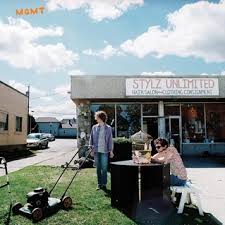
    In 2008, MGMT debuted as an arty pop band produced by go-to psychedeli-pop producer Dave Fridmann. They scored three hit singles (Time to Pretend, Kids, Electric Feel), and while I wasn’t taken with them in general, I voted Time to Pretend as my favorite MGMT self-titledsingle of 2008. Huge-sounding and pretty and minor-key, it plans out a life, starting from “I’m feeling rough, I’m feeling raw, I’m in the prime of my life/ Let’s make some music, make some money, find some models for wives/ I’ll move to Paris, shoot some heroin and fuck with the stars/ You’ll man the island and the cocaine and the elegant stars”, then proceeding to nostalgia-for-their-naive-youth, dumping their model wives for younger women, and choking to death on their own vomit. The excellent critic Tris McCall dismissed it as cheap sarcasm, and my ballot in his poll argued with him: “The music and the second verse are squarely aimed at poignance, first-person with a first-person sense of loss. Beyond that, the album reminds me of the Modern English album with I Melt With You, not in style but in spirit: an arty album by a band that seems desperately afraid of writing too many hits. Time to Pretend comes across to me as much more honest than the band would care to admit; and since fame _is_ attractive and _is_ scary, I find it moving.”

    Which is still how the song sounds to me. But I under-estimated the sincere viciousness of the mockery of their own dreams, and the commitment behind it; I didn’t know that MGMT had broken up before that debut album (Oracular Spectacular) was even made, fully intending to resume life as Wesleyan University students and then as adults. In a story that sounds more 1970s than 2000s, they were chased down by record company execs who’d heard their demos, and begged (and paid) to re-form. When their debut was a hit, they stayed together, but released a second album, Congratulations, that sounded to me like a complete mess. All I heard in it were nebulous “psychedelic” arrangement ideas — song-length but not song-form, neither pretty nor ugly nor energetic — jumbled together under no evident principle beyond “Ha! Let’s see the frat-rats put up with *this*!”

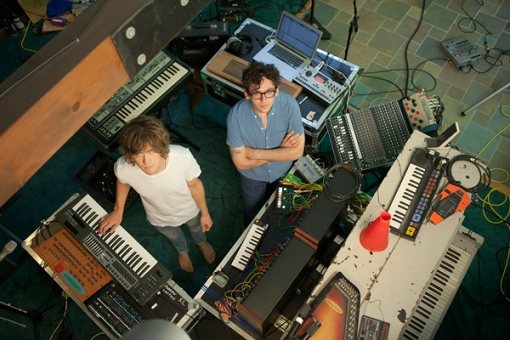
    Which, judging by an excellent 2013 Pitchfork.com feature article by Larry Fitzmaurice, was of course partly unfair — he shows a studio run by a duo of geeks working separately to come up with sounds they think are really interesting — but partly dead-on, as Andrew VanWyngarden and Ben Goldwasser talk contemptuously of “pop songs” and popularity. What makes MGMT work for me where Congratulations failed is that this time, they can’t help writing pop songs anyway — no matter what they do to them.

    Alien Days stretches VanWyndgarden’s mild tenor voice an out-of-character octave and a half in a strong, George Harrison-style tune. The massive yet pretty psych-pop landscape of reverberated and warped cymbals/ kick-drums/ organs/ theremin is built to from a recognizable structure of strummy folk-pop, andMGMT with Keyboards the chord sequence uses chords built on all 12 tonic notes from A to G-sharp. Cool Song No. 2 is sing-song and jaunty with a firm heartbeat, even as the sounds are again stretched and gated and distorted, every piano note or whistle or syllable flying off in several directions at once — and it keeps lurching into brief unnerving melodies before slipping back into its summery stride. Mystery Disease is Georgio Moroder-style European disco plus real cathedral-born drums, dark and mysterious and built for dancing.

    Introspection makes a catchy melody from half an octave, and moves from Smiths-style jangle-pop into wobbling synthesizers, tea-kettle-style pennywhistles, and an echoing march beat. Your Life is a Lie, swift and percussive and major-key, is a brutally jolly children’s tune — “Count your friends/ on your hands/ Now look again/ They’re not your friends/ Hold your breath/ Everyone left/ No surprise” — like a catechism taught in school by a Stephen King monster. Plenty of Girls in the Sea is perkier still, Paul McCartney with his most manic grin, tossed from one deformed hand to another by screeching kazoo-beasts and fiddle-creatures, and shambling 1960s robots covered with spinning knobs. Even the sedate, whooshing outro song an Orphan of Fortune has a cinematic moodiness that’s hummable.

    This doesn’t mean MGMT‘s delusion that they hate pop music is a problem, or an irrelevancy. Instead, it’s MGMT‘s strength. Oracular Spectacular, precisely because it wasn’t conceived as a fuck-you to any wrong person who might dare to like them, was a fairly lightweight album (Time to Pretend aside): no stronger than the tunes VanWyngarden could sing, and he kind of mumbling at that. The songs on MGMT are crammed with interesting distractions. *And* the melodies (and the singer’s projection) have improved. Maybe those tunes are, to quote Cool Song No. 2, “something to soften the sadistic urge”. Fine: they’re also what make the urges worth listening to.

    – Brian Block

    To see the rest of our favorites, visit our Favorite Albums of 2013 page!

  • #31 album of 2013 – Pop Full Stop by Statuesque

    Artist: Statuesque

    Album: Pop Full Stop

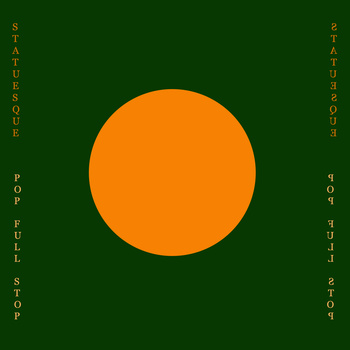
    Statuesque is the name under which Stephen Manning has played (all but the drums) and recorded his intensely literate, feyly melodic Brit-pop songs since the late 1990s. Their older albums — peaking for me with 2004’s superb Choir Above, Fire Below —  Statuesque_Pop Full Stopoften gave a striking imitation of full-band performance and professional production. I imagine that’s expensive and time-consuming for a hobby, though, so by 2013’s Pop Full Stop he’s settled into releasing large gobs of songs (25 on Pop Full Stop itself, plus he released two other albums that year) that sound much more like one guy plus a part-time drummer. It’s completely understandable but disappointing. Not because the resulting album isn’t a pleasure; it is one, hummable and lonely/ funny and playing with complicated rhymes and over-extended metaphors (about which more in the third paragraph). It’s disappointing only because it’s the outlines of a masterpiece that no one had time to fill in.

    Some of the arrangements are winners, mind you. Out Crowd stomps along on big fuzzy bass riffs and echoing, syncopated drums, with pinging guitar decorations near the top of the treble range. Jigsaw Island hides a Proclaimers-like jangle behind Smiths-style dreaminess and another big fuzzy riff, this one sinister. Over Being Over You gets mileage from clip-clop drums, agile leaps of guitar melody, wordless harmony vocals, and the extreme intensity of Manning’s yelp; Augmental from creepy chord changes strummed out with Ani DiFranco-like disregard for the health of the skin on his fingers, plus woozily psychedelic production drones on the chorus guitar and vocals. Micronationals rings out like mid-’80s R.E.M. God, Alcohol, and the Moon and My Life is One Long Cartwheel are loud and bleary yet pleasantly twee, sounding like a Sarah Records band, or Guided By Voices. But the majority of songs here are just voice-and-simple-guitar or voice-and-ukelele, simple-or-no drums  — which, while fine, puts all the pressure on words and melodies. At which point one can start to notice that as strong and distinctive as Statuesque‘s melodies are, they re-use some of their most interesting, sidewise progressions from song to song.

    Luckily, the English language (and his voice is *very* English, of some modest-income regional variant from the island’s south) has more words than the music alphabet has notes, so the words provide novelty where needed. Pop Full Stop is rooted in defeat and fatalism, but cleverly so, set in a world of “Limits set down early/ Playground conquistador/ Whose dad will vanquish yours./ Don’t judge him too sternly: /He lacks the Myers-Briggs/ To find the Boson Higgs”. “Some are born fighting/ others, alighting, apologize their way into the world”, he sings elsewhere, and we know he’s the latter. Many pop songs seek romance; few of them admit what a much larger number think, phrased here by Manning as “I want a girl with a flipchart heart/ who’ll declare my moods are a work of art/ who’ll delete my history as each day starts”.  Micronationals isn’t the first love song to propose a You-and-Me-Against-the-World arrangement, but there’s a clarity to “Give away your dignity/ and celebrate what’s left with me/ we’ll be like micronationals/ pinning medals on passing gulls”.

    It’s probably too stark to be a winning message; I’ve rated Pop Full Stop slightly ahead of Yeezus in my countdown of 2013, but it’s hardly a surprise when the groupies vote against me. A few times Manning’s romantic frustration lashes out (albeit cleverly: I’d rather be attacked by him than Phil Collins, if forced to either fate), but mostly he keeps his lashes inward. Given that rock criticism is predominantly male, it is a little bit off that Statuesque has no standing with the critics’ polls. Kanye West lashes out too, far more than Stephen Manning does, and as unproductive as both of their complaints may be, Stephen’s are, for most of us, a better fit to our style and our memories of youth. It’s possible he should focus, as Dr. Nerdlove would suggest, on better dress and posture and a warmer conversational style more full of active listening and well-timed touching; but look, while he wasn’t doing that, he recorded 25 new songs. I don’t live in London; his actual choice, then, was far more useful to me.

    – Brian Block

    To see the rest of our favorites, visit our Favorite Albums of 2013 page!

    The Amazon link is for my favorite Statuesque album. Pop Full Stop is my 2nd-favorite Statuesque album and is available for £5 from their bandcamp page.