“Alternative orchestral synth rock Portland”, announces Lost Lander‘s Bandcamp tags: a fair place to start. Their songs – calm, pretty, elegant, and fond of long, glistening notes – remind me of “laptop-pop” bands like Postal Service and Owl City. But the ways the comparison fails are important too. Matt Sheehy’s voice is deeper and more strained, and Lost Lander are an actual band. Patrick Hughes’s drums thump and pitter-pat and crash and echo; Sheehy’s guitar is often acoustic or seems so, resonating with the hollow space in the wood; Sarah Fennell plays more piano than synthesizer. Unless the string sections that sometimes appear mid-song are synthesized; if so, they’re seriously well-arranged imitations.
DRRT‘s great strength, for me, is each song’s steady progression of arrangement ideas. Songs start with single textures, and pick up new layers one by one, discarding older textures before they get over-crowded. Two minutes into a song you might be listening to four different instrument lines, none of which were there at the beginning, yet there’s never a feeling of disorientation, of “what the heck?”. The main melodies – which to me suggest ones Radiohead’s Thom Yorke might use as he ages and loses his high notes – carry steadily through the switches. The album is always revealing something new, but patiently.
DRRT‘s weakness, for me — other than the vague lyrics (Through Your Bones does have some storytelling resonance) — is that, unfairly, I want it to be a different record. Hughes is a strong and propulsive drummer who keeps his feel and his patterns varied. I don’t want all those nice dynamic transitions when he breaks into a drum-free song, then departs; I want him to take some songs over. Wonderful World has a melody line that doesn’t fill out two long bars, so I want it to tighten up and barge ahead in 7/4 time (remembering that barges are not fast-moving boats). Lost Lander just fill the eighth beat with echoey guitar.
I enjoy how Your Name is a Fire starts with synth bass, clattering kettle drums, and urgent vocals trying out three ever-so-slightly conflicting ideas about where the beat is (which I’m certain is on purpose, but then they straighten things out). I enjoy how the cymbals and piano on Belly of the Beast/Valentina edge near chaos as the song falls apart (I’d enjoy it even more if the chaos was blended into the song). Pretty much I want Lost Lander to record the sequel to World Leader Pretend‘s final album Punches. But theirs is a calmer, more deliberative form of pop-rock; and sometimes, late at night, I decide that calm is a thing I’ve underrated.
Riverhood opens with two distant echoed voices in solemn harmony. The song, aptly, is called Unfold. Finger-snaps join, then foreground voices: Luke Loseth, tenor, sings a long, agile melody while his sister Charlotte, soprano, wordlessly decorates around him. Piano enters, heavily echoed; so do less-identifiable drones. It’s a gorgeous track. It merges smoothly into Hurricane Season, what hip-hop might have been if invented by Brian Eno to help his 10-year-olds play when they weren’t in aggressive moods: giddy, full of put-on voices that weave intuitively among each other, while dozens of different melodic tones and soft percussion bits whir into being and then vanish.
Way the World Goes Round is basic folk-guitar children’s-album fare, and quite convincing, but the singers’ voices are echoed and distended, while the xylophone’s plinkings wobble in and out of tune. Plus there’s drones that wash over the track by the end. Down to the River to Pray begins as a-capella gospel, and could absolutely have worked without any instruments intruding. But the first gentle folk-guitar accompaniment is the Trojan Horse for an invasion of more piano echoes, drones, abstract fuzztone, and darting vocals lines that get ever more labyrinthine, until it approaches the Beatles’ a Day in the Life inpeak intensity.
Albums in love with drone can aim to be ugly or beautiful or just alien; I prefer beautiful. But it’s my experience that albums in love with drone will short-change words and tunes, or even jettison the entire idea of the human voice. Holobody have made, in Riverhood, a beautiful debut in which the drones assemble songs together, and singing is pre-eminent. To me, this is a welcome experiment.
Hi! My name is Brian Block. I’m new here; pleased to meet you. I wear silly hats; I own silly cats. I read too much; I teach; I had Attention Deficit Disorder before it was cool. I raise two small children who don’t have Attention Deficit Disorder even though it is cool now.
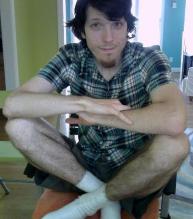
Yes, this is me.
I used to write long, passionately in-depth music reviews at a website called Epinions. I don’t do that anymore, because it’s less important to me than raising two small children. But I have been invited onto Pop Rock Nation to practice the mini-reviewing skill I’ve been working on, where – in usually fewer than 200 words – I take an album I like and try to explain its style, its mood, its sounds, and its singing and lyrics, so that you can figure out if you would like the album too.
As I settle in, I will normally use Pop Rock Nation for mini-reviews of recent albums (or at least ones that are recent discoveries to me). But I thought I would start by making a list of 30 all-time favorites, and letting the list fill with hyperlinks as I submit reviews of each – fuller reviews, say 500 words, perhaps one every other day. You will notice a couple of things about the list (beyond my dubious taste) that have a good chance of bothering you, and I’d like a chance in both cases to explain myself before you see the list and react.
* Half these albums are little-known.
There’s an unfortunate stereotype of standoffish “hipsters” who insist on being the first to hear the underground sounds, on only knowing the things too good and precious for the mass audience: people who reject a band the moment fraternity guys start going to the concerts. Those fans exist, sure. But in my experience, the people with really obscure favorite cd’s got there the same way I did: wide-open enthusiasm. I love good music; therefore I want to hear *all* the good music. Therefore it’s easy for even one person’s recommendation – if it’s descriptive in a way that grabs me – to make me want to hear a record … and I spend a ridiculous amount of time looking for those recommendations. (While listening to music I already have, of course.)
Some of my favorite music has been known and loved by tens of millions of people: from the Beatles’ “a Day in the Life” to Beyonce’s “Countdown”, from Queen’s “Bohemian Rhapsody” to System of a Down’s “B.Y.O.B.”, from Simon and Garfunkel’s “Scarborough Fair” through Nirvana’s “Smells Like Teen Spirit” and Pulp’s “Common People” to the Jay-Z/ Kanye West collaboration “No Church in the Wild”. One of the best and most profound essays I ever wrote, when I wrote essays, was a defense of Starship’s “We Built This City”, which is why I am never going to be an important writer.
But literally millions of Americans are in bands, and several times as many non-Americans: most songs will not be famous. Most songs *that deserve to be famous* will never be famous, crushed by the power of simple math. Plus, yeah, I love plenty of weird and difficult stuff too. Sometimes I convince other people to join me.
* This album list disrespects history: most of it is from the last two decades.
The fact that the 1960s and 1970s are represented once each is partly a fluke based on old record company practices, in which bands were asked to churn out one or two new 35-minute albums per year. It is easier to make a spectacular 55-minute album in three years than an equally spectacular 35-minute album in nine months – I should probably admit to having an economics degree, and therefore an unshakeable belief that 55 of a good thing is better than 35 of a good thing even without other considerations – and a list of the Best of the Best is going to show this. If Simon and Garfunkel had combined the best of Sounds of Silence and Parsley, Sage, Rosemary, and Thyme … if Yes’s Close to the Edge had included the same-year single Roundabout … if Blue Oyster Cult had held back Secret Treaties until they could put Don’t Fear the Reaper on it … they would be on this list.
That said, I absolutely think that the amount of great music being made goes up over time. For one thing, cheap access to ever-better recording equipment means that thousands of albums are released every year that, in the 1970s or maybe even the 1990s, would have been stuck inside the makers’ heads. Some of those albums are excellent. For another thing, the Classic albums – in the popular or especially the critical canon – are often albums that discovered a new trick. But discovering a new trick is not the same thing as writing great songs; it is my experience of the world that the best albums might invent a few tricks, but they steal and re-purpose many more. As time passes, more and more tricks have been invented, ready and waiting for clever use.
The list, then: 30 Great Albums I Intend to Review in the Near Future:
 important too. Matt Sheehy’s voice is deeper and more strained, and Lost Lander are an actual band. Patrick Hughes’s drums thump and pitter-pat and crash and echo; Sheehy’s guitar is often acoustic or seems so, resonating with the hollow space in the wood; Sarah Fennell plays more piano than synthesizer. Unless the string sections that sometimes appear mid-song are synthesized; if so, they’re seriously well-arranged imitations.