web analytics

Author: brian

  • #15 album of 2012 – Clockwork Angels by Rush

    Artist: Rush

    Album: Clockwork Angels

    Rush — singer/ bassist Geddy Lee, guitarist Alex Lifeson, and lyricist/ drum collector Neal Peart — have made albums since 1974, which I think warrants a bit of background for newcomers, until that set of asterisks below. There’s a constant element of Rushness to their sound, but they’ve rush_clockwork_angelsgone through some large stylistic changes. They began as a shrieky hard-rock band. At first ripping off Led Zeppelin and Black Sabbath stomps, they quickly evolved towards 13/8 time signatures, drum solos, album-long stories, and Ayn Randist political fables delivered with the cockiness of defiant 15-year-olds. Keyboards and glossier guitar production entered their sound with 1980’s Permanent Waves, and for three years they had a series of massive (in my opinion terrific) hits. The Spirit of Radio stitched twiddly slow-evolving synth intros from the Who, lyrics modified from Simon & Garfunkel, and a bridge from 3rd-hand rumors of reggae into a grand anthem. Free Will, Red Barchetta, Limelight, and Subdivisions made classic-rock staples out of shifting time signatures. Tom Sawyer made 4/4 towering and novel.
    1982-87 saw their songs getting icier, more synthetic and abstract. But Lee’s voice started to deepen and refine, and by Presto (’89) and Roll the Bones (’91) Rush were a pop band: capable of dazzling riffs, capable of out-playing your favorite band and proud of it, but a pop band, melodic and graceful. Peart, the former lyricist of such lecture-like fantasies as the Temples of Syrinx and By-Tor and the Snow Dog, wrote sensitively about teenage insecurity, a suicidal friend, the improbable events involved in any two lovers finding each other, and how “I’m not one with a sense of proportion … I’m just improvising … I radiate more heat than light”.

    Then they gave up the synthesizers and became, I would argue, a sort of heavy metal band. Metal or not, they made two albums of thundering, riff-intensive, densely layered pop songs: most notably Counterparts (’93), almost a theme album about the challenges of learning empathy, an apology for youthful Ayn Rand worship without naming her. But then came a multi-year hiatus when Neal Peart’s wife and daughter died within a year’s span. On his return (for Vapor Trails (’02)), his lyrics were vaguer, more evasive — for which I blame him not at all. The band’s music was leaner and fiercer: the riffs aggressive, the solos rare, the “tunes” more like bluesy meandering.

    ******

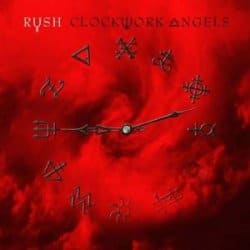
    In 2012, following two albums of that, came Clockwork Angels. It has been widely hailed as their best record since their glory days, usually meaning 1977-81. I’ll agree, if I’m allowed to define their glory days as 1989-93. Produced by Nick Raskulinecz — a Grammy winner known for work with modern-rock radio bands like the Foo Fighters, Evanescence, and the Deftones — it’s 66 minutes of loud, impeccably polished and up-to-date power-trio rock songs that, if rather uniform in the grand scheme of things, do an excellent job calling attention to the details of individual performances. (Vapor Trails fought awful, blurry production: professionalism has its uses.) Atmospheric synthesizer and delay-pedaled, tremolo-pedaled guitars set dramatic openings for many songs, and those synths (and perhaps actual bowed strings a couple of times?) do more background service during the songs proper than in any Rush album for 20 years. All attention, however, is centered on guitar/ bass/ drums. Lifeson’s solos are back; they’re tuneful enough. Geddy Lee’s bass playing — his agile quick-fingered runs, his little turns towards funk or spaciness, and his sheer attempts to crush you — may be the most impressive it’s ever been, which means it’s pretty near as impressive as *anyone* has ever been. Neal Peart still takes, and talks about, his drum lessons, and while he’s omnipresent here, he finds a wide if subtle variety of ways to push the songs along.

    Most of the vocal melodies still seem, to me, wandering and interchangeable, but the many-segmented Clockwork Angels itself puts together several soaring ones, and both Brought Up to Believe and the Wreckers are quite hummable. As for a more typical track here like the Anarchist, I hum the bass and guitar parts, and those synthesized-strings faux-snake-charmer bits. I’ve learned that while melody is central for me, and the vocals are where I first turn for it, I’m happy to find good wordless ones; Rush‘s Clockwork Angels strews ’em throughout. Lee’s bass playing can be foreground for me; his singing can be background, in which context it’s strong, flexible, and pleasant.

    Which will be a “Wait? What?” claim for many fans, because Clockwork Angels is a story album. It’s a philosophical quest in a steampunk universe, in the course of which our narrator leaves his childhood small-town still half-believing in a planned, properly-slotted order for everyone. He experiences awe at his capitol city’s (yes) clockwork angels, “Celestial machinery” that “Span the sky in clockwork arcs, hint at more than we can see”; but he’s restless. He joins a carnival, falls in love, loses love, searches for gold, is captured by pirates. He disdains pre-destination and has failed at individual glory; his final conclusions are in favor of forgiveness and trying to lead a small, kind, worthy life focused on the personal choices he can control. It’s a far better story than Peart was writing in the 1970s, certainly.

    If he was a good enough writer for it, who knows how high I’d’ve ranked this record? But if you’re going to create a different world, teach us what it’s like to believe in it. William Kotzwinkle’s wonderful the Ants Who Took Away Time, a picture-heavy book that my 6- and 4-year-olds adore, conjures a clockwork universe with humor and absurdity but utter commitment. Ray Bradbury and Dean Koontz and Genevieve Valentine and Erin Morgenstern and even Doctor Who have made carnivals seductive, magical, and spooky. Treasure hunts and pirates have been fantasy staples for centuries. Peart’s narrator gives us little sense of the appeal of any of this. In particular, since you and I and everyone around us believes it’s our job to find our own way — even the fundamentalist Christian browsing the self-help section and paying a dating site to help “find God’s match for you” does — I would love to have a song from *inside* the belief that wisely-programmed machines will put us on our correct course. Instead we just get the rejection of it. We’re told it’s a journey for the narrator, but it’s sure as heck easy for us.

    So I’m not here, ultimately, for the words (though they’re well above average, don’t get me wrong). Clockwork Angels is, to me, 2012’s most potent demonstration of the power and melody a guitar, bass, and drum set can bring. I write about rock music; you can assume I appreciate that sort of thing.

    – Brian Block

    To see the rest of our favorites, visit our Favorite Albums of 2012 page!
     

  • #16 album of 2012 – the Idler Wheel is Wiser by Fiona Apple

    Artist: Fiona Apple

    Album: the Idler Wheel is Wiser than the Driver of the Screw, and Paid Its Mortgage Selling Half This Rhyme to Mountain Dew™ 

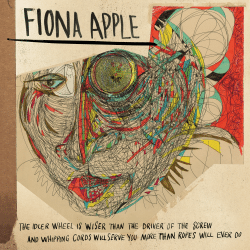
    Fiona Apple‘s fourth album is built on

    (1) impassioned, bluesy, yet highly articulate singing

    (2) Charlie Drayton’s inventive, busy percussion (drums and cymbals, but also vibraphone; drumsticks tapping light-switches; moths fluttering into walls while wearing tap-dancing shoes; the wheels of tiny wagons pulled across pebbly trails by nervous midget horses; storage-room shelves collapsing; floors of empty basketball arenas being stomped; distant washed-out recordings of overheating steam-engine boilers. Or so I choose to deduce)

    (3) Apple’s minor-key piano, often itself highly rhythmic.

    My impression from quick attempts to sample her older material is that the Idler Wheel is Wiser is the musically sparest, most percussive, and most direct of her four albums. I’m basically new to her. Her breakout first single Criminal  struck me as slick and bland (it still does), and fiona_apple_idler_wheelcreeped me out with its video, hard-selling the idea that Anorexic Abuse Victim Is The New Sexy. Her insistence that her second album have a 100-word title was intriguing, but I didn’t *like* the title, so I tuned her out. I might never have fixed that, had not a negative review of the Idler Wheel is Wiser pointed unhappily to the Left Alone couplet “You made your major overtures when you were a sure and orotund mutt/ and I was still a dewey petal, rather than a moribund slut”.

    Which is brilliant. Alright, sure, I can see not being struck that way if (as I’m guessing the reviewer didn’t) you don’t know “orotund” or “moribund”, but, y’know… I had to look up the fourth word of “My ills are reticulate, my woes are granular” later in the same song. Before, I didn’t know “reticulate” describes complex, diffuse networks; now I do, and the line is damned insightful. What I loved about these lines — about, basically, the prospect of relationship songs by a bluesy female Tom Lehrer — is that there’s a natural clash between what I might consider the two most important style elements of good writing: “Say what you’re trying to say”, and “Make it new”. The fancy parts of Left Alone are direct, literal-minded storytelling *and* strikingly original phrases — and high-wire rhymes, to boot. Which doesn’t make it one of 2012’s greatest songs by itself. Neither does the clattering drum solo. Neither even, quite, does the skewed jazz-punk piano riff, off which her rhythmic scat-singing and Drayton’s drum flurries bounce at interesting angles. What finishes elevating it is that once she’s finished a tricky rhyme with “cultivate a callus”, she advances the idea in the starkest language. “And now I’m hard, too hard to know/ I don’t cry when I’m sad, anymore…./ How can I ask anyone to love me, when all I do is beg to be left alone?”. The eloquence has been a defense; putting it down is made an act of bravery. Yet she still gives you, in the best part of the chorus melody, the words “calcify” and “coincide” to sing to, because she can, and it’s a cool trick, and those words, too, help say what she’s trying to say.

    Periphery is another with show-off writing: a defiant, funny, willfully juvenile attack on social strivers, where the music — despite impressively spooky backup vocals and bursts of off-kilter intensity — keeps returning to a goofy carousel piano riff. The spare but bouncy Daredevil features fiona_apple_idler_wheel_full_textthe impressive strength-in-recovery metaphor “Say I’m an airplane, and the gashes I got from my heartbreak/ make the slots and the flaps upon my wing, and I use them to give me a lift”. But mostly, she’s more reined in: she simply uses her intelligence, intelligently. The pop-jazz ballad Valentine is as precise for “You didn’t see my valentine/ I sent it via pantomime” as its continuation “while you were watching someone else./ I stared at you, and cut myself”, and uses both to inform “I root for you, I love you”. Jonathan, its music as cloudy and ominous as Tori Amos’s Precious Things but muted and careful like it’s sitting next to you in front of three dozen strangers, attacks her own wordiness: “Kiss me while I calibrate and calculate, and heaven’s sake, don’t make me explain…/ I don’t wanna talk about anything”. The singles from this album both make good reading, but turn on the phrases “And then we can do anything we want”, and “I just wanna feel everything”.

    My wife and I have been watching early seasons of Aaron Sorkin’s the West Wing recently, our second time with the show. It was mostly a show, abnormally near-realistic by TV standards, about clever, educated, funny, earnest people who care about each other and are trying to improve the world. They were held back by a system designed to be subject to hundreds of competing egos; by their own egos, gigantic enough to fit in; by the many ways the task “improve the world” is ill-defined and unclear to begin with. But they were easy to root for. Now and then, though, it attempted (painfully) to be a romantic comedy about these same people being completely incapable of treating would-be lovers well, because they’re too damned uptight to ever openly ask for what they want, or to try to get people to like them by being likable.

    Fiona Apple spends the Idler Wheel is Wiser trying hard not to be that person. Maybe that’s a new project: see as well her affecting 2012 letter to her fans where she canceled her concert tour to be with her dying dog. Then again, if she’s been this direct and vulnerable since her 1997 debut, maybe it hasn’t been working for her, or it’s only been something she knows how to do when she’s writing and singing. It is, either way, a worthy attempt, one I’m glad I finally let myself hear. And when she ends her album with the peppy, Beyonce-ish love/ lust celebration Hot Knife, I choose to hope it’s not too late to root for her.

    – Brian Block

    To see the rest of our favorites, visit our Favorite Albums of 2012 page!

     

  • #17 album of 2012 – Rewotower by Profusion

    Artist: Profusion

    Album: Rewotower

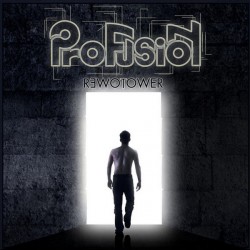
    For fans of progressive rock — a genre most widely known for Yes, Jethro Tull, Peter Gabriel-era Genesis, Rush, Dream Theater, and Mars Volta — there exists a useful web community called ProgArchives. If you hear for the first time of the existence of a prog-rock band, there’s a good Profusion-Rewotowerchance you can find several reviews of them by ProgArchives members. Any given review there has a solid 50/50 chance of being competent, and is usually written, even if negative/ disappointed, with the helpful enthusiasm of a fan rather than any kind of elitist snobbery. I’ve been vaguely aware of them for years. But this past summer — happy upon my discovery that folks there understand what a brilliant late-career revival Jethro Tull’s Roots to Branches was — I decided to use their easy database search to learn what new albums ProgArchives users rated most highly, and read those reviews to find exciting new things to try.

    I’ll probably do that once or twice a year from now on. Still, if I don’t, the reason why not will be simple: the bulk of what I found didn’t impress me. Progressive rock is named for a hippie-era idea of progress: that all musics would blend into something new that everyone could enjoy together. Listen to ’70s Yes albums, for example, and you’re hearing a band making something new out of hymns, hard rock, classical, soul, folk, and various 3rd-world musics … and by Relayer and Going for the One they were either listening to the avant-garde, or simply being it. Listening to ProgArchives finds like the Flower Kings, Threshold, and Distorted Harmony, on the other hand, I felt I was hearing bands that grew up obsessed with progressive rock: bands engaged in ancestor worship. Which is admirable; their records are fine. I simply saw no reason to choose the apprentices over the masters; to choose bands saying “You taught us everything we know!” over bands that could say “But we didn’t teach you everything *we* know, silly”.

    *****

    Then again: if it weren’t for ProgArchives’s 2012 list, I wouldn’t have Profusion‘s Rewotower. (Or two albums too recently purchased for a shot at my top fifty. Magma’s Felicite Thosz is a rock album that’s short and weird, but cheerful, pretty, and bursting with vocal harmonies. iamthemorning‘s ~ is full of lovely, austere, classical/romantic piano songs). Profusion come from Italy, a strange land where I gather it’s still normal for young people to listen to classical and folk musics. Their songs are expertly-played and well-structured — virtues normal to progressive rock — but they’re also full of catchy hooks of many sorts. Listening to Profusion, it is obvious that you’re supposed to have a good time; and they haven’t pre-decided who the “you” of that goal are.

    A few tracks of note: Ghost House suggests Rush if they’d combined their pre-stardom time-signature games, their Tom Sawyer / Spirit of Radio synth-rock mass appeal, and Geddy Lee’s later, lower, de-shrieked melodious voice. So Close But Alone starts as an elegant mainstream piano ballad, then morphs gently into a Latino dance song; it also futzes with time signatures, but unless you’re dancing, you’re unlikely to notice. Tkeshi is a soft, gorgeous interlude of acoustic guitar and African drums and chanting. Chuta Chani starts as a mix of classy string quartet and ominous bass-with-tribal-drums; brings in heavy metal guitar, classical guitar, and hymnal ambience; then launches into a pop-song chorus with the sort of over-the-top gloriousness that — as I’ve heard of no triumphant Queen/ ABBA collaborations (or even any dire ones) — I associate only with Japanese chart-pop. (Then there’s a dazzling synthesizer solo.) The Tower – Part 1 is progressive metal, but the kind you write when you know classical and jazz music — and heck, possibly Richard Marx — as well as Rush and Dream Theater.

    As for The Tower – Part 2, mostly an instrumental, it reminds me of those Joe Satriani guitar-god albums that critics scorn. But many people enjoy those, because the playing really is exceptional, and for these 5 minutes 30 seconds, I know I’m siding against the critics. Rewotower is an album made by people who spent thousands of hours developing the skills to put on a quality show, and tens of thousands of listening hours figuring out all the things a quality show might sound like.

    – Brian Block

    To see the rest of our favorites, visit our Favorite Albums of 2012 page!