web analytics

Author: brian

  • #12 album of 2012 – Nightflight by Kate Miller-Heidke

    Artist: Kate Miller-Heidke

    Album: Nightflight

    Kate Miller-Heidke entered my life with her second album, Curiouser, one of my two favorite albums of 2010. Witty and tuneful, danceable and good-natured, sung both prettily and expressively by a woman unafraid to make brief, surprising use of her opera training, it was for me the greatest Kate_miller_heidke_nightflightalbum of mainstream chart-pop since … well, ever. The Beatles’ best albums were mainstream only because the mainstream ran to catch up with them; Curiouser was in a category with early Madonna, Cyndi Lauper, Kylie Minogue, or Lady Gaga, except far more personal and more musical. Also smarter, but not in an intellectual or intimidating way. Miller-Heidke simply proved smart enough to story-tell a heartbreaking apology to a boy she’d once been mean to (Caught in a Crowd); completely take down a pickup artist (God’s Gift to Women); tell a gossipy friend to step off (I Like You Better When You’re Not Around); write a catchy dance song about her awkward self-consciousness while dancing (Can’t Shake It); find disheveled glee in a despairing protest song about apathy (Politics in Space); and relate novel post-relationship stresses in the age of Facebook (Are You Fucking Kidding Me?). Curiouser peaked at #2 on the album chart in her native Australia, and included a #1 single (the slow, yearning Last Day on Earth).
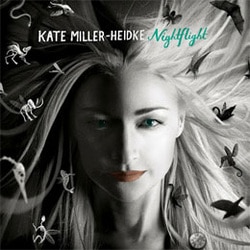
    She’s released two albums since, each of which changed direction a bit. Liberty Bell (2011, known in Australia by the better title Fatty Gets a Stylist) went heavy on the synthetic dance-pop; I found it disappointing, though my young sons adore it and have helped bring me ’round. Nightflight is altered in a different way: like Robyn Hitchcock’s gorgeous but surprising Perspex Island, it’s not witty or clever, nor does it aim to be. It’s a lovely mainstream pop record, but earnest, and the people it most sounds like to me could have been stars but weren’t: Sinead Lohan and Heather Nova (part of the “Wait, is this pop or does this go on 120 Minutes?” confusion of the mid-90s), Brooke Fraser and Katie Herzig (Christian Contemporary singers of the present day). Much as I like those four, though, I prefer Nightflight to any of their records. Quite a few Australians seem to agree.

    When I review mainstream pop, it can be hard to explain what makes it special. I can point to little details of construction, sure. Piano-based anthem Ride This Feeling‘s chorus is delayed, building anticipation, by a dramatic pre-chorus dialogue between hair-metal power chords and near a-capella singing. The verse melody on the ominous Sarah builds towards the chorus but then slows and spirals inwards, again changing the chorus’s impact; the arrangement makes good use of sawing strings, timpani, bell-like piano, and background opera notes. Nightflight is a piano ballad in 4/4, but its best parts integrate the rolling propulsion of 3/4 by emphasizing the first, fourth, and seventh of every eight beats (the bridge), or actually combining the time signatures (the chorus). On the bridge of the Tiger Inside Will Eat the Child, Miller-Heidke‘s wordless voice pipes like a pennywhistle. I’ll Change Your Mind isn’t far from Taylor Swift’s Red, but has another good chorus-delaying tactic: some thinking-aloud lyrics to a repeating chord that refuses to resolve. Beautiful Darling is a Joshua Tree-alike, and those tremolo-and-delay-pedaled guitars and sharp echoed drums don’t need to be new details to be really good ones. (The lovely faux-aboriginal vocal hook is more like Enigma.) The acoustic guitar on the Devil Wears a Suit, minor-key Irish folk, unsettles by putting the beat before or behind where you expect.

    I can point to lyrics, too. Sarah is a well-told story of a friend disappearing at a Ben Folds concert they attended together. Nightflight is about a life built on long-distance travel: “Oh ladies and gentlemen, keep your luggage with you at all times/ I’m 35 hours and three bad movies away/ and if one more person coughs on me, I’m gonna punch them in the face/ Well not really, I’ll just hold my breath as always”. I’ll Change Your Mind is an account of one-way love: “You’re no stranger to 3 a.m./ You call me just because you can/ Cuz you know I’ll come/ Cuz you know I’m helpless…. I know you’re using me for comfort and for company/ I’m using you too, to feed my fantasy”. In the Dark mourns a father by sitting in the now-unneeded car he taught her to drive in. Fire and Iron‘s account of old love has vivid details like “You tried to impress me by rolling a smoke/ Your hands were shaking and the paper broke/ I played it cool and I took a drag/ Coughed like the kid on the Panadol ad”. But sometimes the most ordinary details hit me, like the little apology in “I woke up this morning, made a pot of coffee/ went out onto the stairs to sit in the sun/ I haven’t been myself, I know I haven’t been much fun/ But I woke up this morning, and the air felt different”.

    Ultimately, I’m not sure how much of my reaction is down to those details. There is one truly unusual-sounding highlight here, the desolate Humiliation (cello, tugging/ echoing vocals, In the Air Tonight-style drums, little synth buzzes and Pink Floyd whirs, bits of opera, and the glistening guitar-or-is-it-harp riff that holds it all together). Otherwise, most of these songs have choruses that, sonically, any leading song-factory writer (Linda Perry, Max Martin, Bruno Mars) might’ve written for any given starlet or girl group or boy band. Except … now and then those folks write *really good* choruses. Here’s an album with at least half-a-dozen of those, plus two or three more in the folkie mode, and the restraint not to bludgeon them into your head with repetition. They also have abnormally excellent singing. Plus lyrics with a likable individual’s thoughts behind them, and I’m told she’s still hilarious in concert. But maybe I’m just pretending the choruses wouldn’t be enough.

    – Brian Block

    To see the rest of our favorites, visit our Favorite Albums of 2012 page!
     

  • #13 album of 2012 – Trouble with Machines by District 97

    Artist: District 97

    Album: Trouble with Machines

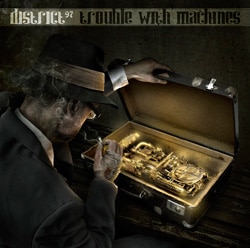
    District 97 are a Chicago band of four varyingly dorky-looking male rock musicians, all quite skilled; a not-at-all-dorky-looking woman named Leslie Hunt who joined the band after being a top-10 finalist on American Idol; and a cellist, Katinka Kleijn, talented enough to do solos for the district_97_troubleChicago Symphony Orchestra. That lineup concept is why I tried them out in the first place. Say what you like about American Idol (in my case, “I’ve never watched it”), Kelly Clarkson made it clear early on that it’s a fine machine for the discovery of singing talent, stretchable beyond any musics that the show itself — from what I’m told — would demonstrate. For example! While I’ve ranked District 97’s Trouble with Machines slightly above Rush’s Clockwork Angels, what I’d emphasize is that they’re comparable. If you’re a fan of one, I think there’s a good 75% chance you could end up a fan of the other.

    On a broad level, both albums are full of ambitious, multi-segmented, quasi-metal songs that rock out. District 97 even attempted an album-long story on their excellent 2010 debut Hybrid Child, although this time they restrict that impulse to the individual 10-minute story-songs the Perfect Young Man and the Thief. Micro-level similarities include near-identical drumming styles (drummer Jonathan Schang is even District 97‘s primary composer); bass to some extent (Patrick Mulcahy often matches Geddy Lee’s more aggressive tones, though at other times he’ll essay a Metallica chug, spacious and staccato math-rock, or punk-pop simplicity, instead of Lee’s funk or melodic leads); and some tuneful heavy-metal guitar solos (Jim Tashijian’s being shinier and more ’80s rapid-fire than Alex Lifeson’s). Both albums also are full of angular vocal melodies, although where Lee’s tunes on Clockwork Angels often felt unfinished and wandering to me, Hunt’s on Trouble with Machines are clearly odd on purpose, making precision leaps over chasms. She’s got more than enough charisma to sell them, at least to me.

    Rob Clearfield’s keyboards have a flashiness, and a hookiness, that fits far better with the Rush (or Yes) of thirty years ago. So, too, do the frequent time-signature switches here. Back and Forth and the Perfect Young Man feel especially like hybrids of Rush old and new. The lean, slippery Who Cares? is its own beast: Tashijian’s limber, non-distorted guitar reminds me of his acoustic-based side band Treehouse, and Hunt’s singing is at points more yearning, more bitter, and more taunting than progressive rock in general is known for. Open Your Eyes, the single in 4/4 time, has a catchy Pat Benatar-like directness (although still a fairly unusual melody). The Actual Color — melodically and rhythmically the bizarrest song on Trouble with Machines — has nonetheless a dramatic and emotional heft that reminds me of Queen’s later records. Read Your Mind opens with a nifty, elegant minute-long demonstration of various tricks cellist Kleijn learned in conservatory; the song as a whole is at once the most Clockwork Angels-like track here, and the one most influenced, in its slower, more drawn-out moments, by chamber music and by the synth-jazz-pop early-80s works of Joe Jackson (Steppin’ Out) and Donald Fagen (New Frontier). Final track the Thief makes me admit I’m being silly not having brought up Dream Theater before. It’s song-like enough and often gentle enough to be on Images and Words, but with group-playing segments fiery and jaw-dropping enough for … how did Dream Theater let Rush beat them to the song title an Exercise in Self-Indulgence anyway? Don’t give me that “They weren’t born in time” excuse; temporal immobility is for losers. Anyway, there’s enough song on the Thief that the instrumental parts enhance it rather than upstage it.

    Like those other bands, District 97 try to sing about lives well or poorly led. Unlike those other bands, District 97 do so by centering on personal relationships: flirtations, cliques, seductions, breakups, encouragements, marriages, children, illnesses. In the broader context of pop music that’s conservative; in progressive rock, it’s almost radical. Right now the lyrics need work, I’d say: they sustain a narrative *or* scatter a few good lines, but not both. This album is high on my list for how great it sounds. There’s potential for something deeper next time. I’ll be listening.

    – Brian Block

    To see the rest of our favorites, visit our Favorite Albums of 2012 page!
     

  • #14 album of 2012 – Paralytic Stalks by Of Montreal

    Artist: Of Montreal

    Album: Paralytic Stalks

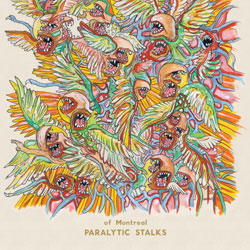
    Perhaps it’s because the real ending of the Beatles was so disappointing — four men who’d pushed each other to brilliance got tired of doing so, released a spotty final record, and spread outward to fairly ordinary musical careers — but sometimes I’ll see a new and unrelated record as if it of_montreal_paralytic_stalkswere an alternate Choose Your Own Adventure of the Beatles’ story. Of Montreal’s Paralytic Stalks, for example, is the version where John and Paul and George and Ringo go ahead and loathe each other, but express it in bitter lyrics and a deepening creative tension where they’re ever more inclined each year to reach in and screw with each other’s songs, yanking them back and forth in increasingly unlikely directions. Without ever messing up their best melodies. Oh, and they’ve kept doing this long enough to be as influenced by disco and Parliament/ Funkadelic as by modernist orchestral music… although Sgt. Pepper and Abbey Road remain in sight and in mind at most times.

    In reality, Of Montreal are a shifting collective led by an American named Kevin Barnes. They began playing giggly psychedelic folk, developed a leftist political edge, then tightened their sound to make a couple of ebullient but professional pop records, Satanic Panic in the Attic (’04) and the Sunlandic Twins (’05), both of which sound more than a little like the Magical Mystery Tour re-done with drum machines, synthesizers, and funky electronic bass. Barnes sold one of his catchiest songs, Wraith Pinned to the Mist and Other Games, to Outback Steakhouse for rewriting with jingle lyrics, a tribute to commercialized gluttony which sits quite poorly with attacks on the greed of politicians. So after a few defensive and snotty interviews, he started writing about topics he could bring sincerity (and redeeming sly humor) to, like his favorite drugs and sex acts. The songs over several albums got less catchy and more complex, which often is a trade I’m happy with, but which in this case mostly lost me. I may or may not have been influenced by the time I waited 2+ hours past Of Montreal’s scheduled stage appearance at Gate City Noise before they showed up, stoned out of their minds and barely able to half-remember their songs … but not, I assume, rejecting that night’s paycheck either.

    Paralytic Stalks is a triumph, though. On the one hand, it’s overstuffed and bursting with some of my favorite melodies Of Montreal have ever recorded. On another hand, it’s as expressively vicious (outwardly and inwardly) a set of relationship lyrics as I’ve ever seen, which also makes its periodic stumbles towards truce and redemption more powerful. On a third hand — Paralytic Stalks being a deformed creature with many non-standard body parts — it combines Barnes’s long-established interests in psychedelia, pop, funk, cabaret, and disco with a brand new interest in strings and flutes, long droning tone clusters, and outbreaks of free-jazz orchestration. All of which are used with the expressionist power of a Edvard Munch painting, and are reined in to bring a form of peace.

    The poppiest moments make sense to explore first. Spiteful Intervention is the obvious single, even with dissonant strings and harpsichord peeking around the edges and rickety drums collapsing in the background. Beginning with dramatic narration-singing — “It’s fucking sad that we need a tragedy to occur to gain a fresh perspective in our lives/ Nothing happens for a reason, there’s no use pretending, you know the sad truth as well as I” — it moves into lilting sing-song over ’80s dance-pop. Then it launches into the acrobatic chorus melody: “I spend my waking hours haunting my own life/ I made the one I love start crying tonight/ and it felt good! Still, there must be some more elegant solution”. The melody spins its own memorable variations and continues: “Lately all I can produce is psychotic vitriol/ that really should fill me with guilt”. The backup singing supports a mood like the mad laughter before a breakdown. Yet it’s the catchiest thing — and if quite exaggerated from the worst things I’ve ever felt (so far) about anyone I loved, it’s recognizably vivid.

    Dour Parentage, riding in on massed flutes and echoey drums, is top-notch experimental Stevie Wonder with modern recording technology.  We Will Commit Wolf Murder is a pretty ’80s dance tune and love song, chopped and screwed: the vocal production and instrumental arrangements changing almost every line, and the sentiments along the line of “Someone’s terrorized my psyche to get even/ Lately you’re the only human I believe in” and “I’m considered ugly from every angle/ You’re the only beauty I don’t want to strangle”. Malefic Dowery is genteel pre-rock drawing-room pop, with a bit of hymnal a-capella, about how “Now I feel that you’re provoking me with your fidelity/ that your loyalty and affections are somehow a vulpine act of hostility/ Now we’re a bore, we’re afternoon TV”. It’s sort of a love song too.

    The long tracks, 7 to 13 minutes, are the ones with the thorniest passages. I don’t find ’em difficult — my Dad was (among other things) a minor-but-talented modernist composer who played me Bartok and Penderecki when I visited him — but for those of you who do, I’ll point out simply that the weird classicisms aren’t a gimmick; they’re *used*, in a surprisingly straightforward way. The songs start with hummable melodies (especially Wintered Debts, like Paul McCartney and Marvin Gaye getting together to taunt you personally, and Authentic Pyrrhic Remission, soulful and sunny). They move into weird tonalities, slowly-evolving repetitions, and aggressive dynamics when the lyrics get, well, even more desperate than usual. They return to pleasant tunes (not the same as they began with) in search of partial resolutions. I’d hate to marry someone like Kevin Barnes; well, that isn’t news. There are nights — not too many, but some — when I’d hate to marry someone like me either. Paralytic Stalks is a masterful evocation of that. Not bad for such good pop songs.

    – Brian Block

    To see the rest of our favorites, visit our Favorite Albums of 2012 page!