web analytics

Commercial-isms: T-Mobile vs. Laurie Anderson “O Superman”

HTC O… M Effing G
I took it as further evidence of my exceptional parenting when my 17-year-old son perked up at the sound of Laurie Anderson’s “O Superman” coming across from the TV and pronounced “Awesome song!” In my head, I was congratulating myself: My son knows Laurie Anderson’s music! I am a good dad! I am a good dad! But this moment of parental pride was sullied when I realized that familiar “hah hah hah hah hah hah” (I always thought it sounded like a robot breathing) was being played in the background of a commercial. For T-Mobile’s new HTC One phone.

Really?

Now I’m not so naive to actually believe that, at least when it comes to pop culture, some things might actually be sacred. But seriously: what’s “O Superman” doing in a cell phone commercial? Suddenly the tired arguments about artists “selling out” with their licensing choices feel freshly relevant. Not that I think Laurie Anderson has sold out, nor do I begrudge her whatever money she might be making from a 30-year-old song that might only be regarded as a “hit” in the most artsy-NYC-hipster-ish sense. (It did top the Village Voice’s 1981 Pazz & Jop singles poll.) But there is something sad about such a monumental song reduced to… this.

If you’ve never heard “O Superman”, you may be asking yourself just what the big deal is. And if you’re just hearing “O Superman” for the first time, you should know: it’s damn weird. But it’s also wonderful. As proud as I am that my son could identify it so readily, he was a tiny bit wrong in pronouncing “O Superman” an “awesome song”. It certainly is awesome, and I don’t mean “awesome” in the deeply trivializing 80s-vintage colloquialism sense, but rather in the Old Testament music to bring down the walls of Jericho sense. It is awesome. But to call it simply a song is also a little trivializing.

For one thing, it’s just not very song-like. For another, it’s massive: eight-and-a-half minutes massive, sustained without benefit of a catchy chorus or an extended guitar jam or even a drum solo. The music is stark and electronic, the words poetic and prayerful, and delivered (through a vocoder) alternately as a monologue and a chant – ah-hah-hah-ah hah-hah-hah-ha-ah. It is by turns funny and sweet (“Hi Mom!”), and chillingly prophetic:

Here come the planes
They’re American planes
Made in America
Smoking
or Non-smoking

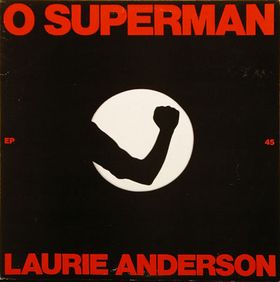
There’s also a visual element that is integral to the song itself. In live performance, Laurie Anderson would play her synthesizer with one hand, and with the other, punctuate her lines with hand and arm gestures projected as shadows in a circle of light on a screen behind her.

Laurie Anderson “O Superman” (1981)

The song was first released as a NEA-funded limited edition 7″ single in 1981; the following year it became the centerpiece of Anderson’s major label debut record Big Science, which, itself, was conceived as part of an epic scale multi-media performance piece called United States, inspired largely by a four-year field trip Anderson took around the country, working various sorts of jobs as she went. “O Superman” is still regarded as Anderson’s masterpiece, and in the same way the “Hallelujah Chorus” (all 100 or so seconds of it) has become “bigger” than the larger work it was part of (Handel’s “Messiah” oratorio), “O Superman” has eclipsed United States in sheer concentrated power and historical resonance.

The song was inspired by the aria O Souverain, O Juge, O Pere, from French composer Jules Massenet’s opera Le Cid, and alludes to its words. Laurie Anderson described the aria as a “prayer for a knight on the eve of a hopeless battle… a prayer about empire, loss, and ambition.”

‘Cause when love is gone, there’s always justice.
And when justice is gone, there’s always force.
And when force is gone, there’s always Mom.

“O Superman” was also inspired by current events: specifically a tragically failed military mission during the Iran hostage crisis of 1979. But 9/11 and the government’s ongoing struggle to respond to it – both the military interventions in Iraq and Afghanistan, as well as the domestic policies passed in the name of security – have given the new song an even more powerful and unforeseen resonance. Here’s Laurie on performing the song to a New York audience a week after 9/11, from her notes to the 2007 reissue of Big Science:

“During a top-secret mission to rescue hostages being held in Tehran, American helicopters crashed in a sandstorm and blew up. The mission’s failure was a blow to the United States’ reputation as a technological superpower and played a role in the downfall of the Carter Administration and the rise of Reaganism. Almost thirty years later we’re fighting the same war… I suddenly realized I was singing about the present.”

So yeah, how about that skydiving fashion photographer? Here’s the song that opens the Big Science album:

Laurie Anderson “From the Air” (1982)

Comments

21 responses to “Commercial-isms: T-Mobile vs. Laurie Anderson “O Superman””

  1. chadwys@gmail.com'
    chad

    In theory It must surely be difficult to separate the commercialism from the commercial, but in truth I’ve been doing it my head for as long as I can remember. I don’t view this as a defense mechanism — though I might — anymore than I view it as my way of separating the truly artful aspects of what I experience in culture from the disposable noise that I don’t require. Advertising is a fact of life — it doesn’t have to be, but it is. We can begrudge this as intellectuals and as morally responsible artists, and we do, but we still find ourselves in the midst of a highly visual (and audible) culture that is also persistently commercialized. That is a side effect of capitalism, and the alternatives to capitalism do not yield much better results, socially speaking. So we are in the midst of a commercial culture and we must deal with it how we will. (Resistance is healthy when it brings about healthy change, but I have found selective, or discerning, resistance most enjoyable.)

    As a fine artist I have come to respect the work of the graphic designers and advertising firms tasked with creating the good commercial work that we see around us. Not all persons tasked with an advertising campaign are driven to transform us into zombie consumers. Some are genuinely thoughtful and creative people interested in putting a visually challenging product (I am referring to the advertisement itself and not the product or service being marketed) into the culture in which they, and we, live and work. Some advertising is entertaining, creatively stimulating, and at best inspiring. It’s the fastest and easiest way we can be exposed to a great many new things… like a new song, or a new method of animation.

    I wonder if you’ve thought about the qualities of that T-Mobile ad as a visual experience unto itself (the version linked to in this post is only 15 seconds, whereas the one I’ve seen on TV is twice as long). It has artful — I say beautiful — aerial photography and a really great Laurie Anderson song accompanying it. As a photography I actually connect on a narrative level with the — what? — protagonist. I suppose it should be difficult to ignore the fact that the ultimate purpose of the ad is to sell a phone, but I find myself acknowledging, coming to terms with, and then setting aside that information. Doing this allows me to both appreciate Anderson’s song and the artfulness of the visual production without much prejudice. I don’t think to myself, “I need a new phone.” When I see this particular ad, I think to myself how well “O Superman” sits in the context of these new visuals… and I’m brought back to “O Superman” anew.

  2. chadwys@gmail.com'
    chad

    To clarify that sentence in my last paragraph, what I mean to say is: as a photographer myself, I actually connect on a narrative level with the (I guess we can call him) protagonist of the commercial. I find myself appreciating the premise of a fashion shoot occurring during a skydive… set against the sounds of “O Superman” no less.

    1. paulrocksmyworld@hotmail.com'
      Paul Lorentz

      Thanks for the thoughtful (and thought-provoking) comment. I’m not quick to cry sell-out when I hear a song I love (even one by a “serious” capital-A artist) in a commercial. My thinking is that music (and advertising) can serve a number of different purposes, and using a song for one doesn’t necessarily preclude it’s effective use for another. As far as the HTC-One commercial goes – eh. I can see how a fine art photographer can connect with the narrative (my background is in the fine arts as well), but the commercial itself doesn’t do much for me. What I do love about it is that it’s introducing this song not only to a new generation of listeners who weren’t around for Laurie Anderson’s artistic heyday, but also to the generation of listeners who did grow up in the 80s but still never heard of her. My hope is that people who are turned onto O Superman by the commercial go on to check out Big Science, and then maybe “Strange Angels” (the album that introduced me to Laurie Anderson), or last year’s “Homeland”, or “The Ugly One with the Jewels”. Thus, my linking to “From the Air” – which, really, might have worked even better in the commercial.

  3. gc4life2@mail.com'
    Sean

    I would think to call it anything but a “song” would be silly even though it is not structured like normal commrcial stuff. I think its awesome when companies choose legit artists to pay for the rights to their art. I know many people disagree but I think its pretty punk to take money from a corporation just for letting them use your song. Selling out is not getting paid for work you have done, it’s changing the work you do in order to get paid.

  4. mgm@marisadesign.com'
    Margie

    Of course, it’s wonderful for a new group of people to become aware of Laurie Anderson and her fabulous work. I’ve been a fan of Laurie since the very first time I heard “O Superman,” and my daughter grew up on the music from “Strange Angel” (“Baby Doll” was her favorite song). But I do find it a bit odd hearing this particular song on a phone ad.

    However…it’s very possible that she did not approve the use of the song. Many years ago, a snippet of “O Superman” that was even shorter than the snippet used in the T-Mobile ad was used in a British Sterling car ad. She was unaware of it until someone asked her about it during a Q&A performance. Shortly thereafter, the ad was pulled.

    1. paulrocksmyworld@hotmail.com'
      Paul Lorentz

      Margie, I love that your daughter grew up loving “Baby Doll”. “Strange Angels” came out when I was in high school and it was my first Laurie Anderson album – I still love it from start to finish. I remember when “Big Science” was re-issued about 5 years ago, listening to it in my car, and my two boys (then 12 and 7 years old) loved it – laughing out loud in parts, and asking questions like: “Let x = x? What does that even mean?” Maybe Laurie Anderson should do a kids’ album – but then maybe she’s been making kids’ albums all along.

  5. Roebean@hotmail.com'
    Robyn

    So what you’re saying is, “This is the time, and this is the record of the time.” 🙂

    1. paulrocksmyworld@hotmail.com'
      Paul Lorentz

      Actually, what I meant to say was, “Honey, you’re my one and only, so pay me what you owe me.”

  6. omaissen@yahoo.com'
    Omar

    This song was played on repeat and used as a torturous song during my college fraternity’s hell week! BRUTAL!!

    1. paulrocksmyworld@hotmail.com'
      Paul Lorentz

      Oooooh, poor fellow! Sorry to hear that! It must give you flashbacks when that commercial comes on!

  7. brigitm@gmail.com'
    Brigit

    What seems most off to me is the affect. The song does indeed have its funny and sweet moments, but its overall feeling is deeply ominous. I listened to it over and over as an 80s teenager obsessed with my imminent nuclear doom, and I thought of it over and over that September morning. It just doesn’t fit the mood.

    1. paulrocksmyworld@hotmail.com'
      Paul Lorentz

      Brigit, I’m so glad you mentioned “imminent nuclear doom”. The idea that eventually (sooner rather than later) we would all be vaporized Day After-style by the Soviets or Qaddafi or Matthew Broderick was so pervasive for me, and it totally shades how I remember the songs I grew up with – this one (and the rest of the Big Science album) included. I think your observation about the recording not fitting the post 9/11 mood is probably right – but I wonder how the song itself has changed, or how the song’s resonance changes when Laurie Anderson performs it live these days.

  8. teige.sheehan@gmail.com'
    tps

    I grew up in the 80s, and I like Laurie Anderson (or at least my limited exposure to her music/art–essentially through So/Mr. Heartbreak, being a big Peter Gabriel fan). I won’t comment much on the fact that the song is in an ad, although, in brief, I can’t help but be a little bummed by that (notwithstanding my agreement with some of the comments above noting the positive aspects of featuring good art/music in ads). My point, though, is just in response to the expressed wish that this ad turn 80s-era people who were not previously aware of it on to this song and it has done so in my case. I hadn’t heard it before seeing the HTC ad–one of my older brothers let me know its provenance. Just listened to the song several times in a row on YouTube and watched her performance along with it and am planning to put Mr. Heartbreak back into my commuting soundtrack rotation, maybe pick up some of her other works as well (i.e., Big Science). (So, coming full circle, not the worst thing in the world that it was in an ad, I’ll admit. Still, seems like a really odd choice for selling smartphones. Ominous, eerie, and sort of lamenting the degree of human separation that is attendant to technology and telecommunication.)

  9. debrevis@netscape.net'
    Debrevis

    Take this solace: i was less than a year old when this song was created. I missed it. And now, thanks to a shallow commercial, I have discovered this moving piece of art. It is diminished for some, but I am thankful to have it now.

  10. gbnyc@rcn.com'
    GBnyc

    wow.
    so much to respond to in both the original article (thank you Mr Lorentz) and the replies and responses to your article.

    I was astounded, freaked-out, saddened and maddened when I first heard this ad a week or two ago.

    I immediately wrote to the “fan mail” button, but we only have Faacebook.
    I live a few blocks away from Laurie and Lou.
    (if any of you have tried, fan mail is non-existent and only Facebook presides over any contact with our favorite artists).

    In any case I have had no response from Laurie
    how much I have loved her all these many years………
    even through the softer work…….

    thank you for writing on this subject immediately, and I hope Laurie is reading

    I hate hearing this song on a simple commercial for upgrading to your 4G – 3G – whatEVER G phone — and now I hear it at least three time a day….maybe she was paid a lot……and I guess that’s good for her, but still I feel deceived, defiled, violated.

    I almost didn’t want to play it again. Big Science.

    Big Science always accompanies me on long drive X-country because of the natural storytelling aspect of the entire LP…does anyone know what it means anymore? an LP? it might not be vinyl, but it does tell a story in words and images that is important to a visual artist (like myself) and the fact that a musician can cross visual boundaries has always been wonderful. I don’t care about the original video, but I did see United Staes I, II, III and IV at BAM. Now, when I hear O Superman I will visualize this guy falling out of a plane and doing his photography thesis assignment. NOT WHAT I WANT TO SEE in my mind.

    thanks for this post

    GB

    1. paulrocksmyworld@hotmail.com'
      Paul Lorentz

      “Wow”, right back-actcha GB! Thanks for such a great comment. I love that you pointed out what a great road trip album Big Science is. Like you, I’m often packing that CD for long road trips – a lot of times, these days (y’know with kids and work and stuff), those road trips are about the only time I can really listen to an album uninterrupted from start to finish. And you’re right, the storytelling of the album is key to that: I love how Big Science changes the way I see the landscape around me as I’m driving; and I love how the landscape around me, in turn, informs how I hear Big Science.

      I’m not sure that I’ll think of the skydiving photographer every time I hear O Superman in the future (then again maybe I will), and I don’t feel this as such a direct artistic betrayal – well, maybe I do, but not as intensely as your comment suggests. It may be that I was late to Big Science (“Strange Angels” – which is another one of my favorite albums by anyone ever – was my introduction to Laurie Anderson). But I don’t think you have to think Laurie Anderson sold out to say that the song is really too big for a commercial.

  11. gbnyc@rcn.com'
    GBnyc

    ps–I forwarded your article to several friends along with the images from the commercial

    I am still gathering up their responses

    GB

  12. gbnyc@rcn.com'
    GBnyc

    dear mr lorenz
    thank you for your reply to my post.
    I have to admit that your assessment of my reaction is well balanced and true.

    I agree entirely that maybe a “selling out” is not the issue…..but rather as you state: the song is simply too big for a commercial.

    (note: a recent installment of Mad Men—-
    Don–“when did music get to be so important”
    Meghan–“it has always been important”
    Don–“jingles, yes”)

    This scene regarding a client that wants the Beatles for a “hard day’s night” spot featuring cologne for men…..may or may not apply directly, but to me the Ad Game is connected across time and borders, influencing both sales, purchases, gender identity, age barriers, global commerce….etcetera
    thanks again
    GB

Leave a Reply

Your email address will not be published. Required fields are marked *