web analytics

Category: Commercial-isms

songs-from-commercials

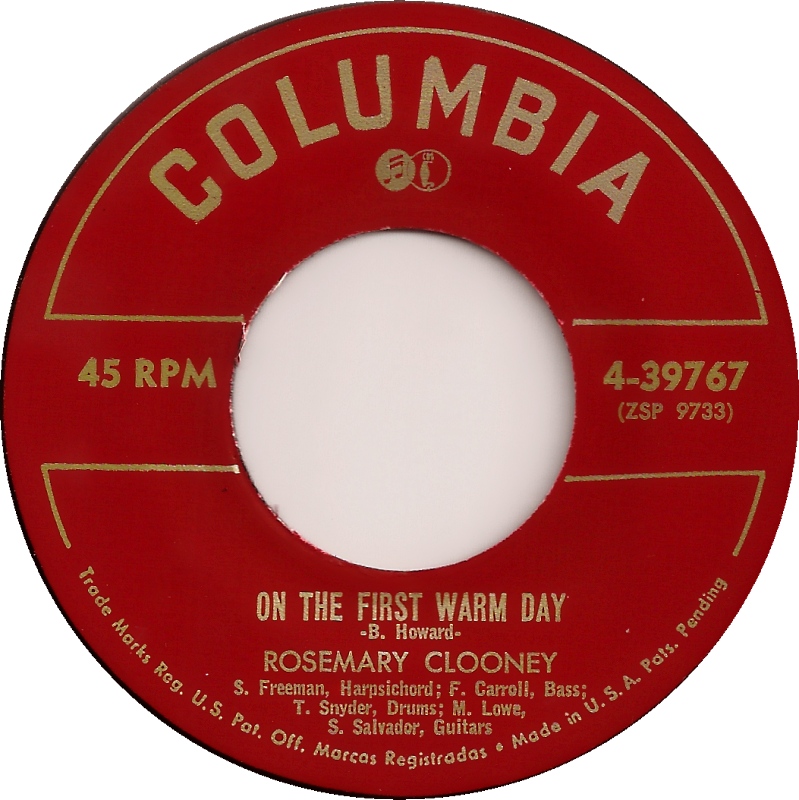
  • Commercial-isms: JCPenney vs. Rosemary Clooney “On the First Warm Day”

    Also released in that brand new format, the ''45''
    It’s ten years ago this summer that jazz and pop singer Rosemary Clooney, (George’s dear aunt, and this dude‘s mom) died of lung cancer at the age of 74. But a new JCPenney ad is making sure she’s not forgotten.

    And like the retailer’s April ad featuring a little-known song by 60s teen pop star Lesley Gore (“Sunshine, Lollipops, and Rainbows”), they’ve dug deep and come up with a lovely find – the perfect soundtrack for a morning spent potting pansies and pulling up those pesky thistles in the garden before the guy comes to deliver your five cubic feet of mulch. (I love the smell of cypress mulch in the morning.)

    Aww yeah: JCPenney’s new commercial features a 60-year-old b-side! The song’s called “On the First Warm Day”, and it first appeared as the flip side to Clooney’s 1952 78 rpm single for Columbia Records, “Botch-A-Me (Ba-Ba-Bacciami Piccina)” which charted all the way to #2 in its day.

    Rosemary Clooney “Botch-a-Me (Ba-Ba-Bacciami Piccina)” (1952)

    But even that huge hit is largely forgotten, having been overshadowed by another “ethnic” Italian novelty she recorded: “Mambo Italiano,” which has become to mob movies what Gloria Gaynor’s “I Will Survive” is to gay movies. I love that JCPenney is running with these lost oldies (what will they think of for June?). I’m a fan of Rosemary Clooney. One of my more recent CD acquisitions is a reissue of her 1956 album with Duke Ellington Blue Rose (featuring this swoony take on “Mood Indigo”). But I’d never heard “On the First Warm Day” until the JCPenney commercial.

    Rosemary Clooney “Mambo Italiano” (1954)

    Because I first associated Rosemary Clooney (born on May 23rd, in Maysville, Kentucky) with the goofier songs that she’s better known for (“Come On-a My House”, “Mambo Italiano”), I really became a fan of her more melancholy performances. One of my favorite Clooney songs is her gender-reversed take on the song “Hey There”, from the Adler & Ross musical The Pajama Game. The song itself was really inventive – a man having a heart-to-head chat with himself about the crush he’s got on that woman he knows from work (you know, the one who hates his guts). In the musical, he sings the verse into a dictaphone, then plays it back to himself, singing back to it in reply. In this performance, some background singers understudy for that dictaphone, but in the recording (which hit topped the pop charts for 6 weeks in the fall of ’54), she duets with herself.

    Rosemary Clooney “Hey There” (1954)

    I still love her sad songs best (and I still disdain the goofy ones), but I love the sense of joy she brings to “On the First Warm Day”. It doesn’t preclude the possibility of future sadness, but in its moment, it’s bright and hopeful: “we’ll teach those birds and bees a thing or twooooooo….” The song may not make me want to head right out to JCPenney, but it does make me want to browse their record collection.
  • Commercial-isms:  JCPenney vs. Lesley Gore “Sunshine, Lollipops and Rainbows”

    Commercial-isms: JCPenney vs. Lesley Gore “Sunshine, Lollipops and Rainbows”

    Sunshine, Lollipops, Rainbows, and a Simplified Pricing Scheme

    Attention all professional (and do-it-yourself) outraged social conservatives! JCPenney is now officially f*cking with you.

    We all remember your impassioned pleas to the big-box retailer to drop their tacit endorsement of the homosexual agenda, embodied by their hiring of arch-lesbian Ellen DeGeneres to appear in a series of ads touting the chain’s revolutionary (giggle) new pricing scheme. Not only did they refuse to back down and give the job to someone more appropriate – like Elizabeth Hasslebeck – but recently, they’ve taken your hero Sarah Palin’s advice (Don’t Retreat: Re-Load!) and opened a new line of attack on family values. A stealth attack, even! Like the big bad wolf dressed up as sweet old grandma, JCPenney’s latest endorsement of the morally bankrupt gay lifestyle is dressed up as sunshine, lollipops, and rainbows.

    Or rather: “Sunshine, Lollipops and Rainbows,” the 1965 Top 20 hit single by Lesley Gore (from the movie Ski Party, starring Frankie Avalon!).

    Lesley Gore “Sunshine, Lollipops and Rainbows” (1965)

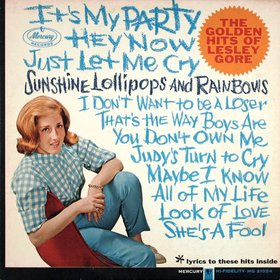
    Lesley Gore is most famous for a pair of singles (produced by a very young Quincy Jones), “It’s My Party” and its sequel “Judy’s Turn to Cry.” The two songs chronicle a love triangle between Lesley, her boyfriend Johnny (who seems like a total nob), and her duplicitous best friend Judy who shows up to Lesley’s birthday party wearing Johnny’s ring (it’s all good – Johnny goes back to Lesley!). Over the course of eight albums released by Mercury between 1963 and 1967, this Jersey girl covered an encyclopedic range of squeaky clean (and, it goes without saying, totally heterosexual), romantic teenage drama, each two-minute song a self-contained soap opera.

    In “Hey Now”, she tells off an indecisive beau (it’s like a 20-year-pre-emptive reply to The Clash’s “Should I Stay or Should I Go” with an even more contagious groove). In “She’s a Fool”, she calls out another girl for mistreating her boyfriend (upon whom Lesley is crushing). In “Maybe I Know,” she admits she’s in denial about her cheating boyfriend (“deep down inside, he loves me!”), but won’t DTMFA. And in the darkly fabulous “You Don’t Own Me”, she asserts some pre-feminist girl power: “Don’t tell me what to do, and don’t tell me what to say, and please when I go out with you, don’t put me on display.” (In 1987, the song was covered by the British synth-soul group The Blow Monkeys for the Dirty Dancing soundtrack – that was where I first heard it – and I remember my sister and I being scandalized/titillated by the way lead singer Dr. Robert sang it without changing the gender of the verse: “Don’t say I can’t go with other boys.”) Here she is, having just turned 19 years old:

    Lesley Gore “It’s My Party”(1965)

    “But, Paul,” the conscientious social conservative might ask, “these are sweet, wholesome, totally heterosexual songs sung by a sweet-faced pre-sexual revolution teenage girl.” But are they? Are? They? The fact is – correction: the superfabulous fact is… that Lesley Gore is gay. She hasn’t had a hit single since 1967 and for the last 40 years she’s mostly been retired from recording. (She has occasionally released new music – her most recent album was 2005’s Ever Since, a collection of torchy jazz interpretations, including a great new version of “You Don’t Own Me”) But in 2004, she started hosting the PBS LGBT newsmagazine In the Life, and came out publicly soon thereafter. That’s right, OneMillionMoms.com! JCPenney now have two lesbians shilling for their newly simplified pricing schemes!

    Of course, like Ellen DeGeneres, Lesley Gore is one of those people it’s extremely hard to dislike, much less hate. When I was 11 or 12, and receiving my allowance in 45 rpm records (I would give my Mom a list), my mother snuck in a reissue “oldies” single of “It’s My Party” b/w “She’s a Fool” in between the latest hits of Duran Duran and Culture Club, and I became an instant Lesley Gore fan. And that was long before I’d ever heard “Sometimes I Wish I Were a Boy“! And really, how do you protest against sunshine, lollipops, and rainbows?

  • Commercial-isms:  T-Mobile vs. Laurie Anderson “O Superman”

    Commercial-isms: T-Mobile vs. Laurie Anderson “O Superman”

    HTC O… M Effing G
    I took it as further evidence of my exceptional parenting when my 17-year-old son perked up at the sound of Laurie Anderson’s “O Superman” coming across from the TV and pronounced “Awesome song!” In my head, I was congratulating myself: My son knows Laurie Anderson’s music! I am a good dad! I am a good dad! But this moment of parental pride was sullied when I realized that familiar “hah hah hah hah hah hah” (I always thought it sounded like a robot breathing) was being played in the background of a commercial. For T-Mobile’s new HTC One phone.

    Really?

    Now I’m not so naive to actually believe that, at least when it comes to pop culture, some things might actually be sacred. But seriously: what’s “O Superman” doing in a cell phone commercial? Suddenly the tired arguments about artists “selling out” with their licensing choices feel freshly relevant. Not that I think Laurie Anderson has sold out, nor do I begrudge her whatever money she might be making from a 30-year-old song that might only be regarded as a “hit” in the most artsy-NYC-hipster-ish sense. (It did top the Village Voice’s 1981 Pazz & Jop singles poll.) But there is something sad about such a monumental song reduced to… this.

    If you’ve never heard “O Superman”, you may be asking yourself just what the big deal is. And if you’re just hearing “O Superman” for the first time, you should know: it’s damn weird. But it’s also wonderful. As proud as I am that my son could identify it so readily, he was a tiny bit wrong in pronouncing “O Superman” an “awesome song”. It certainly is awesome, and I don’t mean “awesome” in the deeply trivializing 80s-vintage colloquialism sense, but rather in the Old Testament music to bring down the walls of Jericho sense. It is awesome. But to call it simply a song is also a little trivializing.

    For one thing, it’s just not very song-like. For another, it’s massive: eight-and-a-half minutes massive, sustained without benefit of a catchy chorus or an extended guitar jam or even a drum solo. The music is stark and electronic, the words poetic and prayerful, and delivered (through a vocoder) alternately as a monologue and a chant – ah-hah-hah-ah hah-hah-hah-ha-ah. It is by turns funny and sweet (“Hi Mom!”), and chillingly prophetic:

    Here come the planes
    They’re American planes
    Made in America
    Smoking
    or Non-smoking

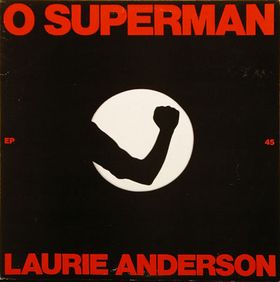
    There’s also a visual element that is integral to the song itself. In live performance, Laurie Anderson would play her synthesizer with one hand, and with the other, punctuate her lines with hand and arm gestures projected as shadows in a circle of light on a screen behind her.

    Laurie Anderson “O Superman” (1981)

    The song was first released as a NEA-funded limited edition 7″ single in 1981; the following year it became the centerpiece of Anderson’s major label debut record Big Science, which, itself, was conceived as part of an epic scale multi-media performance piece called United States, inspired largely by a four-year field trip Anderson took around the country, working various sorts of jobs as she went. “O Superman” is still regarded as Anderson’s masterpiece, and in the same way the “Hallelujah Chorus” (all 100 or so seconds of it) has become “bigger” than the larger work it was part of (Handel’s “Messiah” oratorio), “O Superman” has eclipsed United States in sheer concentrated power and historical resonance.

    The song was inspired by the aria O Souverain, O Juge, O Pere, from French composer Jules Massenet’s opera Le Cid, and alludes to its words. Laurie Anderson described the aria as a “prayer for a knight on the eve of a hopeless battle… a prayer about empire, loss, and ambition.”

    ‘Cause when love is gone, there’s always justice.
    And when justice is gone, there’s always force.
    And when force is gone, there’s always Mom.

    “O Superman” was also inspired by current events: specifically a tragically failed military mission during the Iran hostage crisis of 1979. But 9/11 and the government’s ongoing struggle to respond to it – both the military interventions in Iraq and Afghanistan, as well as the domestic policies passed in the name of security – have given the new song an even more powerful and unforeseen resonance. Here’s Laurie on performing the song to a New York audience a week after 9/11, from her notes to the 2007 reissue of Big Science:

    “During a top-secret mission to rescue hostages being held in Tehran, American helicopters crashed in a sandstorm and blew up. The mission’s failure was a blow to the United States’ reputation as a technological superpower and played a role in the downfall of the Carter Administration and the rise of Reaganism. Almost thirty years later we’re fighting the same war… I suddenly realized I was singing about the present.”

    So yeah, how about that skydiving fashion photographer? Here’s the song that opens the Big Science album:

    Laurie Anderson “From the Air” (1982)