web analytics

Blog

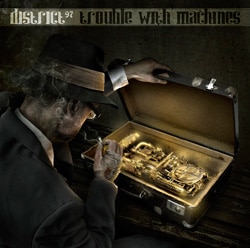
  • #13 album of 2012 – Trouble with Machines by District 97

    Artist: District 97

    Album: Trouble with Machines

    District 97 are a Chicago band of four varyingly dorky-looking male rock musicians, all quite skilled; a not-at-all-dorky-looking woman named Leslie Hunt who joined the band after being a top-10 finalist on American Idol; and a cellist, Katinka Kleijn, talented enough to do solos for the district_97_troubleChicago Symphony Orchestra. That lineup concept is why I tried them out in the first place. Say what you like about American Idol (in my case, “I’ve never watched it”), Kelly Clarkson made it clear early on that it’s a fine machine for the discovery of singing talent, stretchable beyond any musics that the show itself — from what I’m told — would demonstrate. For example! While I’ve ranked District 97’s Trouble with Machines slightly above Rush’s Clockwork Angels, what I’d emphasize is that they’re comparable. If you’re a fan of one, I think there’s a good 75% chance you could end up a fan of the other.
    On a broad level, both albums are full of ambitious, multi-segmented, quasi-metal songs that rock out. District 97 even attempted an album-long story on their excellent 2010 debut Hybrid Child, although this time they restrict that impulse to the individual 10-minute story-songs the Perfect Young Man and the Thief. Micro-level similarities include near-identical drumming styles (drummer Jonathan Schang is even District 97‘s primary composer); bass to some extent (Patrick Mulcahy often matches Geddy Lee’s more aggressive tones, though at other times he’ll essay a Metallica chug, spacious and staccato math-rock, or punk-pop simplicity, instead of Lee’s funk or melodic leads); and some tuneful heavy-metal guitar solos (Jim Tashijian’s being shinier and more ’80s rapid-fire than Alex Lifeson’s). Both albums also are full of angular vocal melodies, although where Lee’s tunes on Clockwork Angels often felt unfinished and wandering to me, Hunt’s on Trouble with Machines are clearly odd on purpose, making precision leaps over chasms. She’s got more than enough charisma to sell them, at least to me.

    Rob Clearfield’s keyboards have a flashiness, and a hookiness, that fits far better with the Rush (or Yes) of thirty years ago. So, too, do the frequent time-signature switches here. Back and Forth and the Perfect Young Man feel especially like hybrids of Rush old and new. The lean, slippery Who Cares? is its own beast: Tashijian’s limber, non-distorted guitar reminds me of his acoustic-based side band Treehouse, and Hunt’s singing is at points more yearning, more bitter, and more taunting than progressive rock in general is known for. Open Your Eyes, the single in 4/4 time, has a catchy Pat Benatar-like directness (although still a fairly unusual melody). The Actual Color — melodically and rhythmically the bizarrest song on Trouble with Machines — has nonetheless a dramatic and emotional heft that reminds me of Queen’s later records. Read Your Mind opens with a nifty, elegant minute-long demonstration of various tricks cellist Kleijn learned in conservatory; the song as a whole is at once the most Clockwork Angels-like track here, and the one most influenced, in its slower, more drawn-out moments, by chamber music and by the synth-jazz-pop early-80s works of Joe Jackson (Steppin’ Out) and Donald Fagen (New Frontier). Final track the Thief makes me admit I’m being silly not having brought up Dream Theater before. It’s song-like enough and often gentle enough to be on Images and Words, but with group-playing segments fiery and jaw-dropping enough for … how did Dream Theater let Rush beat them to the song title an Exercise in Self-Indulgence anyway? Don’t give me that “They weren’t born in time” excuse; temporal immobility is for losers. Anyway, there’s enough song on the Thief that the instrumental parts enhance it rather than upstage it.

    Like those other bands, District 97 try to sing about lives well or poorly led. Unlike those other bands, District 97 do so by centering on personal relationships: flirtations, cliques, seductions, breakups, encouragements, marriages, children, illnesses. In the broader context of pop music that’s conservative; in progressive rock, it’s almost radical. Right now the lyrics need work, I’d say: they sustain a narrative *or* scatter a few good lines, but not both. This album is high on my list for how great it sounds. There’s potential for something deeper next time. I’ll be listening.

    – Brian Block

    To see the rest of our favorites, visit our Favorite Albums of 2012 page!

     

  • American Idol Season 12: Cutting Down To 7

    Katharine McPheeWednesday night’s show was a little rough around the edges. They re-introduced the duets and group performances which can go away as far as I’m concerned. It’s a bit awkward to see them sing in groups again in such a cutthroat competition. We saw Burnell and Devin throw Lazaro under the bus as the reason for their terrible Four Tops cover. And even a halfway decent Madonna Like A Prayer cover by Janelle and Kree (Summer) was littered with Nicki comments about how badly Kree outperformed Janelle. They just need to do away with them. It’s a solo competition. This isn’t X-Factor.

    Will American spare Lazaro yet again? It’s at the point where you feel sorry for him. He has to know how out of his own league he is.

    Who rocked the stage?

    Colton the Muskrat performed and it sounded nice, but I can’t take him seriously with the shaved and spiky mullet. How can anyone?

    One Republic performed with Katharine McPhee as well. I got a lot of heat for ranking McPhee so highly on my top American Idol contests of all-time list. Some of that heat came from the guy who runs this very website. See if you can find him.

    Keith Urban performed and he has that Huey Lewis thing going on. When he speaks, he has a slight accent. But when he sings, I hear no slight accent.

    Who were in the bottom three?

    The three guys who screwed up the Four Tops – Devin, Burnell, and Lazaro. All the girls made it and all the guys are in the bottom three. That’s some American Idol justice right there (even I’m sure the voting didn’t necessarily play out that way – they just did it for the drama). I now fear for Devin and Burnell’s lives.

    Who went home?

    It wasn’t Lazaro. Devin Vasquez was the unlucky soul who had to pay the Lazaro tax. He performed a great version of Impossible and for a second, I thought they were going to save them, but they didn’t. I think they’re saving it for when one of the girls is unfairly placed in the bottom three.

    Is Lazaro the new Sanjaya?

    I think Nicki thinks he’s a newborn baby for some reason. (Thanks to YMCM Baby.)

    Nicki gif

  • A look at 1983… and the ways I find music I like

    Was 1983 really 30 years ago?

    I had a surreal experience this morning as I struggled to wake up with some strong coffee. I turned on the TV and switched the channel to nuvoTV, a channel devoted to modern Latino entertainment. I’m not Latino, but I’d rather watch re-runs of the old television show, Fame, than any of the morning news shows. This morning, the episode of Fame that aired was a concert they did highlighting the hits of 1983. Songs like “Billie Jean”, “Beat It”, “Sweet Dreams are Made of This”, “Total Eclipse of the Heart”, “Take Me To Heart”, and “Electric Avenue” were performed in rapid succession, giving viewers a look at 1983. It was like the soundtrack of my youth was being badly covered right before my very eyes. Suddenly, I felt horribly old. The throbbing pain in my hip this morning doesn’t help matters.

    The camera panned over the audience and I saw lots of adolescents in the crowd with feathered and winged hair. Up on the stage, actor Billy Hufsey wore a white Members Only jacket as he and actress Cynthia Gibb sang “We’ve Got Tonite”, a song originally made famous by Bob Seger in 1978 and turned into a duet by Kenny Rogers and Sheena Easton. He was soon joined by the late Gene Anthony Ray and Debbie Allen, who sang a duet of Lionel Richie’s “You Are”, while Carlo Imperato and Valerie Landsburg singing “Never Gonna Let You Go”, by Sergio Mendez. Then there was the show stopper! Irene Cara, who starred in the film version of Fame and was on my favorite children’s show, The Electric Company back in the day, came on stage in a sequined jump suit to sing the theme to Flashdance. It was followed by a totally overwrought cover rendition of “Up Where We Belong” originally sung by Joe Cocker and Jennifer Warnes. Of course, Irene Cara sang the last song, the theme song for both the movie and television show, Fame. It was a very glitzy, high speed show. It was very… 1983.


    Valerie Landsburg sings “Total Eclipse of the Heart” and “Love Is A Battlefield”…

    I mainly watch old episodes of Fame for fun. When I was young, I paid attention to the storylines and characters. I looked up to them. Thirty years later, I think the show is very cheesy. It’s still entertaining, but in a different way. Now I like to watch it because I enjoy snarking on it. Sometimes the show is so snarkworthy that I post clips on a friend’s Facebook page, knowing that she gets it! Then it occurs to me that in 1983, thirty years ago meant 1953, which back then seemed positively ancient. Even today, it seems like 1983 is not as different as 2013 was. Is that just because I’m so old?

    Where did all the years go? It seems like yesterday I was a ten year old kid who loved all the new music on the radio. Nowadays, I find out about new music on the Internet, mostly. Sometimes I hear it on television, too. I also find a lot of good music on YouTube, if you can believe that. In fact, last night I was watching an adorable pet video from YouTube and noticed that I liked the music in the background. Using Shazam, I found out the name of the song and the musicians who performed it, The Ipanemas, a Brazilian band that has been around for over forty years. I downloaded the album.


    This inspired me to buy music!

    Last night was not the first time I’ve found music in that way, either. A few months ago, I was watching a gymnastics montage someone made and I liked the background music. The video had a link to YouTube, so I downloaded the album. Later, I reviewed it on Epinions.com, realizing that the piece that had led me to download was pretty much the only music on the album that I really liked a lot.


    And this inspired me to buy music, too…

    It occurs to me that thirty years ago, finding music in this fashion would have been unthinkable. Back then, I found music on the radio and sometimes television. The music I heard was usually popular stuff, which explains why I enjoy so much cheesy music from the past. Today’s young people have a vast array of places to find good music. I can go to any number of sources to find music I like and my choices can be tailored. In 1983, no one was thinking about Internet radio sites like Spotify or Pandora.com.

    In a way, I think it’s kind of sad that traditional radio has sort of gone out of style. When I was in college, I was a disc jockey for the campus radio station. It was a lot of fun and a great way to be part of the community. Likewise, when I was growing up, listening to local radio stations was a great way to connect to the local community. I still remember a lot of the disc jockeys I used to listen to back in the day… and I listened not just because of the music, but because I liked the radio personalities, too. Today, I would be hard-pressed to tell you who any of the local disc jockeys are in my community. I don’t listen to the radio anymore, so I’ve lost that connection. In fact, the only time I listen to local radio is when there’s a weather emergency and the power is out.

    Maybe I should commit to listening to the radio again. I could take it a step further and pull out some blank cassettes so I can tape the music. On the other hand, even local disc jockeys have kind of gone the way of the dodo bird. Nowadays, everything is syndicated, just like on television. *Sigh*… this makes me wonder how we’ll be finding music in 2043.