My dad introduced me to boxing at a very young age. I used to hear story after story about how great Muhammad Ali was and how he was untouchable. My favorite at the time was Larry Holmes, who was always a poor man’s Ali, and had to live with that his entire career even if he was one of the top ten heavyweights of all time. But he wasn’t Ali. I wanted my own Ali, someone I could tell my kids about when I was older.
And for a very short time, Tyson was that for me. He didn’t have Ali’s gracefulness and gift of gab. But he had something else. He had rage and quickness and power. Power was important to me. Who didn’t want that kind of ferocity? He had more power than Ali in that small frame. He ended fights and left you without a doubt who the better man was that night. Judges need not show up when Mike Tyson fought. Power.
The first time I heard a Tupac Shakur song, I was in high school trying to figure out who I was supposed to be. Who did high school want me to be? How many different groups did I have to fit in with? On the basketball team, I had to fit in with a diverse crew. Actually, they weren’t all that diverse. To them, I was diverse. They were basketball players, athletes, buddies, homies, and fans of rap music. All I knew back then was MC Hammer and Bell Biv Devoe. And then I found A Tribe Called Quest and immediately fell in love with rap music.
Rap music was what people would call it in an undignified manner. I liked it when people called it hip hop. Made it more poetic. It was respectful. You couldn’t say “Rap is crap” when you called it hip hop. I knew Tupac Shakur from Brenda’s Got A Baby, but even then, that song wasn’t what I thought was powerful. It was a superb message, but I didn’t want message music. I wanted hip hop to make me hyped for basketball. I wanted songs that made me jump higher. I wanted songs that I could listen to in my head when I played so that it felt like I was dancing on the court rather than running. Ironically, today the message music touches me more.
When Mike Tyson first lost to Buster Douglas and was then jailed because of a rape charge, I struggled with the idea that I should still root for him. It was a moral issue. If Mike Tyson did rape Desiree Washington, how could I be a fan? If I was a fan, did that make me also someone who was okay with rape? It’s still a moral conundrum that I live with today. And how can you be powerful in jail?
Everyone was jumping off the Mike Tyson bandwagon. Didn’t they know that he just took Buster lightly? Didn’t they know he was still lost without his mentor Cus D’amato and that being married to Robin Givens was screwing with his head? I couldn’t jump off the bandwagon. It wasn’t what I was taught. Mike needed my support. He was still the baddest, and plus, I was taught to stick with my teams and my boxers, no matter what.
The first time I bought a Tupac Shakur album was through BMG’s music service. Remember the BMG music catalog? It was also a way in which I could hide what the album actually was. I didn’t think my mom would be cool with her 17-year old son buying an album called Strictly 4 My N.I.G.G.A.Z. So I slipped it underneath her nose by getting it in the mail.
Soon thereafter, I’d have to live with the same conundrum with Pac that I did with Tyson. How could I stand for someone who was in jail because of a rape charge? My favorite boxer and favorite rapper were both in jail because of unfathomable charges. I’m still uncomfortable with that today. But It was worse when I was 19. Way worse.
They both got out of jail in 1995. Out on bail, fresh outta jail, California dreamin’. I was a freshman in college. Suge Knight bailed Pac out and immediately put him to work. For Tyson, it was Don King who promised to help put his life back together. Pac came out of the clink and had a hit record out on the radio in months. Tyson was knocking out dudes in less than a year. Damn, that was power.
I was at a friend’s house when Mike Tyson knocked out Frank Bruno in his just third fight out of jail. A little dude approached him as he was going back to the locker room. Then, they embraced. I was the only one out of everyone there who knew that was Tupac. It was a meeting of two guys I was secretly rooting for harder than most. And they were friends. It was like just one year prior when Will Smith and Martin Lawrence starred in Bad Boys. Two of my favorites working together to prove to people what I already knew. They were the best and I helped spread that message to the rest of the world.
Tyson’s next fight was the fight with Bruce Seldon on that dreaded day. Tupac and Suge Knight were in the building to support their boy. Or at least Tupac’s boy. People today will say that there was something in the air that night in Las Vegas. A Mike Tyson fight in Las Vegas must’ve made that city erupt in testosterone. I remember watching Tyson destroy Bruce Seldon’s will and thinking that he had that fight won at the stare down. No one took Seldon seriously anyway. But still, Tyson knocked the guy down with an over right hand that didn’t even fully connect and it was just seconds later that it was over. I had no idea what was about to come next.
I remember waking up the next morning and hearing my dad say that Tupac was shot. I didn’t really show any remorse at the moment because I didn’t want him to know how much it bothered me. But I did secretly turn on the radio to hear what the FM DJs were saying about him. I remember thinking that he was going to be okay because he was way too powerful to let some busters kill him. Just like Tyson was too powerful to let his career slip away after a Buster (Douglas) beat him. I also remember thinking that Biggie Smalls had something to do it because of the East Coast/West Coast feud. It wasn’t too long before that Pac released Hit ‘Em Up, which targeted Biggie and the Bad Boy crew.
Exactly a week later, Pac was gone. It was an odd time because he was gone, yet his music was still on the radio. In fact, when he died, radio DJs were playing his music more than ever. His music was littered across the radio stations. The day he died on September 13, 1996, I remember hearing his first single off his next album, Toss It Up. It was really hard to fathom. His videos were on TV, his songs were all over the radio, and yet, he was gone.
I’m not sure it’s simply just a coincidence that Tyson would go on to lose to Evander Holyfield twice in his next two fights. The first fight with Holyfield was the same week that Pac’s The Don Killuminati: The 7 Day Theory was released. I’m not saying that he was depressed over Pac’s death. His own life was in shambles. But their career arcs were so similar that it’s almost as if it was supposed to be this way. Thankfully for Tyson, he seems to have turned his life around, but at the time, you expected him to go out like Pac did; in a blaze.
It was either the one year anniversary of Tupac’s death, or his next birthday that I bought some alcohol to simply pour out for Tupac. I hadn’t ever bought alcohol before and I had to ask my girlfriend what the heck I should buy to pour out in his honor. I don’t think alcohol had even touched my lips at that point. Around the same time, I would ride around in my convertible mustang with Pac’s music blasting out while I mean-mugging and mouthing his lyrics which I memorized. I didn’t ever do that while listening to any other music. I guess it just made me feel powerful.
I still followed Mike, even when he told Lennox Lewis that he was going to eat his children. And Mike wasn’t powerful anymore. After he lost to Lewis, he started losing to guys he would’ve beaten before the bell, much like he beat Seldon. I should’ve poured out some liquor for Tyson’s career.
Today, I still wonder why I feel so connected to the two icons. I’m not a violent person. I don’t feel the need to tell anyone off. Yet, whenever I need to disconnect and just zone out the rest of my world, I’ll throw on some Tupac and mean-mug again. Two or three times a year, I’ll go back to the time when I was 20 and my worries were about school, girlfriends, and what to do on the weekend. My first born wouldn’t even come until three years later. I wouldn’t be married until five years later. I wouldn’t be who I am today until fourteen years later. Picture me rollin’.
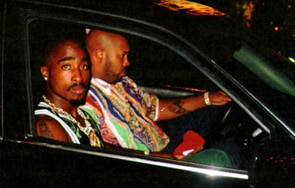
Iconic photo of Tupac and Suge Knight just minutes before Tupac was shot is shared by Wikipedia