Artist: Pepe Deluxe
Album: Queen of the Wave
Queen of the Wave, the fourth album (but first for me) by the Finnish band Pepe Deluxe, is an unlikely combination of two things. It’s a slick modern album of disco-informed dance-pop. It’s also a ludicrously ambitious and overstuffed progressive-rock story album. It’s assembled from dozens of 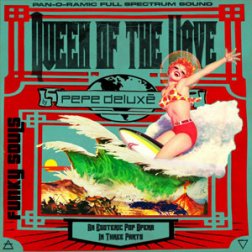 instruments: some as old as harp, harmonium, harpsichord, and clavinet; some random and exotic; some as retro-modern as an attempt to collect every form of organ (keyboard, not bodily part) from mini-Moog to Hammond to Farfisa to pipe organ to Mellotron to an organ carved from giant stalactites. There’s also more than a dozen vocalists here playing different parts, each of them charismatic. I love Queen of the Wave most for being a brilliant success as dance-pop. Its success is simply informed and enhanced by the overreach.
I’ll detail the first five songs to illustrate. Queenswave opens with folky acoustic guitar, synth-drones, a wide variety of birdcalls, and solemn vocals, adding Jethro-Tull-styled flute (played with tongue) and maracas, then drums and metallophone and a second vocalist and a steadily more insistent beat. Then comes harp, joined by buzzy electric guitar that then essays a classic funk-rock solo, circling back in the end to Tull-as-dance-band territory. A Night and Day gets compared to old James Bond theme songs, with funky shuffling drums and bass, lean retro guitar production, whooshing and sirening background noises, and soulful but commanding female vocals. It also has a spectacular a-capella breakdown and a fast-paced strafing keyboard melody, both of which keep the dance rhythm firm. Go Supersonic is similar, adding to the soul singer the second and third obviously-different female vocalists (one cooing, one domineering and operatic). There’s a cheerleading insistence to its choruses, impatiently tugging along its gentler verses and bridge. Temple of the Unfed Fire is a variant on the disco idea that anyone can like classical church music if you put it over a good enough dance beat, though as with most tracks here, the drumming is by humans, and very good indeed. Contain Thyself is folky in singing and instrumentation (here’s that harpsichord! here’s a subtle nod towards Irish reel! here’s more tongue-flute! here’s vocal counterpoint equally worthy of Bach or ’60s girl-group pop!), yet easily absorbs a massive drum-and-organ break.
The second half is just as good. The ultra-danceable Grave Prophecy and the Storm arguably travel farther afield than anything I’ve written about, My Flaming Thirst is calmer and more elegant while still eccentric, and the solemn Riders of the First Ark may be the catchiest track here. I mentioned there’s an over-arching story … well, uh, it’s about heroes and villains at the end of the lost continent of Atlantis, and “Let me tell you of a tale that’s true” is the first invitation the album gives you. The drowning of the last unicorns is here too. This took, for me, some getting used to.
Atlantis was, of course, imaginary — conjured from nothing as a hypothetical in a Socrates dialogue — and one of my early influences on How To Think was a man named Martin Gardner, best known for creating advanced-math puzzles at Scientific American but also fond of making logic-puzzle books for kids. Gardner was pro-whimsy — in his puzzles, in his adoration (passed on to me) of Alice in Wonderland — but he was a fierce, hyper-earnest opponent of pseudoscience: tales of Roswell aliens and psychic powers and healing crystals that people actually believe. Atlantis, apparently, is something millions of people take seriously; Pepe Deluxe might, for all I know, be among them. From childhood I’ve been conditioned to find Queen of the Wave‘s lyrics painful.
 In practice, they’re not great, but I’m admitting their Atlantis tale has some resonance. Advanced human civilization drowned at the peak of its glory, taking beloved species with it; is there no familiar ring to that? Human civilization emerged in the Iraqi/ Israeli “Fertile Crescent”: we over-farmed it and turned it into desert. Greek and Latin civilization emerged in lush, fertile areas that became steadily less so. Easter Island civilization was advanced enough to destroy every tree, and itself, in the process of building impressive statues. Unicorns strike me as a mushroom-fueled vision of rhinoceri, but woolly mammoths and saber-tooth tigers and giant herds of buffalo were real, and huntable, until they were gone.
Global-warming denialists sometimes lead with pure falsehood — claims that “global warming stopped in 1998” (no, the last sixteen years are the sixteen hottest on record, give or take a year or two depending how you measure), or that there have been hotter periods since the rise of cities (based on, to pick a literal example that’s been passed around on right-wing sites, measurements at a single point 500 feet under the ice in Greenland). But some of the things they say are, narrowly, true. Human pre-history had slightly warmer periods than today: true (although check again in 2030). Earth life in general had *much* warmer periods than today: also true. Warmer temperatures, in the abstract, are good for plant growth: sure, which is why, when Svante Arrhenius brilliantly discovered the process of man-made global warming way back in 1896, he wanted people to speed it along on purpose.
All of which misses the point. The rate of change we’re putting our climate through is much faster than even the starts and ends of the ice ages, and our civilization, animals, and plants aren’t adapted for rapid warming. A couple degrees Fahrenheit increase doesn’t sound like much, and for most purposes it isn’t, but it’s been enough to multiply the number of extreme-high temperature days that can decimate a season’s crops. It’s been enough, since warmer air holds more water vapor, to create heavier storms and longer droughts. It’s been enough to trick the life cycles of plants, so they start growing six weeks early and get felled by snap freezes. It’s been enough to start drying out our rain-forest trees, making them vulnerable to massive fires that level everything for miles, because even though evolution *can* make trees for hotter jungles, it *hasn’t had time to*.
Then, of course, there’s been the melting and cracking of the polar ice sheets: a process we don’t fully understand yet, which has kept occurring faster than the scientists’ models. Melted ice becomes ocean water. More ocean water leads to higher sea levels. Higher sea levels lead to floods. More than half of the biggest cities in the world live close enough to the coast to be at risk. When the floods come, will Queen of the Wave be a smart enough album to serve as our eulogy? Not by itself, no. But it’ll be on topic, unlike our political discourse (although at least Finland is part of Europe’s moderately useful cap-and-trade carbon policy). And it will be much, much, much more fun accompaniment for swimming across the dance floor.
– Brian Block
To see the rest of our favorites, visit our Favorite Albums of 2012 page!