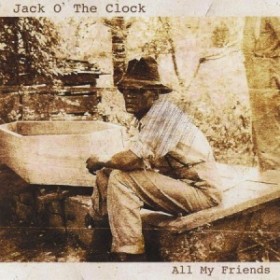
Artist: Jack o’ the Clock
Album: All My Friends
Two years ago, I chose Jack o’ the Clock‘s How are We Doing, and Who Will Tell Us? as my #1 album of 2011. In retrospect I’d put it at #2 — behind They Might Be Giants’s Join Us — but it’s an extraordinary record, blending pretty  folk/Americana and nicely-sung storytelling with avant-garde influences and surrealism, so I’ll tell you about five of its highlights before I continue.
Back to the Swamp is a bluegrass/ jugband number with pretty male/female harmonies, rousing banjo and fiddle; it also sings a series of journeys punctuated by short debates about time, work, religion, and the purpose of human existence. (Not to mention manners: “She said ‘I have been watching, and by now you ought to know/ your shadow’s going to walk with you wherever you go./ Eventually you’ll stop a while and talk to it./ And it tells you it’s a window and without it you’d be blind/ though the only scenes it shows you are the streets you left behind./ Do you take it at its word, or throw a rock through it?’/ I said ‘I still don’t know, do you know?/ Don’t ask me rhetorical questions if you don’t know, it’s mean-spirited”.) Last of the Blue Bloods is folky and languid and thoroughly pleasant, building through lovely piano, bassoon, and violin solos — even if the percussion is clattering, variable, and odd, and the narrator, an old man haunting his old university workplace, is combative and distracted by flickering memories. Schlitzie, Last of the Aztecs, Lodges an Objection in the Order of Things puts Jordan Glenn’s junkyard percussion upfront and distorts Damon Waitkus’s gentle verse singing through faulty old equipment, arranges flutes and bassoons with Flight of the Bumblebee busyness, and bombards everything with odd noises; but it’s a song of empathy and encouragement to a circus freak, and resolves into a folky chorus. Novaya Zemyla is a lovely, weird, increasingly spooky soundscape over which the narrator speaks, in a chatty, amusing, matter-of-fact voice, a narration of a flatly impossible journey. Shrinking, on the other hand, is a gorgeous song almost imaginable as a hit, no more out of left field than the Dave Matthews Band’s Crash into You was: close harmonies, acoustic guitar, violin, tuned percussion, framing its sung observations as a fond, anxious song to a lover.
The songs on How are We Doing, and Who Will Tell Us? all fit together, but the mix of influences (from folk to bluegrass to chamber music to Harry Partsch’s home-made microtonal instruments) kept shifting proportions to make a remarkable range of songs. Jack o’ the Clock‘s 2013 All My Friends uses similar ingredients to make an album that seems to me quieter, cooler, less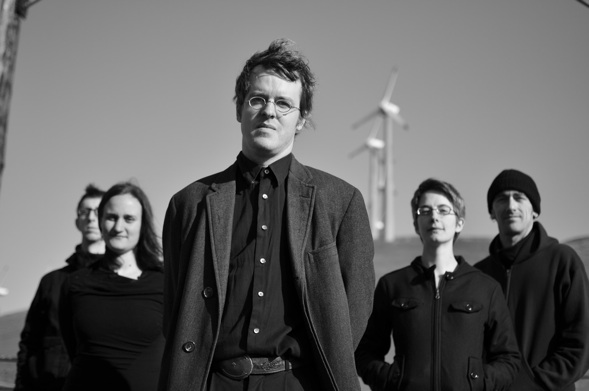 welcoming. 8-minute first track All My Friends are Dead is a good example. It begins slow and quiet, with old recording equipment and the sort of skittering, weird-melody chimes and imperfectly-tuned high piano that indicate “spooky dream sequence” in movies. Kate McLoughlin starts to play a nice, perky bassoon melody, but it’s driven out by echoes of thunder, droning wind, and public address voices echoing in canyons. It fits the accompanying lyrics, certainly (“All my friends are dead. What can you say to that, my friend? Cancer dropped a blockbuster: the formula works. The car crash was a sleeper hit”), but rejects standard notions of how to make a first impression. Not until the 3:28 mark is the revived bassoon melody joined by a band and a beat.
From that point All My Friends are Dead is a jaunty song that I like very much indeed, but it’s still carved evasively into segments — led by bassoon here, guitar there, busy drums for awhile, then a complex cascade of woodwinds; now in waltz time, now in 5/4 — and ends without warning. A short instrumental is played on old precursors of the guitar, while orders we can’t understand are muttered into distant megaphones. Only then, nine-and-a-half minutes into the album, does a loud fanfare of xylophones introduce a forcefully catchy song, a Lot of People are Dead Wrong Most of the Time, hooky with bassoon and violin. “Whip me, teacher, you should know that’s all I ever needed from you. Don’t impress me with your signet, don’t give me any books to leaf through. I only want your love, I will even take it lying down”. The melody is like an especially ambitious Sesame Street tune, not at all like Van Halen, but there’s a plenty spectacular solo — distorted electric violin, maybe? Still, it leads into a spacious, buzzy homemade-percussion song in 11/8 time (the Pilot), then into a drifting Eno-esque instrumental; Jack o’ the Clock are not about rousing you with anthems.
I’m happy to guide you to the most accessible tracks, if you prefer. Besides the aforementioned a Lot of People…, there’s the sparkling, delicate folk song Half Searching, Half There, with impressively agile acoustic guitar and gently surging choruses; if you like Half Searching you should check out Disaster . There’s also the rousing instrumental Saturday Afternoon at the Median, with electric guitar, fast thumping drums, and interlocking bassoon lines that should resolve any doubts you might have that the bassoon is a great rock’n’roll instrument. What to Do in Our Neighborhood 1 is catchy and perky.
Buying the MP3’s of a few songs like that would be a decision to enjoy Jack o’ the Clock‘s tunes, and the purity of Damon Waitkus’s gently gliding, keening, articulate voice, and lyrics like “Won’t you take me upstairs to your room when you’re starting your day/ to the place where you find all the words that you say/ to your pantry of pills that keep the demons away?” Or “I am not afraid of you; are you afraid of me?/ Don’t go! Step into my house. We’ll fry a little fish, we’ll brew a little tea./ We’ll walk around the town, we’ll go down to the river, we’ll stare across the river/ animal to animal, like we were kind of dumb. And we *are* kind of dumb”. All My Friends has a friendly side: philosophical and peculiar in its intimacies, but friendly. It’s entirely fair to enjoy that side only.
If you get curious, after all, to hear the rest of the album — the echoing drums and tuned percussion solos and detuned pianos and retreats into soft noise — it should still be there. The old, weird America never went away with the coming of 24-hour celebrity news channels and information superhighways; if anything, it’s still there and has cell phone cameras now to document itself. Jack o’ the Clock are an idiosyncratic folk band. At our best, we’re an idiosyncratic country; who better, then, to document us?
– Brian Block
To see the rest of our favorites, visit our Favorite Albums of 2013 page!
[AMAZONPRODUCTS asin=”B00BQBPRWI”]