Artist: MGMT
Album: MGMT (Self-Titled)
In 2008, MGMT debuted as an arty pop band produced by go-to psychedeli-pop producer Dave Fridmann. They scored three hit singles (Time to Pretend, Kids, Electric Feel), and while I wasn’t taken with them in general, I voted Time to Pretend as my favorite 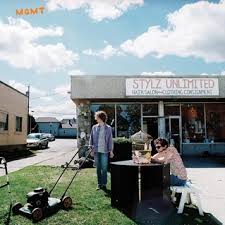 single of 2008. Huge-sounding and pretty and minor-key, it plans out a life, starting from “I’m feeling rough, I’m feeling raw, I’m in the prime of my life/ Let’s make some music, make some money, find some models for wives/ I’ll move to Paris, shoot some heroin and fuck with the stars/ You’ll man the island and the cocaine and the elegant stars”, then proceeding to nostalgia-for-their-naive-youth, dumping their model wives for younger women, and choking to death on their own vomit. The excellent critic Tris McCall dismissed it as cheap sarcasm, and my ballot in his poll argued with him: “The music and the second verse are squarely aimed at poignance, first-person with a first-person sense of loss. Beyond that, the album reminds me of the Modern English album with I Melt With You, not in style but in spirit: an arty album by a band that seems desperately afraid of writing too many hits. Time to Pretend comes across to me as much more honest than the band would care to admit; and since fame _is_ attractive and _is_ scary, I find it moving.”
Which is still how the song sounds to me. But I under-estimated the sincere viciousness of the mockery of their own dreams, and the commitment behind it; I didn’t know that MGMT had broken up before that debut album (Oracular Spectacular) was even made, fully intending to resume life as Wesleyan University students and then as adults. In a story that sounds more 1970s than 2000s, they were chased down by record company execs who’d heard their demos, and begged (and paid) to re-form. When their debut was a hit, they stayed together, but released a second album, Congratulations, that sounded to me like a complete mess. All I heard in it were nebulous “psychedelic” arrangement ideas — song-length but not song-form, neither pretty nor ugly nor energetic — jumbled together under no evident principle beyond “Ha! Let’s see the frat-rats put up with *this*!”
Which, judging by an excellent 2013 Pitchfork.com feature article by Larry Fitzmaurice, was of course partly unfair — he shows a studio run by a duo of geeks working separately to come up with sounds they think are really interesting — but partly dead-on, as Andrew VanWyngarden and Ben Goldwasser talk contemptuously of “pop songs” and popularity. What makes MGMT work for me where Congratulations failed is that this time, they can’t help writing pop songs anyway — no matter what they do to them.
Alien Days stretches VanWyndgarden’s mild tenor voice an out-of-character octave and a half in a strong, George Harrison-style tune. The massive yet pretty psych-pop landscape of reverberated and warped cymbals/ kick-drums/ organs/ theremin is built to from a recognizable structure of strummy folk-pop, and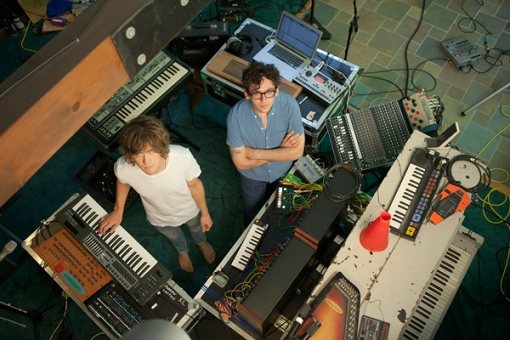 the chord sequence uses chords built on all 12 tonic notes from A to G-sharp. Cool Song No. 2 is sing-song and jaunty with a firm heartbeat, even as the sounds are again stretched and gated and distorted, every piano note or whistle or syllable flying off in several directions at once — and it keeps lurching into brief unnerving melodies before slipping back into its summery stride. Mystery Disease is Georgio Moroder-style European disco plus real cathedral-born drums, dark and mysterious and built for dancing.
Introspection makes a catchy melody from half an octave, and moves from Smiths-style jangle-pop into wobbling synthesizers, tea-kettle-style pennywhistles, and an echoing march beat. Your Life is a Lie, swift and percussive and major-key, is a brutally jolly children’s tune — “Count your friends/ on your hands/ Now look again/ They’re not your friends/ Hold your breath/ Everyone left/ No surprise” — like a catechism taught in school by a Stephen King monster. Plenty of Girls in the Sea is perkier still, Paul McCartney with his most manic grin, tossed from one deformed hand to another by screeching kazoo-beasts and fiddle-creatures, and shambling 1960s robots covered with spinning knobs. Even the sedate, whooshing outro song an Orphan of Fortune has a cinematic moodiness that’s hummable.
This doesn’t mean MGMT‘s delusion that they hate pop music is a problem, or an irrelevancy. Instead, it’s MGMT‘s strength. Oracular Spectacular, precisely because it wasn’t conceived as a fuck-you to any wrong person who might dare to like them, was a fairly lightweight album (Time to Pretend aside): no stronger than the tunes VanWyngarden could sing, and he kind of mumbling at that. The songs on MGMT are crammed with interesting distractions. *And* the melodies (and the singer’s projection) have improved. Maybe those tunes are, to quote Cool Song No. 2, “something to soften the sadistic urge”. Fine: they’re also what make the urges worth listening to.
– Brian Block
To see the rest of our favorites, visit our Favorite Albums of 2013 page!
[AMAZONPRODUCTS asin=”B00F4FGC0S”]