Wednesday night’s show was a little rough around the edges. They re-introduced the duets and group performances which can go away as far as I’m concerned. It’s a bit awkward to see them sing in groups again in such a cutthroat competition. We saw Burnell and Devin throw Lazaro under the bus as the reason for their terrible Four Tops cover. And even a halfway decent Madonna Like A Prayer cover by Janelle and Kree (Summer) was littered with Nicki comments about how badly Kree outperformed Janelle. They just need to do away with them. It’s a solo competition. This isn’t X-Factor.
Colton the Muskrat performed and it sounded nice, but I can’t take him seriously with the shaved and spiky mullet. How can anyone?
One Republic performed with Katharine McPhee as well. I got a lot of heat for ranking McPhee so highly on my top American Idol contests of all-time list. Some of that heat came from the guy who runs this very website. See if you can find him.
Keith Urban performed and he has that Huey Lewis thing going on. When he speaks, he has a slight accent. But when he sings, I hear no slight accent.
Who were in the bottom three?
The three guys who screwed up the Four Tops – Devin, Burnell, and Lazaro. All the girls made it and all the guys are in the bottom three. That’s some American Idol justice right there (even I’m sure the voting didn’t necessarily play out that way – they just did it for the drama). I now fear for Devin and Burnell’s lives.
Who went home?
It wasn’t Lazaro. Devin Vasquez was the unlucky soul who had to pay the Lazaro tax. He performed a great version of Impossible and for a second, I thought they were going to save them, but they didn’t. I think they’re saving it for when one of the girls is unfairly placed in the bottom three.
Is Lazaro the new Sanjaya?
I think Nicki thinks he’s a newborn baby for some reason. (Thanks to YMCM Baby.)
I had a surreal experience this morning as I struggled to wake up with some strong coffee. I turned on the TV and switched the channel to nuvoTV, a channel devoted to modern Latino entertainment. I’m not Latino, but I’d rather watch re-runs of the old television show, Fame, than any of the morning news shows. This morning, the episode of Fame that aired was a concert they did highlighting the hits of 1983. Songs like “Billie Jean”, “Beat It”, “Sweet Dreams are Made of This”, “Total Eclipse of the Heart”, “Take Me To Heart”, and “Electric Avenue” were performed in rapid succession, giving viewers a look at 1983. It was like the soundtrack of my youth was being badly covered right before my very eyes. Suddenly, I felt horribly old. The throbbing pain in my hip this morning doesn’t help matters.
The camera panned over the audience and I saw lots of adolescents in the crowd with feathered and winged hair. Up on the stage, actor Billy Hufsey wore a white Members Only jacket as he and actress Cynthia Gibb sang “We’ve Got Tonite”, a song originally made famous by Bob Seger in 1978 and turned into a duet by Kenny Rogers and Sheena Easton. He was soon joined by the late Gene Anthony Ray and Debbie Allen, who sang a duet of Lionel Richie’s “You Are”, while Carlo Imperato and Valerie Landsburg singing “Never Gonna Let You Go”, by Sergio Mendez. Then there was the show stopper! Irene Cara, who starred in the film version of Fame and was on my favorite children’s show, The Electric Company back in the day, came on stage in a sequined jump suit to sing the theme to Flashdance. It was followed by a totally overwrought cover rendition of “Up Where We Belong” originally sung by Joe Cocker and Jennifer Warnes. Of course, Irene Cara sang the last song, the theme song for both the movie and television show, Fame. It was a very glitzy, high speed show. It was very… 1983.
Valerie Landsburg sings “Total Eclipse of the Heart” and “Love Is A Battlefield”…
I mainly watch old episodes of Fame for fun. When I was young, I paid attention to the storylines and characters. I looked up to them. Thirty years later, I think the show is very cheesy. It’s still entertaining, but in a different way. Now I like to watch it because I enjoy snarking on it. Sometimes the show is so snarkworthy that I post clips on a friend’s Facebook page, knowing that she gets it! Then it occurs to me that in 1983, thirty years ago meant 1953, which back then seemed positively ancient. Even today, it seems like 1983 is not as different as 2013 was. Is that just because I’m so old?
Where did all the years go? It seems like yesterday I was a ten year old kid who loved all the new music on the radio. Nowadays, I find out about new music on the Internet, mostly. Sometimes I hear it on television, too. I also find a lot of good music on YouTube, if you can believe that. In fact, last night I was watching an adorable pet video from YouTube and noticed that I liked the music in the background. Using Shazam, I found out the name of the song and the musicians who performed it, The Ipanemas, a Brazilian band that has been around for over forty years. I downloaded the album.
This inspired me to buy music!
Last night was not the first time I’ve found music in that way, either. A few months ago, I was watching a gymnastics montage someone made and I liked the background music. The video had a link to YouTube, so I downloaded the album. Later, I reviewed it on Epinions.com, realizing that the piece that had led me to download was pretty much the only music on the album that I really liked a lot.
And this inspired me to buy music, too…
It occurs to me that thirty years ago, finding music in this fashion would have been unthinkable. Back then, I found music on the radio and sometimes television. The music I heard was usually popular stuff, which explains why I enjoy so much cheesy music from the past. Today’s young people have a vast array of places to find good music. I can go to any number of sources to find music I like and my choices can be tailored. In 1983, no one was thinking about Internet radio sites like Spotify or Pandora.com.
In a way, I think it’s kind of sad that traditional radio has sort of gone out of style. When I was in college, I was a disc jockey for the campus radio station. It was a lot of fun and a great way to be part of the community. Likewise, when I was growing up, listening to local radio stations was a great way to connect to the local community. I still remember a lot of the disc jockeys I used to listen to back in the day… and I listened not just because of the music, but because I liked the radio personalities, too. Today, I would be hard-pressed to tell you who any of the local disc jockeys are in my community. I don’t listen to the radio anymore, so I’ve lost that connection. In fact, the only time I listen to local radio is when there’s a weather emergency and the power is out.
Maybe I should commit to listening to the radio again. I could take it a step further and pull out some blank cassettes so I can tape the music. On the other hand, even local disc jockeys have kind of gone the way of the dodo bird. Nowadays, everything is syndicated, just like on television. *Sigh*… this makes me wonder how we’ll be finding music in 2043.
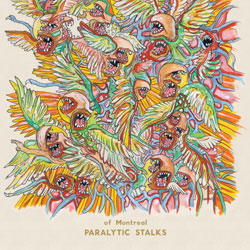
Perhaps it’s because the real ending of the Beatles was so disappointing — four men who’d pushed each other to brilliance got tired of doing so, released a spotty final record, and spread outward to fairly ordinary musical careers — but sometimes I’ll see a new and unrelated record as if it were an alternate Choose Your Own Adventure of the Beatles’ story. Of Montreal’s Paralytic Stalks, for example, is the version where John and Paul and George and Ringo go ahead and loathe each other, but express it in bitter lyrics and a deepening creative tension where they’re ever more inclined each year to reach in and screw with each other’s songs, yanking them back and forth in increasingly unlikely directions. Without ever messing up their best melodies. Oh, and they’ve kept doing this long enough to be as influenced by disco and Parliament/ Funkadelic as by modernist orchestral music… although Sgt. Pepper and Abbey Road remain in sight and in mind at most times.
In reality, Of Montreal are a shifting collective led by an American named Kevin Barnes. They began playing giggly psychedelic folk, developed a leftist political edge, then tightened their sound to make a couple of ebullient but professional pop records, Satanic Panic in the Attic (’04) and the Sunlandic Twins (’05), both of which sound more than a little like the Magical Mystery Tour re-done with drum machines, synthesizers, and funky electronic bass. Barnes sold one of his catchiest songs, Wraith Pinned to the Mist and Other Games, to Outback Steakhouse for rewriting with jingle lyrics, a tribute to commercialized gluttony which sits quite poorly with attacks on the greed of politicians. So after a few defensive and snotty interviews, he started writing about topics he could bring sincerity (and redeeming sly humor) to, like his favorite drugs and sex acts. The songs over several albums got less catchy and more complex, which often is a trade I’m happy with, but which in this case mostly lost me. I may or may not have been influenced by the time I waited 2+ hours past Of Montreal’s scheduled stage appearance at Gate City Noise before they showed up, stoned out of their minds and barely able to half-remember their songs … but not, I assume, rejecting that night’s paycheck either.
Paralytic Stalks is a triumph, though. On the one hand, it’s overstuffed and bursting with some of my favorite melodies Of Montreal have ever recorded. On another hand, it’s as expressively vicious (outwardly and inwardly) a set of relationship lyrics as I’ve ever seen, which also makes its periodic stumbles towards truce and redemption more powerful. On a third hand — Paralytic Stalks being a deformed creature with many non-standard body parts — it combines Barnes’s long-established interests in psychedelia, pop, funk, cabaret, and disco with a brand new interest in strings and flutes, long droning tone clusters, and outbreaks of free-jazz orchestration. All of which are used with the expressionist power of a Edvard Munch painting, and are reined in to bring a form of peace.
The poppiest moments make sense to explore first. Spiteful Intervention is the obvious single, even with dissonant strings and harpsichord peeking around the edges and rickety drums collapsing in the background. Beginning with dramatic narration-singing — “It’s fucking sad that we need a tragedy to occur to gain a fresh perspective in our lives/ Nothing happens for a reason, there’s no use pretending, you know the sad truth as well as I” — it moves into lilting sing-song over ’80s dance-pop. Then it launches into the acrobatic chorus melody: “I spend my waking hours haunting my own life/ I made the one I love start crying tonight/ and it felt good! Still, there must be some more elegant solution”. The melody spins its own memorable variations and continues: “Lately all I can produce is psychotic vitriol/ that really should fill me with guilt”. The backup singing supports a mood like the mad laughter before a breakdown. Yet it’s the catchiest thing — and if quite exaggerated from the worst things I’ve ever felt (so far) about anyone I loved, it’s recognizably vivid.
Dour Parentage, riding in on massed flutes and echoey drums, is top-notch experimental Stevie Wonder with modern recording technology. We Will Commit Wolf Murder is a pretty ’80s dance tune and love song, chopped and screwed: the vocal production and instrumental arrangements changing almost every line, and the sentiments along the line of “Someone’s terrorized my psyche to get even/ Lately you’re the only human I believe in” and “I’m considered ugly from every angle/ You’re the only beauty I don’t want to strangle”. Malefic Dowery is genteel pre-rock drawing-room pop, with a bit of hymnal a-capella, about how “Now I feel that you’re provoking me with your fidelity/ that your loyalty and affections are somehow a vulpine act of hostility/ Now we’re a bore, we’re afternoon TV”. It’s sort of a love song too.
The long tracks, 7 to 13 minutes, are the ones with the thorniest passages. I don’t find ’em difficult — my Dad was (among other things) a minor-but-talented modernist composer who played me Bartok and Penderecki when I visited him — but for those of you who do, I’ll point out simply that the weird classicisms aren’t a gimmick; they’re *used*, in a surprisingly straightforward way. The songs start with hummable melodies (especially Wintered Debts, like Paul McCartney and Marvin Gaye getting together to taunt you personally, and Authentic Pyrrhic Remission, soulful and sunny). They move into weird tonalities, slowly-evolving repetitions, and aggressive dynamics when the lyrics get, well, even more desperate than usual. They return to pleasant tunes (not the same as they began with) in search of partial resolutions. I’d hate to marry someone like Kevin Barnes; well, that isn’t news. There are nights — not too many, but some — when I’d hate to marry someone like me either. Paralytic Stalks is a masterful evocation of that. Not bad for such good pop songs.
 Wednesday night’s show was a little rough around the edges. They re-introduced the duets and group performances which can go away as far as I’m concerned. It’s a bit awkward to see them sing in groups again in such a cutthroat competition. We saw Burnell and Devin throw Lazaro under the bus as the reason for their terrible Four Tops cover. And even a halfway decent Madonna Like A Prayer cover by Janelle and Kree (Summer) was littered with Nicki comments about how badly Kree outperformed Janelle. They just need to do away with them. It’s a solo competition. This isn’t X-Factor.