web analytics

Category: Reviews

music-and-concert-reviews-you-wont-see-anywhere-else

  • #30 album of 2012 – Relapse in Response by Surplus 1980

    Artist: Surplus 1980

    Album: Relapse in Response

    Surplus 1980 — a new band, though founder/frontman Moe Staiano has been a fascinating percussionist in S.F. Bay bands for 15 years — have a well-chosen name. As long as you pick up on the right 1980 musical references: the skewed-punk and post-punk and spiky New Wave ones. surplus_1980Essential Logic, Pere Ubu, the Fall, the Slits, the Ex, Tin Huey, first-album Gang of Four: Relapse in Response is a louder and faster record than any of those, but draw from the same well of shouty discordant rock’n’roll clamor, the same joy in complaining. Chord progressions are less friendly than on a Chuck Berry record, but have the same elemental drive, and the drums — plus Staiano’s various re-purposed metals and tools — are clattered up front to make sure we don’t miss them.
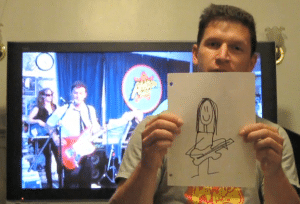
    Sometimes the guitars sound like sound effects from Bugs Bunny cartoons. Sometimes they sound like mis-transcribed Black Sabbath. Sometimes there’s horns, oboes, and clarinets helping out. Or toy piano. Assertively, of course; Surplus 1980 know, surely as any 4-year-old does, that even toys are a form of intrusion.

    Staiano has a strong voice, but makes little pretense of being a singer. He can, when he chooses, go up and down a few notes on a scale, without smashing them beyond the point of repair. More often he’s a speaker, a character actor. M.E.S. Shoe Contract (named for the Fall’s Mark E. Smith) includes bouts of high-speed high-pitched urgency: “I could quit! I feel like having a clear view of focus of a storyline defeats the purpose of anything of lyrical significance! Wit is a form of smartness! Smart is sexy but I am not smart! So I will shut up, which is probably smart!” And a caveman-firm rejoinder: “So that makes me sexy, so that makes me sexy”. And the staccato, firm shouts correcting “But! this! absolutely! has! nothing! to do! with sex! at! all!”. Ironically, his male-female duet with Jesse Quattro later in the song, toying together with the phrase “It’s pure nonsense!”, *is* sexy… or maybe I’m just saying that and don’t really mean it. A little self-knowledge is a dangerous thing; I feel blessed to have none.

    Trying to Succeed, Waiting with Little to No Result is frustrated angst-punk; Let’s Put Another One There is a critique of urban sprawl; the 8-plus minute Ed Saad, crammed with cool high-speed arrangement ideas, is probably about many things but the most obvious is the pleasure of saying “Ed Saad Ed Saad Ed Saad Ed Saad Ed Saad”. The Gooseneck, by Amy X Neuburg and the Cello ChiXtet, is a wonderful punk song to cover, sly and free-associative and funny as well as indignant. Staiano doesn’t even attempt its tricky melody or cello arrangement (although he does have a cello or two just sawing away), just focusing on the words as his band stampedes through: the best melody is handed to trombonists, who let you hear them slide from note to note.

    So if it doesn’t help you to picture Surplus 1980 in relation to a bunch of old punks that only critics and geeks ever liked, perhaps you can picture them as an insane runaway marching band. Which is the best response *I* can imagine to those daily 6:30 a.m. practices, or to being loud strutting mascots to a bunch of annoying high school football players. A good sort of marching band, then, to have around.

    – Brian Block

    To see the rest of our favorites, visit our Favorite Albums of 2012 page!

    Technical note:

    You can hear various Surplus 1980 songs on their Soundcloud page, and buy Relapse in Response at Wayside Music .

    If you’re game for buying things via our Amazon links (and it makes us happy when you do) – well, Amazon doesn’t have Surplus 1980. But if you’d enjoy them, maybe you’d also want the new Pere Ubu cd we’re linking in its place. Or the complete set of Oz books! I hope Amazon has that; click around, find out.
     

  • #31 album of 2012 – Decline and Fall by Thinking Plague

    Artist: Thinking Plague

    Album: Decline and Fall

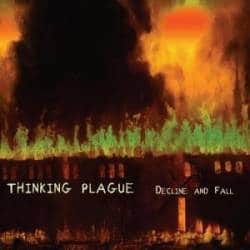
    Thinking Plague are an extremely skillful band of singer (Elaine di Falco), guitar (Mike Johnson), bass (Dave Willey), keyboard and drums (both Kimara Sajn), and sax/ flute/ clarinets (Mark Harris). Oddly for a rock band, they almost entirely avoid distortion, even for bass and thinking_plague_declineguitar. It’s easier for me to give you adjectives about their album Decline and Fall than it is to assure you they’re compliments. “Composed”, in both the musical and emotional senses. “Difficult”. “Uncompromising”. If you started a stylistic line at, say, Maroon 5, and drew it in the direction of the Dirty Projectors (maybe halfway between Bitte Orca and Swing Lo Magellan), then kept going until you’d traveled twice your original distance, you’d be nearing Decline and Fall‘s vicinity, where no melodic or harmonic interval is ever normal and no rhythm is ever unchallenged by cross-currents.

    Or you could navigate the Rock In Opposition island chain where Henry Cow (vocal albums only), the Science Group (ibid), the 5uu’s, Time of Orchids, and the Red Masque keep each other company. Thinking Plague feel more 20th-century-classical, and less heavy, than the latter three, but remain comparable. But if that’s meaningful to you, you’re probably aware of Thinking Plague already. In which case I’ll opine for you that Decline and Fall is their most stylistically consistent, melodically intricate album ever, and (for me) the first whose willfully knotty tunes fall consistently on the right side of the “hmm, interesting!” vs. “yikes – ugly!” border. My favorite Thinking Plague album remains 1989’s In This Life, which was more sprawling and varied and had shameless goth elements. But I’ll take Decline and Fall as the highlight of their mature style.

    Malthusian Dances and Sleeper Cell Anthem are my favorites here, the closest approaches to “catchy”. The oft-pretty A Virtuous Man (length 11:53) shows off the players’ skills extra-well. I Cannot Fly deserves mention for Elaine di Falco’s spectacular interlocking vocals: she can’t exactly sing warmly with the melodies Mike Johnson composes for her, but she’s able to salvage the tone and grumpy charisma of a Liz Phair or a Lisa Germano, if either had spent years being rigorously trained at a school for vocal acrobats.

    Liz Phair gets grumpy, when she does, about men (romantically interesting ones, record executive ones). Thinking Plague get grumpy about mankind. “See us dancing inexorably to the steps of a suicidal choreography, while the clock is ticking out the pace of collapse”, the record begins. At first you’d probably take it for wry, observational Seinfeld-style humor: “Bears and toads and fish floating dead, as blackbirds in their thousands rain down from the sky/ Fleas conspiring, forests expiring, as diseases multiply and rivers run dry” and such. But lyricist Johnson seems like a man making a moral point: he has di Falco sing “We must not place hope in fantasies. Dreaming of sprawling ‘dominion’, unspoken public opinion. Can’t we all strike it rich? Is it not the truth that God helps those who need it least?” No one, the band included, is evading blame: “We are, all of us, the bringers of hunger”, not to mention “Swirling on the currents of the deep blue sea/ thousand miles of plastic debris/ Nurdles and bottles and PCBs/ Compliments of you and me!”.

    If you want redemption from Decline and Fall, you can choose. One song claims (after decrying “dogmas of hate”) “I choose to love my fellow man”. Another, far more vividly, looks forward to “Without us, the roar fades, the air starts to clear/ in green shade, life senses reprieve … Dams burst, roads crumble, shining towers tumble/ Balance is restored. And in time, the forests embrace the oceans”. The latter gets the final word. There is something inspiring, I think, in the purity of Mike Johnson’s anti-sociability, his complete disinterest in whether we enjoy his company or not. It wasn’t enough to salvage, for me, Thinking Plague‘s 2003 album a History of Madness; those melodies made my ears hurt, and I’m sure the composer didn’t mind. But these, I like. Maybe, by listening, I’m a sucker accepting his dare. But somehow, the damn thing’s kinda fun.

    – Brian Block

    To see the rest of our favorites, visit our Favorite Albums of 2012 page!


  • #32 album of 2012 – What We Saw from the Cheap Seats by Regina Spektor

    Artist: Regina Spektor

    Album: What We Saw from the Cheap Seats

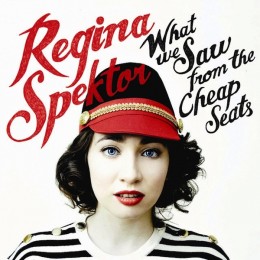
    Regina Spektor plays piano reasonably well, and has a breathy but flexible singing voice fond of chirps, coos, swoops, creative weird mouth noises, and really awkward melisma (switching notes mid-regina_spektor_cheapsyllable). My family and I adore her, and she’s had chart success, mainly with Fidelity from 2006’s wonderful Begin to Hope, but I can imagine why her songs could drive someone batty. Her strengths are childlike, even though her topics aren’t. She hops between specific observations — some mundane, some clever, some bizarre — and well-meaning offers of universal truths she worked out yesterday and hopes you’ll like. I think many of her juxtapositions hold up extraordinarily well, but people have told me she strikes them as too cutesy, or too obvious.

    What We Saw from the Cheap Seats has evidence for all sides, perhaps. Consider the ultra-perky Ne Me Quitte Pas (Don’t Leave Me), piano mostly replaced by some bubbly sound patch like a vibraphone but much cuter, plus fake drums and a horn section. “Down on Lexington, they’re wearing new shoes stuck to aging feet/ and close their eyes and open, and not recognize the aging street/ and think about how things were right when they were young and veins were tight/ and if you are the Ghost of Christmas Past, then won’t you stay the night?” … to me, that’s a heckuvan empathetic verse for someone herself still young and pretty, and I also end up liking the next verse, even though it’s set in “the Bronxy-Bronx”.

    Or consider All the Rowboats, the insistent, percussive, darkly atmospheric musical successor to Apres Moi, Edit, and Machine from prior albums. I’m an instinctive animist, so it could be written for me: “All the rowboats in oil paintings, they keep trying to row away/ and the captains’ worried faces stay contorted, staring at the waves… First there’s lights-out, then there’s lock-up, masterpieces serving maximum sentences/ It’s their own fault for being timeless; there’s a price to pay, and a consequence… But the most special are the most lonely. God, I pity the violins/ in glass coffins, they keep coughing. They’ve forgotten how to sing”. I still like museums; I’m a lot sorrier for the 90% of the New York Metropolitan’s collection that’s not on display at a given moment. It’s a great song topic either way.

    It slots well with the more typical concern for a friend on piano ballad Firewood, where the urgings “Everyone knows you’re going to live, so you might as well start trying” (and later “Love what you have and you’ll have more love/ You’re not dying./ Everyone knows you’re going to love/ though there’s still no cure for crying”) fit around the acknowledgement “Someday you’ll wake up and feel a great pain/ and miss every toy you’ve ever owned”. Me, I just miss the stuffed animals. The eyes; they’re what get ya. Friends usually have eyes too, the bastards.

    When Regina Spektor tells a friend — on the brief Phil Spector-ish pop-orchestrated the Party — “You taste like birthday, you look like New Year/ You’re like a big parade through town/ you leave a mess but you’re so fun”, well, that’s somewhat how I envision her. It means I don’t appreciate, from her, a well-crafted but generic pop-jazz lost-love song like How, and that I prefer Patron Saint‘s jaunty piano and kick-drum to its vague pains-of-true-love musings. In terms of content, half of What We Saw from the Cheap Seats feels slight to me, by Spektor’s standards. It’s also her most stripped-down set of arrangements since 2005’s Soviet Kitsch or before, though that’s not a quality judgment. But “by Spektor’s standards” is the kicker. I really like Regina Spektor albums. This was true before, and remains so.

    – Brian Block

    To see the rest of our favorites, visit our Favorite Albums of 2012 page!