
Oh, and did I mention you can download the song for free from Amazon? You’re welcome.
Oh, and did I mention you can download the song for free from Amazon? You’re welcome.
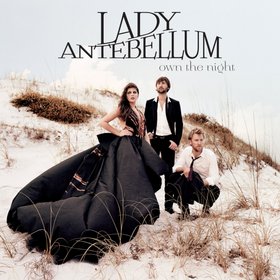
There’s really very little difference between the average Taylor Swift song and the songs of Lady Antebellum. They both play melodic, radio-friendly pop love songs that, for little more than geographic origin, the occasional flourish of mandolin and fiddle and a general lack of Autotune, somehow qualifies as country. (What? No cowboy hats? No songs about tractors?) You could easily imagine that it was the same hit-for-hire team supplying material to both acts. Lady Antebellum singer Hillary Scott even sounds a little like Swift, especially on a big, heart-wrenching, string-laden, piano ballad like “As You Turn Away”, one of the highlights of Own the Night.
What most distinguishes Scott and her bandmates, singer Charles Kelley and multi-instrumentalist Dave Haywood, from Taylor Swift (well, aside from the fact that most of Lady Antebellum’s songs are vocal duets) are the stories their songs tell. These aren’t the chronicles and confessions of high school girls and boys, but the backstories and subtexts of those girls’ and boys’ high school reunions.
Never mind that they’re only a few years older than Swift, Lady Antebellum’s songs are the probable middle-aged ever-afters of Swift’s “Love Story”, where the googly eyed crushes of high school are distant memories, and every first kiss is informed by the consequences of how many other first kisses. In “Just a Kiss”, the album’s lead single, Scott and Kelley arrive at a moonlit doorstep at the end of a date and move cautiously to a good-night kiss, singing “I don’t want to mess this thing up.” These are people with pasts.
Two old classmates reminisce separately about a single high school slow dance they’d shared years earlier, before having gone their separate ways in life – “for me you’ll always be 18 and beautiful” – in the lovely and heartbreaking “Dancing Away With My Heart”. Meanwhile, in “Somewhere Love Remains”, a couple who’ve shared a life together find themselves at the edge of splitting up – again. Sure, “Friday Night” is an upbeat, 80s-style rocker (no way this wasn’t written for the soundtrack of the remade Footloose). But it’s still basically Scott and Kelley assuring each other, in playful strings of opposing metaphors – “chore to check off on your list” vs. “lemonade in the shade” – that they don’t want to ever get into a rut.
There are a few moments of sheer giddy pleasure. “Love I’ve Found In You” is a portrait of unqualified domestic bliss, while “Singing Me Home” is all carnal lust on the open road. But these are intermittent escapes from the album’s general sense of tastefully-rendered, elegantly-packaged, thirty-something, romantic melancholy.
10 years ago – y’know, before iPods and stuff – it was my general practice to keep a mix CD of my current favorite songs in my car to listen to on my way to and from work. And then, every week or so, I’d make a new CD, replacing the songs I was tired of with fresh new ones. I was listening to one such CD Tuesday morning, September 11, 2001. On my way home from work that day, I was struck by how eerie some of the songs felt in light of the day’s events – the same way the absolutely perfect blue sky of that day took a sinister cast once its perfection had become so abruptly purified of the usual air traffic.
In the immediate aftermath of 9/11, radio programmers were purging their playlists of songs that, however popular before, suddenly felt insensitive or inappropriate. The nu-metal act Drowning Pool had scored a breakout hit that summer with a song called “Bodies”, a tribute to the joyful violence of a moshpit. The song had been ubiquitous on rock radio and MTV2 all summer, and suddenly it was gone. Similarly, Jimmy Eat World’s then just-released third album Bleed American was pulled from the market, only to reappear a couple months later, euphemistically retitled as Jimmy Eat World. In the place of those “troubling” songs, came Five For Fighting’s “Superman” (at the time, a 6-month old single that had previously fizzled at radio, like it’s superior – and more troubling – predecessor “Easy Tonight”), and a new version of Enya’s “Only Time”, tricked out with 9/11 audio verite.
In the meantime, I kept my little mix CD, and while I already loved most of the songs on it, the fact is, they’d taken on a whole new dimension for me (in the same way that Five for Fighting song did for so many others). Even now, hearing any one of these songs in any context has a sort of time travel effect, and I’m back on that beautiful, horrible Tuesday morning.
Eventually Bleed American got its original title back. And “Bodies” would eventually be revived, not only as theme music for professional wrestling, but also as an instrument of torture at Guantanamo. And eventually, my little CD got a little beat-up – CD burning was still a relatively new thing at that point, and my home made mix CDs had pretty short playable lives. But I kept the tracklist, and here are ten highlights, presented with no further comment, in the order in which they appeared on my CD.
1. “Crystal” by New Order
2. “Working Girls (Sunlight Shines)” by The Pernice Brothers
3. “Sometimes” by Ours
4. “We Need a Resolution” by Aaliyah
5. “Packt Like Sardines in a Crushd Tin Box” by Radiohead
6. “Hellbent” by Kenna
7. “Blizzard of ’78” by Ida

“Fixing an eye on the hopeful in a heartless room / you’ll be done soon /
Snow is falling down and the whole damn town / is covered in white”
8. “Broke” by The Beta Band
9. “Getting Away With It (All Messed Up)” by James
10. “I Want Love” by Elton John