web analytics

Author: brian

  • #35 album of 2012 – Swing Lo Magellan by Dirty Projectors

    Artist: Dirty Projectors

    Album: Swing Lo Magellan

    One of the most basic music-theory concepts — I don’t know the fancy ones — is the “interval”: the gap between one note and the next. A “first” is the same note repeated. A “third” is two letters apart in terms of the note name: for example, a C followed by an E. dirty-projectors-swingThe third might be a “major third” C to E, “minor third” C to E-flat, “augmented third” C to E-sharp if the key’s eccentric enough, or “diminished third” C-sharp to E-flat. C to G is a “perfect fifth”, part of the major and minor scales. In pop songs, you’ll hear lots of major and minor thirds, lots of perfect fourths, and a fair share of perfect fifths —  but hit songs avoid intervals larger than that. Most of us in the radio/YouTube audience are crappy singers; the bigger the interval, the more likely we’ll sound like an idiot trying to sing along. Therefore, the more likely we are to resent the singer making us feel like an idiot. What a pretentious twit the singer must be, for showing off that way.
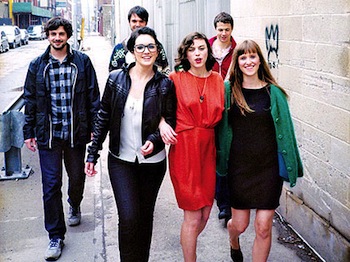
    Perhaps Dave Longstreth — singer, guitarist, and mastermind of Dirty Projectors — *is* a pretentious twit. He’s prone to explaining his songs in interviews by asking stuff like “What could true dissent be? What is a 2012 Exodus from the Society of the Spectacle, to mix language Situationist and Rastafari?”, which is a smart, interesting question phrased in a really annoying way. Many people find his melodies annoying too. They’re relatively full of sixths and sevenths, leaps towards the unknown; and while I have no intention of laboriously turning his tunes into sheet music, I’d expect to find lots of augmentation and diminishment among his intervals, tricksy violations of the “happy”/”sad” principle of major and minor. Longstreth’s own flexible, keening voice is paired with frequent female harmonies from Amber Coffman and Haley Dake, and together they make some unlikely chords.

    Which means, the way *I* hear it, that Dirty Projectors are out there making exciting tunes that few other bands would dare. (Possible bias: my singing voice is thin and erratic, but leaping intervals is a thing I’m okay at.) They’ve also been getting more accessible from album to album. Where 2005’s the Getty Address was slow and dense with classical instrumentation, by 2009’s Bitte Orca it was fair to describe them as a rock band, and Stillness is the Move, a genuine alterna-hit single, was bubbly, funky, and cheerful in its West-African-inflected way. Follow-up Swing Lo Magellan is softer, leaner, and prettier — among the influences Longstreth has cited is the R + B vocal-harmony group En Vogue — and well-designed to win over skeptics to their melodic approach. It finished 11th on the annual Pazz & Jop critics’ poll, it peaked at #4 on Billboard’s Rock Album chart: not bad.

    Highlights: Offspring are Blank is spooky doo-wop over erratic whispering machines, that erupts into classic-rock guitar heroics. About to Die uses African drumming (talking drums included), deep sweet-sounding cello, and an especially long and clever melody that by the chorus — more doo-wop inflections — is even more accessibly lovely than Stillness is the Move, though just as West-African. Gun Has No Trigger has very basic arrangements, putting all its emphasis on the daring interplay between Longstreth’s singing and Coffman’s/Dake’s “ooooohs”. See What She’s Seeing quietly does exotic things with guitar de-tuning, skittering IDM drum machines, and very nice classical violin. Unto Caesar is even relaxed and casual: not the precise, rousing horn parts, but the shuffling rhythm, and definitely the studio back-chatter. I know, I’m obviously supposed to be charmed when one of the gals asks “When should we bust into harmony?” and responds to a Longstreth lyric with “Uh, that doesn’t make any sense what you just said”. But it works, it works.

    Bitte Orca remains my favorite Dirty Projectors album: that was a top-10 album for my 2009. Swing Lo Magellan gets a lot of its accessibility via soft, sappy pop stylings: the half the album I’d file under Avant-Manilow is objectively fine yet not for me. Except the single Dance for You, I guess. Plus the echoey, wobbly folk song Irresponsible Tune. A good melody can carry me through a lot, really. And the more notes you’re willing to use, the more melodies you have to pick from.

    – Brian Block

    To see the rest of our favorites, visit our Favorite Albums of 2012 page!
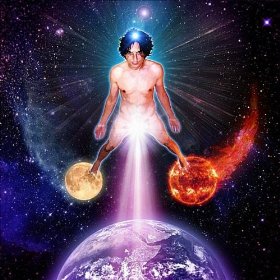
     

  • #36 album of 2012 – Intergalactic Messenger of Divine Light and Love by Jonny Polonsky

    Artist: Jonny Polonsky

    Album: Intergalactic Messenger of Divine Light and Love

    Can you imagine a halfway point between the Beatles’ Rubber Soul and Smashing Pumpkins’ Siamese Dream? If so, you have a good musical imagination: well done! Also, you may have imagined something close to Jonny Polonsky’s Intergalactic Messenger of jonny_polonsky_divineDivine Light and Love. I mean the guitar tones (weighted a bit towards the Pumpkins’ thick-textured grandiosity, especially the fierce solos), the song structures (leaning nearer the Beatles’ compactness), the melodies (pretty equal). To some extent I mean Polonsky’s singing versus Lennon’s and Corgan’s, though he’s throatier than either, and only on See Your Lies does he master Corgan’s piercing whine. Perhaps my “halfway” remark even refers to quality, though that’s endlessly subjective: personally I’d rate Siamese Dream as “good”, Intergalactic Messenger of Divine Light and Love as “very good”, and Rubber Soul as “very, very good”. Also, here’s a more precise comparison for Polonsky’s album that should benefit, if  no one else, my mom: imagine Adam Schmitt’s World So Bright, with a heavier emphasis on the rock aspects. You’re welcome.

    Some of the rock songs build tension through sparse, tense verses. Bearclaw‘s precise drumming plays hide and seek with a limber bass line, a whistling off-key synth line, and harsh squiggles of distorted guitar. Coming into Slaughter looks in outline like Live’s slow-burning but ultimately loud hits Lightning Crashes or White, Discussion, although Polonsky’s voice is higher, tighter, and more articulate than Ed Kowalczyk’s, and his guitar here takes on the richness (and chorus pedal) of Queen’s Brian May. All the Evil Things is punctuated with a huge, rousing synth/guitar riff, and its chorus (introduced with a firework display of drum fills) is big too, but otherwise it’s sung in a harsh whisper and an even lower harmony vocal over soft tip-tapping.

    Then again, See Your Lies is an all-out rant and swaggering rocker Muse would approve of — as might John Lennon have, even if he never had the technology to make his tantrums sound that way. Ugly People Living in the Hole, fast and intense, replaces the swagger with extra drum bursts and sinister cooing. On the quieter end, Something to Believe in is an electrified folk-rock anthem (with a big flock of electric birds joining for the final minute), and Be My Brain has the hazy, punch-drunk country inflections of Mazzy Star or Giant Sand.

    Album title aside, Jonny Polonsky‘s lyrics are vague but reasonable enough. Our corporations and political leaders teach us to want a world that isn’t what we need; we need to “bridge across the chasms of chaos, death, and fear … to get out of here, to rebuild our stately home, and deliver the promise from the night”. Billy Corgan would just scream “Let me out!”; John Lennon would imagine “the world will live as one”; Polonsky’s a bit more prone to asserting “All the world’s an aardvark/ sifting through the sand/ searching for the lost spark/ inside our pineal glands”. But they’d all agree that “Ugly people have more to prove than the rest of the world”. They’d all be talking about themselves, but they’d all be comfortable including me, and probably you. Polonsky proves himself with guitar solos; fair enough. What do you got?

    – Brian Block

    To see the rest of our favorites, visit our Favorite Albums of 2012 page!
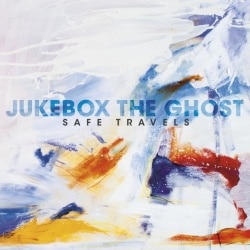
     

  • #37 album of 2012 – Safe Travels by Jukebox the Ghost

    Artist: Jukebox the Ghost

    Album: Safe Travels

    Jukebox the Ghost are a power-pop band. By this I mean they’re energetic; they sing about normal pop topics (loneliness, awkward crushes, relationships); their male singer sounds young and basically ordinary but carries tunes well; they play guitar and bass and jukeboxtheghost_safetravelskeyboards and drums; they use clean production; and they rise and fall based on the strength of their melodies. They’re “pop” in the sense that this was an excellent way to become popular in the 1960s and ’70s, and many of us (including some like me who weren’t even around for that) still vaguely assume it should be.

    Jukebox the Ghost’s Safe Travels, in high-energy mode, reminds me of early Elton John: there’s confident piano, or keyboard sounds that often fit the ’70s, strutting through these songs, and singer Ben Thornewill can pull off a Crocodile Rock-like falsetto. But of course Elton’s records also had all those ballads, even from the start. Safe Travels‘s slow songs feel different from his. Dead and All for Love are dramatic buildups that end up massive, and Devils on Our Side is a mostly understated solo piano performance until the cello arrives, circling around waiting for a tip; if you didn’t like them, it would more likely be that they felt too emo — raw drama arranged and digitized for easy replay — than too schmaltzy. Man in the Moon is mostly voice and sketchy acoustic guitar. The Spiritual, white gospel singing over piano, that could be Elton.

    But I’m mostly here for the rock songs. And honestly, Elton John didn’t always write verses this strong, soaring into new keys for the chorus and leaving room for a distinctive, tuneful bridge; sometimes, but not this reliably. Also Jukebox the Ghost have some good lyrics (who knows what Elton’s partner Bernie Taupin was writing about?). At Last — my choice for a single, switching between stylish percussive verses and over-the-top chorus with strings, plus a nifty guitar solo — sets up a romance-to-be. “He was a songwriter writing songs about a girl/ She was a ghostwriter lying to the world/ in deep anticipation of a day that she had written/ and by her own admission, she’d be picked up, kissed, and twirled”. It gets a detailed eager-but-anxious middle, and a happy (nay, jubilant) ending that feels earned. Say When (excellent piano-synthesizer interaction) is a detailed song about hating parties, that doubles as a pick-up line that also deserves to work.

    Dead is, one hopes, not autobiographical yet, but it’s vivid: “Maybe it was just the sleeping pills when I went to bed last night/ Maybe I just never made it home; and what if there’s always been/ a tiny, tiny hole inside my heart leaking very very very very slowly? And if you’re dead, how do you know if you are really dead/ or stuck in a dull dream about nothing that never ends?” I admire the modesty of its urgent plea: “We all, at minimum, deserve a unique exit from this world/ So if you’re there, God, see to it”. Until which, the potentially depressing Adulthood — “In my lungs I still feel young, but my body won’t play along … Each one’s waiting for the chance/ to be lifted off the ground, but then/ to discover that we’ll all be dust again” — is sung and played to make “I dare you to survive/ being grown for the rest of your life” sound like an honest challenge worth some energy. Which it is. Especially with some nice peppy music around to perk us up.

    – Brian Block

    To see the rest of our favorites, visit our Favorite Albums of 2012 page!