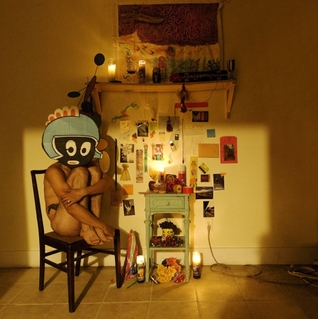
Artist: the Indelicates
Album: Diseases of England
The Indelicates, first of all, have a brilliantly chosen band name. “Indelicate” is, especially in their native England, a judgment of improper behavior, misbehavior. To brag of indelicacy is to forward naughtiness, rebellion. But it’s to do so in an environment where decorum and olde  standards apply: an upper class, at least a schooled upper-middle one, and one largely vanished by the time of the Indelicates’ 2008 debut. It is a band name for scruffy punks, but ones with music training, who wear their ties and school sweaters but simply refuse to arrange them correctly. It is a band name for youngsters who do take pleasure in fucking shit up, sure, but prefer the artfulness of doing so while hiding in other characters from other times. And would rather write a clear melody, then bump it around a tad, than destroy their perfectly good ears in daily blasts of distortion.
Simon and Julia Indelicate, in their educated, articulate voices, are very good lyricists. Chameleonic ones, taking any perspective that seems worth a reaction and running with it. Prior to 2013’s Diseases of England they’d placed four songs on my various best-of-the-year mix-cd sets. America, unfashionably anthemic like the Joshua Tree by way of Sister Christian, attacks their native scene as hurtfully as possible by comparing it unfavorably to the dankest aspects of the New World colonies: “The pop stars who write operas and make fatuous remarks/ the theory-quoting upstarts who snort fair-trade coke in parks/ I find myself a loner and I find myself bereft/ Agreeing with Bill O’Reilly more than the Left”. Which is unreasonable to me too, but then, Jerusalem, a quick-stepping music-hall duet, attacks someone who “Know(s) exactly how clever sounds/ the soft consonants and rounded vowels…/ You and your friends discussing how/ it seems rebellious to vote Conservative now”. That said, Jerusalem’s narrators know their own stereotypes too — “We all love the Smiths and we all love the Clash/ but the smell of leather is intoxicating/ Brilliant minds, we are genii/ we excel at drama and formal debating” — but proudly declare victory in advance.
Savages, slow and grandiose, is a showy doomed-romantic anthem, lovers too powerful for a dull, scuffling world: “We are ash, we are books/ coffee-stained and overlooked/ we are ornamental swords/ forged for the peace after the war/ and the world has no need/ of the songs that we sang/ we are savages, you and I/ and we will hang, hang hang”. And McVeigh, a fast funky dance number with urgently roughened vocals, is an anti-government rant that many of my friends and I would agree with the majority of — sung from the perspective of the genocidal racist who blew up the Murrah Federal building (killing hundreds of Americans) and intended to kill a thousand times more by poisoning major water systems. All four narrators are self-righteous and cocky, but no two can be the same person, and I haven’t even brought up, e.g., the song from one of Patti Hearst’s kidnappers yet.
**********
Diseases of England is the fourth Indelicates album, and their third straight excellent one. It shows off some splendid new tricks. The openers, Bitterness is the Appropriate Response and Pubes, are the heaviest, loudest songs of their career: nasty (but cleanly-produced) bass riffs, swirling carefully-shaped feedback, pounding piano or high-speed synthesizer melodies in the background, Simon and Julia shouting their melodies and harmonies and sensually rolling their r’s. We are Nothing Alike is sprightly with danceable acoustic guitar — flamenco or similar — with soaring duet vocals and, then again, a fervent angry breakdown in 7/4 time. Class gets to the 1:24 mark on only vocals and a powerfully  sustained cathedral organ drone, before brass, woodwind, and strings loosen the tension with an instrumental melody. (Only at 2:52 do the drums show up, carrying a triumphant oom-pa beat to the end.) Dirty Diana slyly morphs from mediaeval hymn to a light-opera translation of a chain-gang work song.
The rest of Diseases of England is a more usual Indelicates mix of show-tune, jazz-pop, and English and Irish folk-song, with just enough hints of woodwind and cello dissonance to keep you from sitting too comfortably. For some reason these more band-typical songs, though nice, are slow and low-energy this time, which tells you right now what excuse I found, besides the usual tyranny of math, to rank the album down at #15.
As for what they sing about, there’s certainly fond new versions of the we-are-better-than-you-lot pose — Everything is Just Disgusting, indeed — but there’s also a new left-wingness to them. Dirty Diana sings the hatred of a servant girl (“grit in her eyes and her cheek/ … acid in the joints of her limbs”) for her masters: “You disgust her with your books and tea and wisdom/ you disgust her with your stories of yourself/ You would lead us, now she sees you on your belly”. Clarifying “the scardom they deserve/ for their comfort and their nerve/ and their pale, flaccid weakness most of all”, the girl exposes the vicious irony of Matthew 5:5: “the meek inherited the earth” already, and paid the strong to do all their work for the lowest wages they could find. Class, written from upper-class perspective, mocks the uselessness of protest by “the envious” when “The scum with aching feet will march ignored in the next street/ because the TV speaks to diction and to stars”. It admits that Downing Street is “a cesspit filled with lime”, but sneers “It would be pretty as a picture if you’d studied architecture/ you haven’t, but you can, for thirty grand”. We are Nothing Alike, sung from old money, tells a rising young professional that she will be embraced and made to look just like them, but will never, ever be treated as equal. Pubes seems at first like its target is internet porn, but turns out to be about how easily women can be dismissed once “the presence of their sex organs has been implied”.
I’d like to think I’ve learned something about the Indelicates’ actual worldview with Diseases of England, but that’s just a fancy way of saying I’d like to think my own worldview is so obviously right that anyone who can articulate it so well must agree with it. This is not a safe assumption. But the Indelicates have never had to agree with me to be an extremely good band. And despite their new albums’ pacing problems, in many ways they’re a more fascinating good band than ever.
– Brian Block
To see the rest of our favorites, visit our Favorite Albums of 2013 page!
[AMAZONPRODUCTS asin=”B00CIYQ14U”]