
web analytics

Tag: Amy Winehouse

  • Happy anniversary to me!

    Happy anniversary to me!

    Bill and me today!
    Bill and me today!

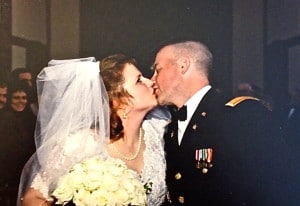
    I’m delighted to report that after eleven years of marriage, I still feel like saying “Happy anniversary to me!”

    My husband Bill and I were married on a rainy Saturday at Virginia Military Institute in Lexington, Virginia. The date was November 16th, 2002. It was Bill’s second trip down the aisle and my first. It’s hard to believe all that has transpired since that fateful day eleven years ago. For the most part, time has really flown. I love Bill more today than I ever have. Every day, I find new reasons to be glad we found each other. In the spirit of my celebratory mood, I have decided to write a post about the music that has meant a lot to me in my relationship with Bill.

    The Ceremony

    I will never forget planning our nuptials. It was a stressful time, mainly because for half the time leading up to our wedding, I was finishing graduate school. We were also really broke. Nevertheless, I determined that I would choose music for the wedding that meant a lot to us. Bill and I are both of Celtic descent. I have more Scottish ancestry, while he is very Irish. I wanted our wedding to be kind of Celtic, while it was also military. No one wore a kilt, with the exception of the guy who played the bagpipes during my walk down the aisle. I chose to eschew the usual “Bridal Chorus” in lieu of a beautiful piece called “Highland Cathedral”. “Highland Cathedral” was composed by two Germans in 1985, yet it sounds like it could be an ancient Scottish piece. The first time I heard it, it was 2001 and I was at a kirk’in of the tartans in Columbia, South Carolina. I was moved to tears and determined that I would use that piece in my wedding if I ever got married. Sure enough, I used it to great success.


    This is a video I made after Bill and I visited Scotland for our 10th anniversary. I used Phil Coulter’s version of “Highland Cathedral” followed by Amy Grant’s very different version of “Highland Cathedral”.

    At my wedding, we had an organist and bagpiper play “Highland Cathedral” together and it sounded something like this…

    Other music used in our ceremony were basic hymns. I also had people sing hymns for us, since I am always singing for them!

    Love songs

    There are quite a few love songs that make me think of my relationship with Bill. Our first dance was to “Someone To Watch Over Me”, a classic Gershwin tune.


    Amy Winehouse singing “our song”.

    But there are plenty of other mushy songs that make me go weak in the knees when I hear them. For instance, I gave serious thought to us dancing to this song by Lyle Lovett…


    It captures my sense of humor, but doesn’t really reflect the truth…

    A better song might have been this one by Beth Nielsen Chapman.


    “All I Have” is a gorgeous wedding song, but harder to dance to.


    My version of Beth Nielsen Chapman’s pretty love song.

    Other songs that come to mind are Judy Collins’ version of “In My Life” and Don Henley’s “Taking You Home”, both of which I recorded recently.


    Judy Collins singing in 1966.


    I covered Judy Collins’ cover of the Beatles’ “In My Life”.

    There have been other, less lovey songs that have inspired Bill and me. While we are in love with each other, our marriage is really more like a great friendship. And we do a lot of things that great friends do together, like drink a lot of beer.


    This video includes “King of Beers” by Too Much Joy and “Beer Run” by Todd Snider, as well as photos of Bill enjoying our favorite pastime.

    In any case, I feel pretty sure tomorrow we’ll have a great time. We usually take trips for our anniversary, but this year’s move and my recent dental woes precluded that. I have high hopes for next year, though! Have a great weekend, y’all!
  • Amy Winehouse and the Myth of the 27 Club (Hint: It’s BS)

    Saturday afternoon, I was busy doing something or other in the kitchen when my partner, browsing at his computer, asked rather non-urgently, “So, who’s Amy Winehouse?” “Why,” I asked him, “Is she dead?” “Yup,” he replied. The singer’s tragic but not terribly surprising death was the “duh” heard ‘round the world over the weekend. Even as authorities try to tamp out the rampant speculation over the cause of her demise, her signature tune – the one she’ll be most remembered for by our kids – was ringing like a grim YouTube joke that had finally found its punchline. As I saw in one poster’s bio line Saturday night: “They tried to make me go to rehab, and now I’m dead, dead, dead.”

    And so the career of this strangely beautiful singer came to its depressingly predictable end. But not without one last stupid nod to the clichés of gone-too-soon rock stardom: Amy Winehouse is the latest dues-paid member to join the 27 Club, that legendary pantheon of self-destruction – Janis, Jimi, Jim, and most recently (albeit a full generation ago) Kurt – all reluctant “voices of their [respective] generation” who martyred themselves to the gods of image-licensing, who gave their lives to become black velvet posters to be won at county fair midway games.

    But here’s the thing about the 27 Club: it’s a bullshit club. And in the case of Amy Winehouse, it confers a level of artistic legitimacy and importance to a career that had scarcely earned it.

    It’s true, I’m no Amy Winehouse fan; but let’s be clear: I’m no hater either. While Winehouse had a distinctive image and delivery, the best thing about her 2006 breakout album “Back to Black” was its defiant sense of deep pop history, most evident in the Northern Soul revival production by Mark Ronson. It was a sound that stood in stark opposition to the Autotune-heavy radio fodder it shared the airwaves with.

    All that said, Winehouse’s unique talent was not so much as a singer, but as a disaster in progress. She left a decidedly scant (and spotty) recorded legacy, and her live performances in recent years have ranged from harrowing to pathetic. Yes, a few of her songs may have gotten play on the radio, but what’s really fascinated us most about Winehouse (right or wrong) for as long as we’ve known her, has been her long, relatively fruitless march to an early grave.

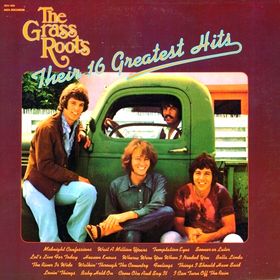
    Rob Grill (in the cab of the truck) 1943-2011: My parents had this record when I was little and I played the hell out of it.
    Frankly, that’s not a legacy I care to celebrate. Why revere the 27 Club?

    Leaving aside the fact that there have been only two new members of the 27 Club in my lifetime, why such reverence for 27, when surely, you can pick any age and find some arbitrarily linked contingent of musical greats who kicked the bucket there? Why not the 67 Club? Or the 57 Club, latest inductee Doug Fieger of The Knack, the guy behind “My Sharona”, a song that feels infinitely more joyful than anything Winehouse had on offer.

    Why not the 47 Club with its cross-generational triumvirate of gay icons – Edith Piaf, Laura Branigan, and of course, Judy Garland? Or the 37 Club, home of the tragic male sex-symbol who died (often violently) at the cusp of middle age: Sal Mineo, Bobby Darin, Michael Hutchence.

    Why even bother with the number 7? How about the 32 Club for dead rock drummers like Keith Moon, John Bonham, and, y’know, Karen Carpenter. Or the 40 Club for John Lennon, John Coltrane, and Johnny Thunders; the 50 Club for dead punk rockers Joe Strummer and Dee Dee Ramone (Joey just missed it). And speaking of just missing it, what about those icons of the 26 Club? Baby Huey? Gram Parsons? Nick Drake? What’s so magical about the number 27? Nothing. It’s bullshit.

    Now, take, for instance, the death a couple weeks ago of singer Rob Grill, at the age of 67, following a head injury. Grill was the lead singer of The Grass Roots, a band whose songs became a staple of AM radio from 1965 to 1975, right around the time the so-called 27 Club was first “established”. True enough, Grill was more singer than songwriter. The Grass Roots were the very definition of a singles group, and his band’s longtime producer Steve Barri was largely responsible for the group’s success. But it’s Grill’s voice you hear on more than 20 great Top 40 hits – songs like “Let’s Live for Today” and “I’d Wait a Million Years” that did as much to define their era as those by his contemporaries, the 27 Club’s charter members.


    I grew up listening to my parents’ Grass Roots records right alongside my own Duran Duran and Culture Club 45s, and I’ve spent countless hours singing along with Grill: in my bedroom growing up, in my Grunge-era college dorm room, and in my car this morning. His voice was not especially distinctive. But he looked good. And his singing was straightforward, and at its best, conveyed a powerful sense of urgency and purpose. He lived long enough to see his band’s rise and fall, make a few modest comeback attempts, and to tour the oldies circuit. As an artist Rob Grill was never terribly fascinating. As a musician and as a human being, he probably accomplished more than Amy Winehouse ever aspired to. But his death warrants only a small blurb in the latest issue of Rolling Stone. R.I.P., Rob Grill, distinguished member of the 67 Club.

    At 27 years old, Amy Winehouse coulda been a contender. Then again, after 5 years and no follow-up record, it’s conceivable that, had she lived to join the 67 Club, she coulda been merely somebody who had once, briefly, been somebody. Not unlike a lot of the now anonymous, aging and/or dead girl group singers she herself revered as signified by that signature beehive. That, more than anything – more than any of her records, which, in their best moments do hint at some kind of forever unrealized greatness – will be her legacy. Forget the 27 Club. It’s so 40 years ago.

  • Big in the UK: “Bang Bang Bang” by Mark Ronson and the Business Intl

    American listeners may not know the name (or they may confuse it with that of the late glam guitar icon Mick), but Mark Ronson was the producer behind one of the hottest musical messes of the last decade, Amy Winehouse’s Back To Black album, not to mention albums and tracks by an impressive cross-genre pantheon of artists as disparate as pop diva Christina Aguilera, British rockers Kaiser Chiefs, and rapper Wale. His signature sound rejected Autotune and all sorts of other sonic CGI in favor of gritty R&B horn sections (no samples please), real life drum sets, and actual singing. The results could be thrilling, but they could also come off sounding unbecomingly gimmicky – a hazard underlined by his 2007 collection of covers called Version. Though that record did yield his biggest hit yet – a cover of the Smiths’ classic “Stop Me If You Think That You’ve Heard This One Before” with Daniel Merriweather on vocals – it was not without a few spectacular duds, like his tedious take on Radiohead’s “Just”, which could only have been worse if he’d recruited Paul Anka or Pat Boone to deliver it.

    For his latest album called Record Collection, he’s billing himself as Mark Ronson and the Business Intl. The record’s first single features guest rapper Q-Tip and singer Amanda Warner of the California techno-pop duo MNDR – it’s called “Bang Bang Bang” and re-embraces electronics, albeit in a similarly retro way, building a sleak 80s-inspired sci-fi dance epic out of the disassembled bits of the French children’s song “Alouette”. While as a producer Ronson has been storming the U.S. charts for the last ten years, he hasn’t had an American hit in his own right. This song, as groovy as it is (seriously, it’s been ages since Q-Tip has been this much fun) isn’t likely to change that. But it’s already a Top 10 hit overseas.