Artist: Red Baraat
Album: Shruggy Ji
Before I digress for two paragraphs, let me tell you that the Brooklyn-based, half-Asian-immigrant band Red Baraat claim to center their sound on “hard driving North Indian bhangra rhythms with elements of jazz, go-go, brass funk, and hip-hop”. (They also 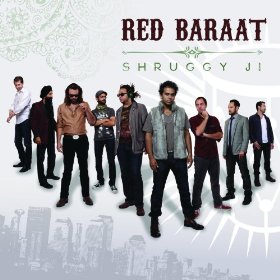 winkingly adopt the genre name “dhol-and-bass”.) I don’t know anything about bhangra or go-go, but I can’t see what they’d gain by lying, so I take this assessment as true.
As I’m starting my 50 Favorite Albums countdown here, I wanted to make a couple of public notes about the composition of this list. I’m happy with the fifty I chose, but I could certainly have made other choices. Most notably, I could have included some better-known records near the bottom of this list. David Bowie had a 2013 record; so did Nine Inch Nails; so did Camper Van Beethoven; they’re good records. I didn’t get much out of the new OMD album, but maybe if I’d worked at it harder I’d’ve loved it, like I do their 2010 comeback History of Modern. More likely, though, I’d’ve felt the way I do about the others I just mentioned: that while they’re fine, I haven’t found any reason why I, personally, would want to listen to them when the Man Who Sold the World or the Downward Spiral or Key Lime Pie (or the gallivanting Goblin King from Labyrinth) are still waiting in my collection for a fresh dose of ardor.
I don’t mean to be unfair. There’s a dozen-plus artists on my list here who are also operating below the level of what I feel was their peak; it’s a basic statistical principle that the more you enjoy an album, the more likely it is that you won’t enjoy any of the artist’s other albums as much, and that’s fine. Many of my old loves this year still made albums that — regression to the mean aside — don’t need from me the benefit of any doubt. But all else being equal? I’m less likely to return to my 5th-favorite Camper Van Beethoven album than to the best album of blazingly modern Central Asian folk-dance music I’ve ever heard. Even if “best” is a near-synonym to “only”.
**********
Genre labels aside, then: what does Shruggy Ji sound like? Lots of clattering percussion, played by three of the eight band members, including band-leader Sunny Jain. Lots of cheerful assertive brass – the trombonist, Ernest Stuart, plays with a far snazzier personality than his instrument normally allows – and trickier, more oblique tunes played by (I think) saxophonist Mike Bomwell, who’s also a superb soloist. Lyrics that are rarely in English (and never in Spanish, the only other language I can occasionally fight to a draw), but — when they are — imply the kind of depth and political instincts we first encountered in Fight for Your Right to Party. (This may, obviously, be unfair.)
The lead vocals, loud and gliding, sing melodies that may suggest, if you’re as ignorant as I am, snake-charmer music or Islamic summonings to prayer (what’s a couple thousand miles and a religious difference between friends?). The lead vocals are supplemented with jock-like backup grunts, “I’m too sexy for my shirt”-style low murmurs, and various noises I can best duplicate by vibrating my tongue really, really fast.
 The review that drew my attention to Red Baraat was, of course, favorable, but criticized the songs for all sounding alike. I’ll first say this needn’t be bad if true: I think the Sex Pistols’ Never Mind the Bollocks and U2’s Boy and Metallica’s And Justice for All and the Cure’s Disintegration are great records, and they’re all variety-impaired. Then I’ll say that I’m not convinced it’s true of Shruggy Ji anyway. The songs certainly mix from similar ingredients, but Halla Bol has a bouncy, dancing-under-the-influence feel that reminds me of “gypsy-punk” bands like Gogol Bordello; Burning Instinct, on the other hand, starts from gleaming precision — like a top high school marching band dressed up for a guest appearance on Miami Vice — then piles on layers of dissonance and a steadily more march-like harshness without ever breaking stride. Dama Dam Mast Qalandar feels solemn, pensive, without needing to clear away the percussion or slow down the hyperspeed sax solo. Shruggy Ji itself is a methodical slow-building juggernaut, several cycling drum lines giving it a fantastically assertive yet swaying groove as the horn section swaggers forward. Sialkot is a particularly strong drum showcase; Private Dancers, rhythmic as Morse Code, somehow manages to be funk, klezmer, and hip-hop all at the same time. Azad Azad has the sneaky propulsion of a nighttime chase scene in an old movie.
Red Baraat is only #50 on my list, for now, because I don’t understand the words, and I don’t really understand the musical traditions either. I can easily tell (some of) the songs apart by concentrating, but no matter how varied Shruggy Ji may be, it kind of all sounds like “oh hey, here’s more Red Baraat” to me because I have only a few other even remotely similar albums. (I can triangulate, badly, from Kultur Shock, Gogol Bordello, the Klezmatics, and the Debo Band, all of whom are strange to me in their own right). In other words, it’s only #50 on my list due to *my* weaknesses; ones I’m surely capable of fixing. And since it’s kinetic and jolly and exciting — well, as long as my stamina holds — it makes me wish to do so.
– Brian Block
To see the rest of our favorites, visit our Favorite Albums of 2013 page!
[AMAZONPRODUCTS asin=”B00AY9T0EY”]