Artist: Redwood Plan
Album: Green Light Go
For some of you, I can do a one-sentence review of the Redwood Plan‘s second album Green Light Go that’s reductive but useful: they’re like if Sleater-Kinney used catchy New Wave synthesizers and only Carrie Brownstein (the one who ended up in Wild 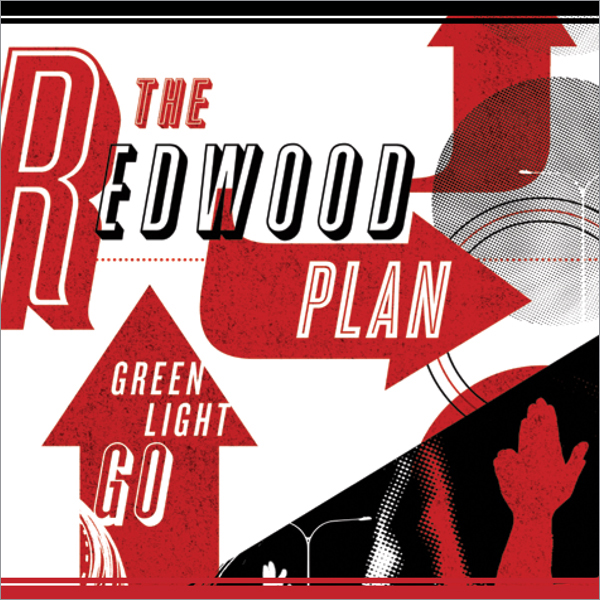 Flag)’s vocals. Or maybe like if X-Ray Spex featured a singer from Seattle instead of Brixton, better vocal pitch, and those catchy New Wave synthesizers instead of saxophone. Redwood Plan singer / keyboardist Lesli Wood doesn’t seem like she’d mind the comparisons: the punk/ riot-grrl scene, as a place to act out rebellion and personal liberation among friends, is a repeated concern of her lyrics. “We need to rattle at the cage, instead of staying silent”; “No one said it would be easy, or that it’s always fair/ You do it cuz you love it, that’s the motivation here”; “It’s been a long damn way to come/ to barely know which side you’re on”; that’s from three different songs. “Your mama gotta take it out on you/ and you are so vicious when you’re feeling so small/ but all the things that bug you don’t mean anything at all”, she sings elsewhere, on Your Fair Share. A song later you and she will “be strong” and “keep our stride” and “[not] waste a second” because “you and me, We are the Team“.
“We don’t need to work it out in silence/ You know that you got to get a reaction”, from the title track, is the record’s central premise. Of course the adult world screwed you up, of course you’re weak and conflicted, of course sometimes you’ve done the wrong thing; but Redwood Plan are here, with forceful singing and pumping drumbeats and limber electric guitars and anthemic blasts of synthesizer, to bring you back to your best self.
Lesli Woods’s full-time work is as a personal injury lawyer, which seems apropos, not because anything on Green Light Go is policy-political (it isn’t), but because hers is a misunderstood line of work whose clients, though often in the right, are looked on with contempt. Hundreds of urban legends circulate about personal injury lawsuits, in which greedy regular joes do something idiotic to hurt themselves, then sue innocent corporations and win millions of dollars. They virtually never hold up to Snopes-type investigations, which reveal that many of the legends are conjured from thin air — no burglar ever sued a homeowner for injuries  sustained while robbing, nobody ever sued a nightclub over getting hurt while trying to sneak in a back window — while most of the rest look entirely legitimate with facts in hand. When a jury awarded 79-year-old Stella Liebeck $2.9 million in damages from McDonald’s, for example, headlines about idiot jurors rewarding some ditz for spilling hot coffee on herself dominated the headlines; the stories rarely bothered to mention that Liebeck had spent eight days in the hospital receiving skin grafts, that McDonald’s regularly kept its coffee 60 degrees hotter than safety allowed, that it had continued to do so while ignoring over 700 reports of 3rd-degree burns from its coffee over a decade, that the “outrageous” fee awarded was two days’ worth of the profit McDonald’s made from coffee alone, or that the judge reduced the fine to less than 20% of what the jury awarded anyway. Woods, when she isn’t singing, is presumably urging her clients, too, to take seriously the wounds inflicted on them by criminal negligence, and not blame themselves just because most of their neighbors are blaming them. No surprise if it carries into the music, and her words-first delivery.
The arguable downside of the record is monotony: that however exciting one Redwood Plan song is, the others are doing the same thing. That’s not absolute, and there’s distinctions to be made. Panic On, the lead single, has an especially catchy clash of rhythmic elements hitting hardest at different beats. The Scenery & Melody is the prettiest song (though still at punk energy), the most plausible fake entry in 1983’s MTV rotation, and the strongest case for Woods being able to sing much more demanding kinds of music. Rattle has the most dance-club rhythm section, and even drops out twice for simple drum-machine solos. Your Fair Share shows the clearest awareness of Skinny Puppy, Nine Inch Nails, and the rhythms of public speaking. The One is sort of a synth-punk power ballad. It Goes Something Like This has a minor-key moodiness suggesting both goth-pop and Another Brick in the Wall, and the chorus rhythm is fierce and unpredictable, tied to the logic of rhetoric instead of beats. Green Light Go has lots of extra syncopation.
Still, these are differences on the margins, of songs that are 70% alike, and I’ve been known to be picky about that. I’m not very picky here because, if you’re going to have a formula, it might as well be a fast, catchy, exciting one. Thinking is an extremely important (and underrated) thing to do *before* the protest. During the action, it’s as important to still feel like acting.
– Brian Block
To see the rest of our favorites, visit our Favorite Albums of 2013 page!
[AMAZONPRODUCTS asin=”B00BC6AP88″]