web analytics

Blog

  • When music is a comfort…

    When music is a comfort…

    Times of trouble are when music is a comfort…

    B Strong for Boston
    B Strong for Boston
    Yesterday, I read about how in the wake of the Boston Marathon bombings, the New York Yankees honored their opponents, the Boston Red Sox, by playing Neil Diamond’s classic hit, “Sweet Caroline”. I don’t follow baseball, but I read that “Sweet Caroline” is a song traditionally played at Red Sox games and sung along to by Red Sox fans. That the Yankees played it in their honor was very classy, but their gesture had an odd effect on me. I found myself tearing up as I read about how the Yankees, indeed how New York City, showed love and solidarity toward Boston following the tragedy that had visited their city on a day that should have been celebratory.


    A clip of “Sweet Caroline” at the Yankees vs. Red Sox game…

    Unfortunately, this is not the first time tragedy out of violence has visited the United States, especially during the month of April. For some reason, as spring arrives, so does a certain insanity, which brings with it people who commit terrible acts against others. And it seems to be getting worse instead of better. Over the past twenty years, the third week of April has brought Waco, the Oklahoma City bombing, Columbine, the Virginia Tech Massacre, and now the Boston Marathon bombings.

    Now, every September 11th, we remember what happened on 9/11/01. My husband, Bill, who was then my boyfriend, was working in the Pentagon when it was struck by American Airlines Flight 77. I did not know if he was dead or alive that entire day. Later, he showed up on Yahoo! Messenger to let me know he’d escaped unscathed. About a month later, Bill escorted family members of one of the 9/11 victims at the Pentagon to a memorial service. He later described the service to me, telling me that the organizers had chosen a beautiful piece of music that he could not name. He said it was a very moving and comforting piece, like a balm for those who were so grief stricken following the shocking events of September 11th.

    I remember back in September 2005, just after Hurricane Katrina hit New Orleans, turning on James Taylor’s 1997 album, Hourglass, and being very soothed by it as I saw the terrible images of people who had lost everything in the massive storm. James Taylor released that album just after losing his father and a few years after having lost his older brother, Alex, to a heart attack. Alex Taylor died on James’s 45th birthday, in part due to his alcoholism. The songs on Hourglass are largely about the troubled times Taylor had endured in the 1980s and 90s. In 1996, he was freshly divorced from his second wife, Kathryn Walker. He seemed to be struggling to make sense of the world with that album, and yet I found it so very comforting as I watched the news and saw so many sad, anguished people.


    “Enough To Be On Your Way”, a tribute to James Taylor’s brother, Alex.


    “Jump Up Behind Me”, a song James Taylor wrote to honor his father, who rescued him when he was struggling with depression and drug addiction as a young man.

    Beth Nielsen Chapman has written several songs that are comforting. Her song “Sand and Water” has been used in several prime time television shows in scenes involving death. She wrote it after having lost her husband, Ernest Chapman, to cancer in 1994. The song has since provided comfort to people who are grieving, but the words are so deeply personal. In the song, she references her son, Ernest, who was a young teenager when he lost his father.


    Beth Nielsen Chapman performs “Sand and Water” with Kieran Goss at the Grand Opera House in Belfast, Northern Ireland.

    Another song that Beth Nielsen Chapman sings that I personally find very comforting is “Godspeed”, which she co-wrote with Annie Roboff. The song was included on the 2001 compilation, The Prince of Egypt: Nashville. The first time I heard this song in 2004, I fell in love with it. It never fails to bring a lump to my throat and tears to my eyes.


    Someone used “Godspeed” in a YouTube memorial for Princess Diana.

    When Bill and I lost our beloved “bagel” dog MacGregor, who died rather suddenly after we discovered a malignant tumor invading his spinal column, I found myself comforted by several bluegrass songs. I know MacGregor was just a dog, but he was a very special companion to Bill and me. Music helped us process the pain in losing him. When Alison Krauss was an up and coming star, she recorded a beautiful song called “On Heaven’s Bright Shore”, which always makes me feel better when I lose someone dear… after a good cry, of course.


    I’m not particularly religious, but this song always comforts me, as does Rhonda Vincent’s beautiful tribute “I Will See You Again”.


    About twenty minutes after we lost MacGregor, this song popped up on my iPod. Bill and I were driving home from NC State’s veterinary school with tears rolling down our cheeks. Even as I write this, I’m getting choked up from the memory.

    I wish we didn’t have such a need to grieve right now. Just months after the Sandy Hook shootings in Connecticut, we are once again plunged into the shock of unexpected violence perpetrated by someone who felt the need to make a statement with violence against innocent people. Just this morning, I read about a massive blast at a fertilizer plant in West, Texas, that could have been the result of an accident or criminal activity. At this writing, it’s not clear what’s happened or why. As you process the senseless events of this week, I wish you peace and the right music to bring you comfort.

  • Religious rock stars…

    Religious rock stars…

    I was very sad to hear about the tragic violence that happened at the Boston Marathon yesterday. It seems that April is the cruelest and craziest month for some people. This week, in particular, seems to be when certain people lose their minds and go on violent rampages. My thoughts and prayers are with those who have been directly affected by this act of terrorism. Peace be with you.

    Roger McDuff
    Roger McDuff

    I was recently reminded of a brief obsession I had with Trinity Broadcasting Network… and its religious rock stars

    Some of my readers may know that I often write reviews for Epinions.com. I’ve been writing on Epinions for over ten years, so I have a lot of reviews posted, any one of which is liable to be read and rated by another Epinions reader. Last week, someone rated a review I wrote about Trinity Broadcasting Network, a religious cable channel I kind of got hooked on back in the summer of 2003. I didn’t watch TBN because I’m especially religious. If I were religious, I doubt I’d get much out of televangelism anyway. I watched because TBN often has its unintentionally hilarious moments. TBN founder Paul Crouch, after all, once gave a very interesting speech about “doctrinal doo doo“.

    Anyway, since someone had rated my review of TBN, I decided to read it again. Suddenly, I was reminded of how funny and entertaining televangelism can be, particularly among the musicians. I posted the review on one of my blogs and a reader whose mother was a fan for the same reasons I was, left me a comment about one of the entertainers I had mentioned in the review. When I wrote my review in 2003, I noticed a man with a very impressive full head of white hair that made me think of Q-tips. I didn’t mention the performer by name, but my reader knew exactly who he was and had some very funny anecdotes to share about him and his wife. Apparently, this guy is a star on TBN. His name is Roger McDuff.

    I found a clip of him on YouTube, performing in 1983 with pink haired Jan Crouch, co-founder of Trinity Broadcasting Network. I watched it, fascinated that this guy had made a career out of singing on TBN. While I don’t think his singing voice is terrible, his vocals are not particularly outstanding, nor is he much of a dancer. And yet back in 2003, he was still on TBN, cavorting with Jan Crouch. Obviously, McDuff has a lot of fans out there in TV land, even if his performance in the above clip reminds me a little of karaoke.

    As I watched a couple of clips of Roger McDuff dancing and trying to sell Jesus to the masses, I was suddenly reminded of a true religious rock star. Mike Farris is a musician I discovered when a public relations firm in Nashville sent me a couple of his CDs to review. Again, I’m not particularly religious, but I do appreciate good music and talented performers. Mike Farris is definitely a musician who has the goods. I remember listening to his 2008 CD Shout! Live, which was recorded with his Roseland Rhythm Review during one of his Sunday Night Shout performances in Nashville. I remember thinking that if I were an atheist, I might be swayed to belief by Mike Farris’s music . At the very least, I figured I’d have a great time at his show. His energy and charisma are infectious, even if you’re just listening to his CD.

    In the above clip, Mike Farris performs “Can’t No Grave Hold My Body Down”. It’s played by real musicians and sung by someone who can sing and knows how to sell a song. As I listen to Farris and his band, I’m thinking I’d love to see him live. And I wouldn’t laugh at him the way I’d laugh at Roger McDuff.

    It should come as no surprise that religion spawns a lot of stars. Many faiths depend on the emotional connection people have with inspirational music and charismatic orators; they help convince people to believe. And so the most successful religious leaders usually have a lot of talent and charisma. Sometimes, people start off as religious performers and go secular, and sometimes they start off secular and become religious.

    The late, great comedian Sam Kinison started out as a preacher. He used his ability to preach to convert legions of people to his brand of comedy. I clearly remember back in the fall of 1990, listening to the radio station at Longwood University. Someone played Sam Kinison’s hilarious cover of “Wild Thing”. I never would have guessed back then that he had once been a preacher, but it later made perfect sense, given his comedic style.

    Sam Kinison’s video for “Wild Thing” even starred former church secretary Jessica Hahn, the very same one who helped cause the downfall of televangelist Jim Bakker’s ministry.

    Rock star Katy Perry was raised by evangelical Christians and released a gospel record in 2001 before she turned to mainstream pop in 2008.

    Here’s a clip of her singing under her original name, Katy Hudson, when she was still performing gospel music. I must admit, I don’t really follow Katy Perry’s career, but she’s obviously very talented and charismatic. Religion gave her a place to hone her talents before she burst on the pop scene.

    Another very talented band that came out of religious roots is Robert Randolph and the Family Band. I was introduced to these talented folks in 2004, when they opened for Eric Clapton. Robert Randolph started out playing music in church and now he’s getting more fans by the day.

    The Osmond family is obviously a religious musical group, owing to the family’s strict Mormon beliefs. But they’ve been performing secular music for over fifty years, with genres spanning everything from barbershop quartet to country. Unlike many young Mormon men, most of the Osmond brothers did not serve a mission for the Church of Jesus Christ of Latter-day Saints, mainly because they were helping to convert people with their music. Nevertheless, they did release a religious concept album in the 1970s called The Plan.

    This is a clip from The Plan. It’s a far cry from their hit song, “Crazy Horses”, which was about air pollution.

    And, I would certainly be remiss if I didn’t mention Pat Boone, who back in the day was considered a sex symbol akin to Elvis Presley. It’s kind of hard to believe that now, as he shills products on television and makes anti-Obama statements. Still, the man was a bona-fide rock star and movie star in the 1950s and 60s and remained a star in Christian circles well beyond his heyday.

    Many years later, he even released a “heavy metal” album. Okay, it was an album full of his big band interpretations of heavy metal songs. Still, I had to give him credit for trying to be cool.

    Despite all of the talented performers that have come into or out of religion, I still have to admit I get a huge kick out of watching the less talented ones on TBN. I also admit to occasionally watching Ernest Angley’s show solely for the cheesy music. What can I say? It makes me laugh.

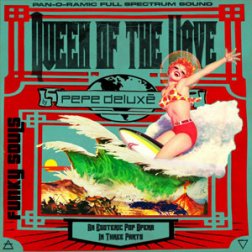
  • #10 album of 2012 – Queen of the Wave by Pepe Deluxe

    Artist: Pepe Deluxe

    Album: Queen of the Wave

    Queen of the Wave, the fourth album (but first for me) by the Finnish band Pepe Deluxe, is an unlikely combination of two things. It’s a slick modern album of disco-informed dance-pop. It’s also a ludicrously ambitious and overstuffed progressive-rock story album. It’s assembled from dozens of pepe_deluxe_queen_waveinstruments: some as old as harp, harmonium, harpsichord, and clavinet; some random and exotic; some as retro-modern as an attempt to collect every form of organ (keyboard, not bodily part) from mini-Moog to Hammond to Farfisa to pipe organ to Mellotron to an organ carved from giant stalactites. There’s also more than a dozen vocalists here playing different parts, each of them charismatic. I love Queen of the Wave most for being a brilliant success as dance-pop. Its success is simply informed and enhanced by the overreach.

    I’ll detail the first five songs to illustrate. Queenswave opens with folky acoustic guitar, synth-drones, a wide variety of birdcalls, and solemn vocals, adding Jethro-Tull-styled flute (played with tongue) and maracas, then drums and metallophone and a second vocalist and a steadily more insistent beat. Then comes harp, joined by buzzy electric guitar that then essays a classic funk-rock solo, circling back in the end to Tull-as-dance-band territory. A Night and Day gets compared to old James Bond theme songs, with funky shuffling drums and bass, lean retro guitar production, whooshing and sirening background noises, and soulful but commanding female vocals. It also has a spectacular a-capella breakdown and a fast-paced strafing keyboard melody, both of which keep the dance rhythm firm. Go Supersonic is similar, adding to the soul singer the second and third obviously-different female vocalists (one cooing, one domineering and operatic). There’s a cheerleading insistence to its choruses, impatiently tugging along its gentler verses and bridge. Temple of the Unfed Fire is a variant on the disco idea that anyone can like classical church music if you put it over a good enough dance beat, though as with most tracks here, the drumming is by humans, and very good indeed. Contain Thyself is folky in singing and instrumentation (here’s that harpsichord! here’s a subtle nod towards Irish reel! here’s more tongue-flute! here’s vocal counterpoint equally worthy of Bach or ’60s girl-group pop!), yet easily absorbs a massive drum-and-organ break.

    The second half is just as good. The ultra-danceable Grave Prophecy  and the Storm arguably travel farther afield than anything I’ve written about, My Flaming Thirst is calmer and more elegant while still eccentric, and the solemn Riders of the First Ark may be the catchiest track here. I mentioned there’s an over-arching story … well, uh, it’s about heroes and villains at the end of the lost continent of Atlantis, and “Let me tell you of a tale that’s true” is the first invitation the album gives you. The drowning of the last unicorns is here too. This took, for me, some getting used to.

    Atlantis was, of course, imaginary — conjured from nothing as a hypothetical in a Socrates dialogue — and one of my early influences on How To Think was a man named Martin Gardner, best known for creating advanced-math puzzles at Scientific American but also fond of making logic-puzzle books for kids. Gardner was pro-whimsy — in his puzzles, in his adoration (passed on to me) of Alice in Wonderland — but he was a fierce, hyper-earnest opponent of pseudoscience: tales of Roswell aliens and psychic powers and healing crystals that people actually believe. Atlantis, apparently, is something millions of people take seriously; Pepe Deluxe might, for all I know, be among them. From childhood I’ve been conditioned to find Queen of the Wave‘s lyrics painful.

    pepe_deluxe_bearIn practice, they’re not great, but I’m admitting their Atlantis tale has some resonance. Advanced human civilization drowned at the peak of its glory, taking beloved species with it; is there no familiar ring to that? Human civilization emerged in the Iraqi/ Israeli “Fertile Crescent”: we over-farmed it and turned it into desert. Greek and Latin civilization emerged in lush, fertile areas that became steadily less so. Easter Island civilization was advanced enough to destroy every tree, and itself, in the process of building impressive statues. Unicorns strike me as a mushroom-fueled vision of rhinoceri, but woolly mammoths and saber-tooth tigers and giant herds of buffalo were real, and huntable, until they were gone.

    Global-warming denialists sometimes lead with pure falsehood — claims that “global warming stopped in 1998” (no, the last sixteen years are the sixteen hottest on record, give or take a year or two depending how you measure), or that there have been hotter periods since the rise of cities (based on, to pick a literal example that’s been passed around on right-wing sites, measurements at a single point 500 feet under the ice in Greenland). But some of the things they say are, narrowly, true. Human pre-history had slightly warmer periods than today: true (although check again in 2030). Earth life in general had *much* warmer periods than today: also true. Warmer temperatures, in the abstract, are good for plant growth: sure, which is why, when Svante Arrhenius brilliantly discovered the process of man-made global warming way back in 1896, he wanted people to speed it along on purpose.

    All of which misses the point. The rate of change we’re putting our climate through is much faster than even the starts and ends of the ice ages, and our civilization, animals, and plants aren’t adapted for rapid warming. A couple degrees Fahrenheit increase doesn’t sound like much, and for most purposes it isn’t, but it’s been enough to multiply the number of extreme-high temperature days that can decimate a season’s crops. It’s been enough, since warmer air holds more water vapor, to create heavier storms and longer droughts. It’s been enough to trick the life cycles of plants, so they start growing six weeks early and get felled by snap freezes. It’s been enough to start drying out our rain-forest trees, making them vulnerable to massive fires that level everything for miles, because even though evolution *can* make trees for hotter jungles, it *hasn’t had time to*.

    Then, of course, there’s been the melting and cracking of the polar ice sheets: a process we don’t fully understand yet, which has kept occurring faster than the scientists’ models. Melted ice becomes ocean water. More ocean water leads to higher sea levels. Higher sea levels lead to floods. More than half of the biggest cities in the world live close enough to the coast to be at risk. When the floods come, will Queen of the Wave be a smart enough album to serve as our eulogy? Not by itself, no. But it’ll be on topic, unlike our political discourse (although at least Finland is part of Europe’s moderately useful cap-and-trade carbon policy). And it will be much, much, much more fun accompaniment for swimming across the dance floor.

    – Brian Block

    To see the rest of our favorites, visit our Favorite Albums of 2012 page!