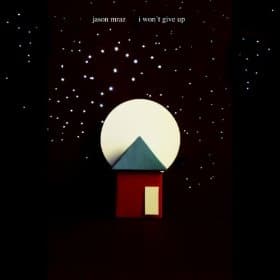
I Won't Give UpWhen we think of the kind of pop stars that thrive on periodic self-reinvention, we generally think of women. Madonna, of course, is the mother superior reinventer, but it’s basically a fact of life for even a minor female pop star that you don’t wear the same look twice and personae should be changed as often as underwear. You know – to stay fresh and stuff.
We don’t think this way about the guys though, do we? And maybe it’s just because in the last 30 years or so, there have been so few male solo artists who have sustained careers in the pop spotlight past their first or second hit that they either don’t stick around long enough to reinvent themselves – that or their reinventions go completely unnoticed. Let this be a warning, Jason Derulo! This is why “I Won’t Give Up”, the new single by Jason Mraz is so surprising.
It’s not the music so much (although there’s that too): it’s the look. I don’t know if it’s more 1971 hippie or 1991 grunge, but Mraz has made a clean break with the my-life-is-a-sunny-beach, dorky-straw-fedora thing that made him a star. Check out the new video, which got a much-hyped premiere on the E! Network on Thursday:
“I Won’t Give Up” sounds to me a lot like late 70s Poco (I mean that in a really good way), only with a bridge that sounds somewhat plagiarized from the Starland Vocal Band (regretfully, also meant in a really good way). I kinda like this song. It’s not the instant charmer that “I’m Yours” was, nor do I think that it will have that song’s legs (has “I’m Yours” ever really dropped out of heavy rotation on Top 40 radio?).
On the other hand, it’s also missing all the things that made me hate to love “I’m Yours” – the cheesy, white-boy-scatting vocals chief among them. On the other hand (is that three now?), this video feels awfully emotionally manipulative (the electrical poles as crosses in the background – sweet touch there) and it makes me like the song less. I’m not looking forward to hearing this one played behind every inspirational Olympics montage, or American Idol introductory video, or PETA commercial for the next two years.
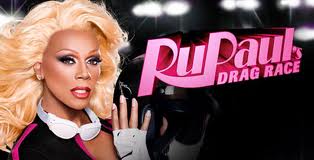
RuPaul’s Drag Race (Logo, Monday nights), which is just a few episodes into its fourth season, follows much the same template as other reality competitions like Project Runway or Top Chef. Skilled creative types are given a weekly challenge. In the end, there’s the top 3 and the bottom 3 and there’s a winner and there’s a loser, and the loser gets the boot.
But RuPaul’s Drag Race throws in one last speed bump on the road to elimination, a chance for one of the week’s bottom two performers to redeem themselves in the eyes of their drag mama RuPaul: Lip Sync… for your Life. At worst, this is a just a way to mark time before we learn of RuPaul’s final decision. But occasionally, one of the queens delivers a performance that is, well… life-affirming (seriously!), transcending its context and completely validating lip-sync as a high art form.
This week, drag queen Dida Ritz, along with rival The Princess (who, strangely, decided to rock chemotherapy-chic this week) was up for elimination. With guest judge Natalie Cole looking on, the two queens took the stage to lip sync Cole’s 1975 hit “This Will Be” (aka “The eHarmony Song!”) and Dida Ritz not only didn’t “f*ck it up”, she very nearly stole the song from its originator for good.
It helps that Ritz bares some passing resemblance to Natalie Cole, but that’s just the gravy. It was her lip sync itself – not her look – that not only saved Dida from elimination but, in the space of a couple of minutes, made her look like a frontrunner in this season’s competition.
She absolutely embodied the song; she owned it as if she’d written it herself and her dance moves and expressions seemed such a natural extension of the music that it made me feel like I was hearing the song for the first time – no small feat considering how ubiquitous the song has become in recent years thanks to Dr. Neil Clark Warren. Almost as fun as watching Dida Ritz, is watching Natalie Cole watching Dida Ritz! It’s the happiest three minutes of TV I’ve seen in ages.
Sadly, Logo hasn’t posted an isolated clip of the Lip Sync for Your Life segment of last week’s episode. But if you don’t want to watch the full episode (although you really should because the show’s sorta awesome), fast forward to the 38 minute mark:
Bruce Springsteen’s latest single is called “We Take Care of Our Own”. The first single from his forthcoming album Wrecking Ball (due out March 6), it’s been out for about a month now, but it got a boost earlier this week when Springsteen and the E Street Band opened the Grammy Awards broadcast with a rousing performance of it – I believe (could be wrong here), the first televised appearance by the band since the death of saxophonist (and spiritual leader) Clarence Clemons last spring. Their performance was loud and triumphant, and the song itself harkens back to the band’s anthemic stadium rockers of the 80s – songs like “Hungry Heart” and “Glory Days” and, of course, “Born in the U.S.A.”
I’ve always been more a reluctant Springsteen fan than a true believer. As much as I loved hearing those songs from the Born in the U.S.A. album on the radio, I never actually bought the album – which, having generated no fewer than seven Top 10 singles, was virtually a greatest hits comp – until much later. Even when I did, I rarely listened to it.
Wherever This Flag's Flown…I have a theory about this. Springsteen has certainly put out some intimate, personal, quiet records, but his most popular ones – specifically Born in the U.S.A. – almost require a communal experience in order to work. You can’t – well, I know I can’t – plop Born in the U.S.A. on the turntable and sit down by myself and just listen. It’s a sound that needs some kind of public space and some kind of crowd to really get across and be heard properly, whether that space is a packed arena and a fist-pumping audience, or the virtual space of a broadcast for a crowd of TV viewers or rush hour commuters, preferably with the volume turned up and the windows rolled down. (I just checked, and it appears that at some point, I got rid of my Born in the U.S.A. CD. I’ve never missed it. After all, its songs still get play on the radio.)
This might also explain why a politician might gravitate to Springsteen’s songs. They sound great at rallies! They’re the audio equivalent of blue jeans and rolled up sleeves. It’s music that brings the people – both bourgeoisie and rebel – together. Hearing the E Street Band, still recovering from their own personal loss, playing “We Take Care of Our Own” to a crowd still reeling from the sudden death of an industry icon; listening to the song’s determined stomp, its optimistic chimes, and its purposeful titular declaration, a thought occurred to me: how long before a Republican presidential candidate uses “We Take Care of Our Own” at a campaign event, totally missing the irony?
Like many of Bruce Springsteen’s most popular songs, “We Take Care of Our Own” is like a Southern Baptist sermon delivered in Arabic
It wouldn’t be the first time this year. Mitt Romney’s already run afoul of rapper K’Naan by using the song “Wavin’ Flag” during his Florida primary victory speech. (K’Naan, a Canadian Muslim who was born in wartorn Mogadishu, Somalia, was understandably upset to hear the message of his song co-opted by an overprivileged white American corporatist who proudly claimed to be not concerned with the very poor.) Nor would it really be the first time conservatives have embraced Springsteen. Born in the U.S.A. was released right into the ’84 election season (y’know, the one that brought us the 49-state landslide victory for St. Ronald), and Reagan and his backers boldly appropriated the patriotic sound of Bruce’s message while missing the message itself entirely.
One could almost have forgiven them their cluelessness back in the 80s. The sound of Born in the U.S.A. is Republican catnip. and whatever political implications one might have drawn from his songs, Springsteen himself largely kept out of politics (until 2004, when he joined John Kerry at some campaign events – in 2008, he publicly endorsed Barack Obama). Like Southern Baptist sermons preached in Arabic, his songs expressed liberal (particularly unionist) sentiments using conservatives’ language: they are crowd songs, they have a patriotic, anthemic feeling; you can wave the American flag to them; you can sing along with them the first time you hear them. His latest is just one more example of that. As triumphant (and triumphalist) as it may sound, “We Take Care of Our Own” is not a song about how we as a country actually “take care our own.” It’s about how we’ve failed to.
So, note to Ron Paul: when you’re giving that victory speech in Maine this weekend to those die-hard supporters who admire the purist libertarian stance you champion: step away from the Springsteen. Try some Kelly Clarkson instead. Her songs also sound pretty good in crowds, and (bonus!) she knows a thing or two about winning votes.