web analytics

Author: Paul Lorentz

  • Awesome Free Download: Levi’s Pioneer Sessions – The 2010 Revival Recordings

    I’ll be honest: I’ve never worn a pair of Levi’s. The truth is I was such a total geek when I was in school that I didn’t wear jeans at all. I wore corduroys. Lots and lots of corduroys. Almost always: corduroys. Thankfully, I eventually grew out of that phase (though I still admire a man who can confidently rock a set of wide-wales), I never really accepted the notion of laying down respectable amounts of money for blue jeans. Count me among the Shopko shoppers in this department. Sorry Levi’s. I like their ads though. With all the Walt Whitman poetry and revolutionary youngsters running around bonfires all free and stuff.

    But it was a musical stunt they pulled this summer which landed Levi’s Jeans in my facebook news feed. Starting in May, they posted two free song downloads to their website each week until, a couple months later, they’d posted an entire album’s worth of songs – 13 in all, and all cover versions – a diverse and optimistic collection of songs performed by an equally diverse and generally unassailable roster of artists, including up-and-comers like recent Oscar-winning singer-songwriter Ryan Bingham, current hipster faves like The Dirty Projectors and Passion Pit, R&B and hip-hop veterans Raphael Saadiq and Nas, and a couple of crunchy granola adult contemporary stars Colbie Caillat and Jason Mraz, the former making a surprisingly convincing case that Blondie’s millennial-era reunion wasn’t a complete waste of our time with a cover of “Maria”, the latter enlisting a gospel choir for an unabashedly gimmicky revival of Norman Greenbaum’s “Spirit in the Sky”. From their introduction to the series:

    While much has changed about music over the past 50 years (artists, genres, popularity, formats, distribution, etc.), one thing remains true: The song is everything.

    The campaign (which has since ended) was called Levi’s Pioneer Sessions: The 2010 Revival Recordings, and though you can’t find it on CD, this collection is one of the best covers albums I’ve heard of late. The performances are generally casual and unfussy, but delivered with genuine affection. That part about the song being everything? It sounds like these artists’ mean it. John Legend and the Roots preview their just-released collection of vintage funk social consciousness Wake Up Everybody with a solid, horn-driven revival of the Stax/Volt obscurity “Our Generation”, while Ryan Bingham, with a courage bordering on foolhardiness, takes on a Stax/Volt classic – Otis Redding’s “That’s How Strong My Love Is” – and turns it into a devotional hymn for a whiskey-voiced loser.

    While Saadiq’s cover of the Spinners’ “It’s a Shame” is a virtual clone of the original and The Shins faithfully reproduce Chris Difford and Glenn Tillbrook’s signature at-octave “harmony” lead vocals on Squeeze’s “Goodbye Girl”, the best entries are also (no surprise) the ones that represent an actual departure in sound. In the reconstructive hands of Colombia’s dance-pop quintet Bomba Estereo, Technotronic’s house classic “Pump Up the Jam” is still a great dance song, but it’s a decidedly trippier, more disorientingly exotic (and, yes, bilingual) experience.

    Elsewhere, Passion Pit wring even more swooning starlit reverie out of Smashing Pumpkins’ “Tonight, Tonight” with their synth-spangled cover, while Glen Hansard (with Marketa Irglova as The Swell Season) sings Candi Staton’s “Young Hearts Run Free” (with gender-unadjusted lyrics) as a strummy folk admonishment – like someone played a joke on him and told him the 1976 disco hit was actually a Cat Stevens original.

    The one real bummer of the collection has nothing to do with the music, but with the cumbersome download process itself. There’s no way to download the entire 13 song “album” all at once – you have to click to each track individually, and even then, the website directs you to your e-mail inbox where each individual automatically sent e-mail re-directs you back to the site to actually complete the download. Urgh. That said, each of the tracks comes with a (pretty cool) customized thumbnail graphic, and if you’re not hot on that, each song’s webpage includes several downloadable photos of the artists, along with “liner notes” for their track. The inconvenience of the download process is easily outweighed by the quality of the music on offer – but also, duh, it’s totally free.
  • The Daily Awesome: The Beach Boys “This Whole World” (1970)

    “Late at night, I think about the love of this whole world…” Last night, I was taking a walk, now that the weather has cooled off some and we can be outside without being immediately attacked by mosquitoes. It was one of those rare walks that I took without headphones. It was more laziness than anything that kept me from going upstairs to get my iPod before I left the house. We’d spent a lot of the holiday weekend working out in the yard with the kids and I was sore all over. But the night was gorgeous, and even though we worked hard, I think we all had a lot of fun – we all felt good about what got done, the garden and the yard looked better than they had all summer. We’d spent some time with two of my sisters and their kids. We’d even carved a little time out for ourselves – playing lazer tag, bowling, go-karting, and eating a lot of pizza on Saturday afternoon.

    Last week, my partner and I attended a funeral for a woman we’ve known for a long time. She died of cancer – only a year older than myself. She was not really part of our regular circle of friends, and so it was hard to know what to say, or if there was really anything to say. The tragedy of it was so obvious that it felt vulgar to try to even say so out loud. I was thinking about her on my walk and about her little girl who would do the rest of her growing up without her, and I was thinking about my own family, my own kids, my own brothers and sisters, and how wonderful it is that we have each other – to play “dogs versus humans” in the park, to burn hot dogs on the grill, to roast marshmallows and watch our son discover how cool a styrofoam plate looks when its melting over the hot coals of a campfire.

    I’m not a religious person, but in the years since I first heard the Beach Boys’ 1970 Sunflower album, I’ve come to regard this little song – not quite two minutes long even – as a sort of profession of my own personal faith. “And when I go anywhere, I see love.” Enjoy.

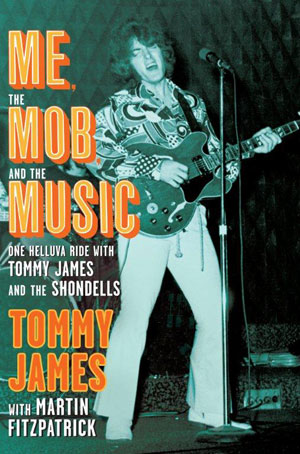
  • Sonic Clash Reads: Tommy James “Me, The Mob and the Music” with Martin Fitzpatrick

    Tommy James was a huge star when my mom was in high school. But his songs were everywhere when I was growing up in the 80s. Joan Jett was singing “Crimson and Clover”. The Rubinoos and Lene Lovich both did covers of “I Think We’re Alone Now”, but in 1987, everyone’s favorite mallrat Tiffany made the song a number one hit. And no school dance was complete without Billy Idol shouting “Mony Mony”. That song was ever-present – Billy actually charted the song twice. Apparently, my high school has banned the song from school dances these days due to a certain bit of traditional audience participation involving chanted profanities. I wouldn’t know anything about that.

    While I knew all those songs were covers, I’m not sure I ever quite made the connection that they all came from the same source until I was in high school, and it wasn’t until I picked up a Rhino Records anthology of his music that I had the first inkling of just how fascinating and joyously inventive a talent the guy was, nor just how popular he had at one time been.

    Born in 1947, Thomas Gregory Jackson was a prodigious little music geek from the Midwest, one who spent all his spare time (not to mention spare change) listening to music, hanging out at the record store, reading record industry trade magazines and fooling around with a ukulele. While his peers were collecting baseball cards and rattling off players’ statistics, Tommy was learning who was signed to what label, what songs were charting, and who wrote and produced them – and dreaming of seeing his own name on those little 7″ inch records with the big holes in the middle. In his new autobiography, Me, The Mob, and the Music, Tommy James likens the pleasure of 45 rpm records to candy. As a 45 lover myself, that comparison rung immediately true. And Tommy James put out some of the sweetest, most colorful chunks of audio candy in all of pop music. Some call his songs bubblegum; I like to think of them as Jolly Ranchers – intensely sweet, crystalline, and enduring.

    Tommy James and the Shondells “Mony Mony” (1968)

    Tommy was a working musician by his early teens, and he and his bandmates would cut the single that would launch Tommy to stardom when he was barely 16 years old. But “Hanky Panky” wasn’t an overnight hit. By the time some dj in Pittsburgh started spinning it in 1966, the band had long since broken up, Tommy and his high school girlfriend were married an expecting their first child, and staring down the reality of responsible adulthood. As it turned out, responsible adulthood would have to wait. For, like, a really long time. Me, The Mob, and the Music is billed as “one helluva ride”. That was what his boss at Roulette Records – the legendary (and infamous) Morris Levy – told Tommy he was in for the day he signed his first record deal.

    Within five years of meeting Mr. Levy, the lanky teenager from Niles, Indiana would rack up an astounding 20 hit singles including classics like “Mirage”, “Do Something To Me”, “Crystal Blue Persuasion”, “Sweet Cherry Wine”, and “Draggin’ the Line”. He got to perform on the Ed Sullivan Show, and rub elbows with his musical heroes (who became his musical peers). And with later albums like Cellophane Symphony (whose title track is a 9-minute instrumental recorded entirely with a Moog synthesizer) he also became one of the very few artists to transcend an early (and well-earned) reputation as a teeny-bopper to make it with the hipper FM radio crowd in the late 60s. With his knack for inventive pop production, he ably straddled a line between artsy and commercial – his pop songs were rarely disposable, and his experiments were rarely indulgent. He approached songwriting and recording with a sense of purpose and drive. But most of all joy. His records are loaded with joy.

    Tommy James “Sweet Cherry Wine”

    But as with any good rock ‘n’ roll story, the Tommy James story isn’t all fame and glory. Me, the Mob, and the Music details the challenges unique to working for a guy like Morris Levy, whose almost certifiably sociopathic business sense was paired with a strong paternal protectiveness, and whose ties to the Genovese crime family in New York would eventually put Tommy James’s career (and his life) in danger. It’s also a story about addiction, recovery, failed relationships and family. Both mostly it’s about his music and his conflicted and financially abusive “father-son” relationship with the volatile and manipulative Morris Levy, which continued long after James severed professional ties with the man.

    In fact, there’s very little in the book dealing with James’s “real” family. He checks in periodically on who he was dating or married to at various points in his career, but after the formative years, we don’t get much about what his parents thought of their only son’s stardom, or how it affected his relationships. Though James was a father at 17, he’s never a father in this book – he’s always “the kid” around the Roulette offices – and his son is only mentioned in passing. Maybe that’s another book. As it is, Me, the Mob, and the Music is as quick and engaging as any of Tommy James’s pop songs. It’s written in a very anecdotal style that makes it pretty breezy reading, and it offers a glimpse into the rise of a 60s superstar, the inner workings of Roulette, one of the iconic pop empires of its time, and the tragic downfall of its beloved tyrant emperor.

    Tommy James “Go” (1990)