web analytics

Tag: video

  • New Video!  Dee Snider Rocks “Mack the Knife”

    New Video! Dee Snider Rocks “Mack the Knife”

    He's gonna rouge his knees and roll his stockings down.
    Finally. Someone – someone great even – has exacted a satisfying revenge on Pat Boone. Pat Boone’s crimes against rock n’ roll are myriad and well-documented. In the mid-50s, his Wonderbread and butter was in recording squeaky clean covers of contemporaneous R&B hits (“black” music) marketed heavily to a mainstream pop (“white”) audience. Not only did his recordings diffuse the power and energy inherent in those songs (imagine John Mayer covering Nirvana), but it succeeded to keeping the original artists behind the songs – The Flamingos, The Charms, The Eldorados – off the radio and out of the record bins.

    Unsatisfied with the shameless real-time castration of some of rock n’ roll’s earliest classics, Boone attempted a late-late-late career comeback in 1997 by donning a leather vest (ewww) and doing a heavy metal theme album called No More Mr. Nice Guy, choosing 12 of the most iconic hard rock songs of the previous three decades and turning them into slick big band punchlines. (I’ll concede: his Latin-jazz take on Van Halen’s “Panama” has a certain Manilowian charm. Is that Reparata singing back-up?.) The obviousness of the song choices make the gimmick transparent. “Stairway to Heaven”? You get a sense that he’s playing for the laughs and doesn’t really respect the songs or the artists who originally performed them. It’s one thing to play fun with Van Halen, but when he starts crooning “The Wind Cries Mary”, that joke isn’t funny anymore.

    A few years after No More Mr. Nice Guy, 50s teen star turned 70s adult contemporary maestro Paul Anka recorded an album called Rock Swings, proving that this sort of thing can be done well; among a few gimmicky selections (“Smells Like Teen Spirit”, Van Halen’s “Jump”) he delivered lovely, stylish, and wholly unironic interpretations of such unlikely numbers as Pet Shop Boys’ “It’s a Sin” and the Cure’s “The Lovecats.” Rock Swings is still very much a Paul Anka album – there’s not a guitar solo in sight – but he approaches the alternative and hard rock songbooks the same way he might approach any other American standard. You get the sense that he really understands, for instance, what a great melodist Robert Smith is – and what a romantic. Listening to Anka sing “The Lovecats”, I wish he’d do a whole album of Cure songs.

    Dee Snider “Mack the Knife” (2012)

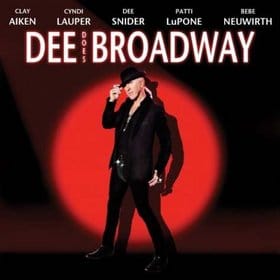
    This month, Twisted Sister frontman (and recent Celebrity Apprentice contestant) Dee Snider turned the tables, releasing Dee Snider Does Broadway. As a fan of both Twisted Sister and Broadway showtunes, I’m happy to report that Snider takes the Paul Anka approach to this concept: he clearly loves the songs he’s singing; he sings them damn well. And along with guests Clay Aiken (his Celebrity Apprentice rival) and Cyndi Lauper (another Celebrity Apprentice alum), he gets buy-in from two of the greatest Broadway divas of the last three decades: Patti Lupone, who joins Snider for the album-closing medley of “Tonight” and “Somewhere” from Leonard Bernstein’s West Side Story, and Bebe Neuwirth who reprises her role as temptress-from-hell Lola, a role she played in the 1994 hit revival of the Adler & Ross musical Damn Yankees, on a duet of “Whatever Lola Wants.”

    His duet with Clay “Always the Bridesmaid” Aiken on Frank Loesser’s “Luck Be a Lady” (from Guys and Dolls) turns that sleak, jazzy 1950 gambler’s plea into a shark-jumping send-up of Sunset Strip decadence. But while he never loses his sense of humor, he plays much of the rest of the stuff – an appropriately snarling take on “The Ballad of Sweeney Todd”, for instance – like the Twister Sister songs Stephen Sondheim had no idea he was writing. Which is to say not necessarily straight-faced, but also not entirely without reverence.
  • Commercial-isms:  T-Mobile vs. Laurie Anderson “O Superman”

    Commercial-isms: T-Mobile vs. Laurie Anderson “O Superman”

    HTC O… M Effing G
    I took it as further evidence of my exceptional parenting when my 17-year-old son perked up at the sound of Laurie Anderson’s “O Superman” coming across from the TV and pronounced “Awesome song!” In my head, I was congratulating myself: My son knows Laurie Anderson’s music! I am a good dad! I am a good dad! But this moment of parental pride was sullied when I realized that familiar “hah hah hah hah hah hah” (I always thought it sounded like a robot breathing) was being played in the background of a commercial. For T-Mobile’s new HTC One phone.

    Really?

    Now I’m not so naive to actually believe that, at least when it comes to pop culture, some things might actually be sacred. But seriously: what’s “O Superman” doing in a cell phone commercial? Suddenly the tired arguments about artists “selling out” with their licensing choices feel freshly relevant. Not that I think Laurie Anderson has sold out, nor do I begrudge her whatever money she might be making from a 30-year-old song that might only be regarded as a “hit” in the most artsy-NYC-hipster-ish sense. (It did top the Village Voice’s 1981 Pazz & Jop singles poll.) But there is something sad about such a monumental song reduced to… this.

    If you’ve never heard “O Superman”, you may be asking yourself just what the big deal is. And if you’re just hearing “O Superman” for the first time, you should know: it’s damn weird. But it’s also wonderful. As proud as I am that my son could identify it so readily, he was a tiny bit wrong in pronouncing “O Superman” an “awesome song”. It certainly is awesome, and I don’t mean “awesome” in the deeply trivializing 80s-vintage colloquialism sense, but rather in the Old Testament music to bring down the walls of Jericho sense. It is awesome. But to call it simply a song is also a little trivializing.

    For one thing, it’s just not very song-like. For another, it’s massive: eight-and-a-half minutes massive, sustained without benefit of a catchy chorus or an extended guitar jam or even a drum solo. The music is stark and electronic, the words poetic and prayerful, and delivered (through a vocoder) alternately as a monologue and a chant – ah-hah-hah-ah hah-hah-hah-ha-ah. It is by turns funny and sweet (“Hi Mom!”), and chillingly prophetic:

    Here come the planes
    They’re American planes
    Made in America
    Smoking
    or Non-smoking

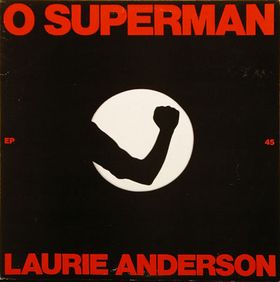
    There’s also a visual element that is integral to the song itself. In live performance, Laurie Anderson would play her synthesizer with one hand, and with the other, punctuate her lines with hand and arm gestures projected as shadows in a circle of light on a screen behind her.

    Laurie Anderson “O Superman” (1981)

    The song was first released as a NEA-funded limited edition 7″ single in 1981; the following year it became the centerpiece of Anderson’s major label debut record Big Science, which, itself, was conceived as part of an epic scale multi-media performance piece called United States, inspired largely by a four-year field trip Anderson took around the country, working various sorts of jobs as she went. “O Superman” is still regarded as Anderson’s masterpiece, and in the same way the “Hallelujah Chorus” (all 100 or so seconds of it) has become “bigger” than the larger work it was part of (Handel’s “Messiah” oratorio), “O Superman” has eclipsed United States in sheer concentrated power and historical resonance.

    The song was inspired by the aria O Souverain, O Juge, O Pere, from French composer Jules Massenet’s opera Le Cid, and alludes to its words. Laurie Anderson described the aria as a “prayer for a knight on the eve of a hopeless battle… a prayer about empire, loss, and ambition.”

    ‘Cause when love is gone, there’s always justice.
    And when justice is gone, there’s always force.
    And when force is gone, there’s always Mom.

    “O Superman” was also inspired by current events: specifically a tragically failed military mission during the Iran hostage crisis of 1979. But 9/11 and the government’s ongoing struggle to respond to it – both the military interventions in Iraq and Afghanistan, as well as the domestic policies passed in the name of security – have given the new song an even more powerful and unforeseen resonance. Here’s Laurie on performing the song to a New York audience a week after 9/11, from her notes to the 2007 reissue of Big Science:

    “During a top-secret mission to rescue hostages being held in Tehran, American helicopters crashed in a sandstorm and blew up. The mission’s failure was a blow to the United States’ reputation as a technological superpower and played a role in the downfall of the Carter Administration and the rise of Reaganism. Almost thirty years later we’re fighting the same war… I suddenly realized I was singing about the present.”

    So yeah, how about that skydiving fashion photographer? Here’s the song that opens the Big Science album:

    Laurie Anderson “From the Air” (1982)

  • Pop Rock International! Morten Harket “Scared of Heights”

    Morten Harket: Still Falsetto-riffic!
    No disrespect to R.E.M., but there may be no band break-up that got me in the gut harder than a-ha’s. We all remember a-ha, of course, for “Take On Me.” But it surprises a lot of people to find that the band, long celebrated as one of the 80s greatest one hit wonders was actually a two-hit wonder here in the U.S. (you mean, you don’t remember “The Sun Always Shines on TV”, a Top 20 hit in 1986?), and that they continued touring and recording for most of the next 25 years, racking up hits in Europe, South America, and Southeast Asia with singles every bit as glorious as their “one hit” – songs like “Forever Not Yours” (which boasted a great Noah’s Ark-inspired story video), the orchestral confessional “Shadowside”, and the driving, gothic “Celice” – not to mention “Summer Moved On”, a later-career falsetto-and-Spanish-guitar masterpiece, or their moving farewell single “Butterfly, Butterfly (The Last Hurrah)”.

    a-ha “Forever Not Yours” (2002)

    A-ha – Forever Not Yours (Clip) by Meubal

    They might not have gotten any play here, but each of the four studio albums a-ha released since 2000 is worth the import price you have to pay to obtain them, so, yes, it was incredibly sad for me to see this band call it a career at the end of 2010. I’ll take some solace that all three of these guys had already established interesting solo careers prior to the band’s break-up, and that the band’s dissolution is giving them time to give those endeavors more energy.

    Lead singer Morten Harket is first out of the gate with a new solo album. Out of My Hands is the fifth solo record by Harket, and his third English-language release (following 2009’s Letters from Egypt and 1995’s Wild Seed). He’s previewing the album with a pair of singles. In February, there was the lovely, driving “Lightning” which you can listen to below. And then, last week marked the premiere of the video for the second, a song called “Scared of Heights” that finds Morten indulging his falsetto maybe just a tad too much. The song’s fruity melody and even fruitier video (which features a lot of slow motion hair-ography – thank you for that, Glee – while Harket preens at the roof’s edge of a green-screen skyscraper) are an embarrassing reminder of some of a-ha’s not-so-great moments. Morten’s voice just works better on sadder sounding songs.

    Morten Harket “Lightning” (2012)