web analytics

Tag: Oldies

  • Commercial-isms:  JCPenney vs. Lesley Gore “Sunshine, Lollipops and Rainbows”

    Commercial-isms: JCPenney vs. Lesley Gore “Sunshine, Lollipops and Rainbows”

    Sunshine, Lollipops, Rainbows, and a Simplified Pricing Scheme

    Attention all professional (and do-it-yourself) outraged social conservatives! JCPenney is now officially f*cking with you.

    We all remember your impassioned pleas to the big-box retailer to drop their tacit endorsement of the homosexual agenda, embodied by their hiring of arch-lesbian Ellen DeGeneres to appear in a series of ads touting the chain’s revolutionary (giggle) new pricing scheme. Not only did they refuse to back down and give the job to someone more appropriate – like Elizabeth Hasslebeck – but recently, they’ve taken your hero Sarah Palin’s advice (Don’t Retreat: Re-Load!) and opened a new line of attack on family values. A stealth attack, even! Like the big bad wolf dressed up as sweet old grandma, JCPenney’s latest endorsement of the morally bankrupt gay lifestyle is dressed up as sunshine, lollipops, and rainbows.

    Or rather: “Sunshine, Lollipops and Rainbows,” the 1965 Top 20 hit single by Lesley Gore (from the movie Ski Party, starring Frankie Avalon!).

    Lesley Gore “Sunshine, Lollipops and Rainbows” (1965)

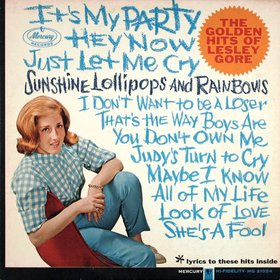
    Lesley Gore is most famous for a pair of singles (produced by a very young Quincy Jones), “It’s My Party” and its sequel “Judy’s Turn to Cry.” The two songs chronicle a love triangle between Lesley, her boyfriend Johnny (who seems like a total nob), and her duplicitous best friend Judy who shows up to Lesley’s birthday party wearing Johnny’s ring (it’s all good – Johnny goes back to Lesley!). Over the course of eight albums released by Mercury between 1963 and 1967, this Jersey girl covered an encyclopedic range of squeaky clean (and, it goes without saying, totally heterosexual), romantic teenage drama, each two-minute song a self-contained soap opera.

    In “Hey Now”, she tells off an indecisive beau (it’s like a 20-year-pre-emptive reply to The Clash’s “Should I Stay or Should I Go” with an even more contagious groove). In “She’s a Fool”, she calls out another girl for mistreating her boyfriend (upon whom Lesley is crushing). In “Maybe I Know,” she admits she’s in denial about her cheating boyfriend (“deep down inside, he loves me!”), but won’t DTMFA. And in the darkly fabulous “You Don’t Own Me”, she asserts some pre-feminist girl power: “Don’t tell me what to do, and don’t tell me what to say, and please when I go out with you, don’t put me on display.” (In 1987, the song was covered by the British synth-soul group The Blow Monkeys for the Dirty Dancing soundtrack – that was where I first heard it – and I remember my sister and I being scandalized/titillated by the way lead singer Dr. Robert sang it without changing the gender of the verse: “Don’t say I can’t go with other boys.”) Here she is, having just turned 19 years old:

    Lesley Gore “It’s My Party”(1965)

    “But, Paul,” the conscientious social conservative might ask, “these are sweet, wholesome, totally heterosexual songs sung by a sweet-faced pre-sexual revolution teenage girl.” But are they? Are? They? The fact is – correction: the superfabulous fact is… that Lesley Gore is gay. She hasn’t had a hit single since 1967 and for the last 40 years she’s mostly been retired from recording. (She has occasionally released new music – her most recent album was 2005’s Ever Since, a collection of torchy jazz interpretations, including a great new version of “You Don’t Own Me”) But in 2004, she started hosting the PBS LGBT newsmagazine In the Life, and came out publicly soon thereafter. That’s right, OneMillionMoms.com! JCPenney now have two lesbians shilling for their newly simplified pricing schemes!

    Of course, like Ellen DeGeneres, Lesley Gore is one of those people it’s extremely hard to dislike, much less hate. When I was 11 or 12, and receiving my allowance in 45 rpm records (I would give my Mom a list), my mother snuck in a reissue “oldies” single of “It’s My Party” b/w “She’s a Fool” in between the latest hits of Duran Duran and Culture Club, and I became an instant Lesley Gore fan. And that was long before I’d ever heard “Sometimes I Wish I Were a Boy“! And really, how do you protest against sunshine, lollipops, and rainbows?
  • Oldies Station: The Association, and “Darling Be Home Soon”

    Oldies Station: The Association, and “Darling Be Home Soon”

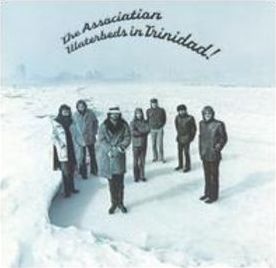
    Waterbeds in Trinidad (1972)
    I recently completed my collection of The Association‘s CDs when I discovered a reissue (from the British label Rev Ola) of their 1972 album Waterbeds in Trinidad!, their first and only record for the Columbia label following their departure from Warner Bros. with whom they’d had their biggest hits in the 60s – harmony-drenched songs like “Never My Love” and “Windy” and “Everything That Touches You”.

    The group’s fortunes waned towards the end of that decade as their old fashioned vocal pop sound and earnest, collegiate lyrics fell out of fashion, but they continued recording into the 70s; their sound, which, with virtually every band member a singer-songwriter, was never entirely coherent anyway, evolving in a more country-pop direction.

    The Association “Along Comes Mary” (1966)

    It had been nearly four years since the band’s last real hit when Waterbeds in Trinidad! was released, and the move to a new label did nothing to revive interest public interest in their music. That’s unfortunate because it’s really a solid, confident record full of some of the group’s loveliest performances.

    The Association “Come the Fall” (1972)

    The album’s opener, a rousing singalong cover of singer-songwriter Ron Davies’s “Silent Song Through the Land”, remains one of my favorite Association songs, although as far as I can tell, it was never released as a single and, like the rest of the Waterbeds album, isn’t available commercially for download in the U.S. (The Rev Ola import CD is available at a fairly reasonable price though.) Click here to hear some of it.

    Two singles were released from the album, “Come the Fall”, written and sung by the group’s own Terry Kirkman (who had also written and sung the group’s biggest hit “Cherish” in 1966), and a gorgeous cover of The Lovin’ Spoonful’s 1967 hit “Darling Be Home Soon” sung by the group’s resident psychedelic pop balladeer Jerry Yester. Both songs failed to chart on the Billboard Hot 100 (the latter “bubbled under” at #104). That August, the band would lose bassist Brian Cole (that’s him doing the goofy band intro to “Along Comes Mary” above) to a heroin overdose.

    The Association “Darling Be Home Soon” (1972)

    Of course, doing a lovely version of “Darling Be Home Soon” is like taking a pretty picture of a sunset. The song is filled with so much quiet yearning, and it’s got a such a sweet, delicate melody, you’d almost have to try to mess it up. As such, it’s one of John Sebastian and the Lovin’ Spoonful’s most covered songs. And artists as diverse as Bobby Darin, Joe Cocker, and British glam rockers Slade have taken it on. Then again, while anyone can take a pretty picture of a sunset – and just about everyone has – how many of those pretty sunset pictures are memorable to anyone besides the photographer? I like to think that The Association took the definitive picture of this particular sunset.

    John Sebastian “Darling Be Home Soon” (1970)

  • MHW Reads: A Requiem for a Not So Endless Summer

    Bob Greene's book "When We Get To Surf City"How’s this for serendipity?  20 years ago, journalist Bob Greene wrote a book based on a diary he kept as a teenager in 1964.  The book was called Be True to Your School, and, a few years after its publication, it caught the eye of a guy named Gary Griffin, who, as a touring musician, spent a lot of time in airports.  Griffin picked up the book at an airport bookstore – just something to read – and one of the book’s diary entries, in which Greene notes that he picked up the new 45 by the surf music duo Jan & Dean, caught Griffin’s eye.  At the time, Griffin was playing keyboards for the legendary duo as they were making their way across the country in their annual summer tour, and after a few phone calls had arranged for Bob Greene to join them at a show.  
     
    As it happened, Greene’s starry-eyed meeting with the aging rock ‘n’ roll idols of his youth turned out to be the start of a beautiful friendship – with Jan Berry, Dean Torrence, and the guys who helped them deliver there two-and-a-half-minute odes to fun in the California sun to Midwestern state fairs, Mississippi casinos, private corporate parties and reunions across the country every summer; and his latest book When We Get To Surf City is an affectionate memoir of the days and nights he spent on the road with these “Lost Boys”, as he calls them – men in their 40s, 50s, and 60s playing their iconic songs about “The New Girl In School” and places like “Drag City” and “Surf City” as if they were still teenagers, and in so doing, providing the nearest possible approximation to a portable fountain of youth. 

    (more…)