Okay, so I’m late with the Buffet this week. I wish I could say it was for some dramatic pressing emergency (actually, I’m glad I can’t), but that wouldn’t be true. In fact, I spent an incredible (incredibly sad?) amount of time digitizing my collection of vintage vinyl Broadway cast albums. The Tony Awards are only a week away, and like football fans ahead of the Super Bowl, I have to quell my growing craving for showtunes any way I can. This weekend, that just meant spending time using Audacity to try to minimize the pops and clicks in my copy of the cast album of Wildcat, a 1960 Cy Coleman musical starring Lucille Ball as a conniving wannabe oil prospector (did I mention that Desilu Productions put up most of the money for this?).
The show proved to be a miserable failure, meeting with one catastrophe after another. Its Broadway opening delayed because trucks containing the show’s sets were stranded in a blizzard, and the show was closed and re-opened repeatedly due to Ball’s health problems. One night, she collapsed on stage. Moreover, nobody was coming to see Wildcat – they were coming to see Lucy, and Ball gradually tried to assimilate her role as the title character with her popular TV Lucy persona, an unfortunate acting choice that peeks through a bit, like a persistent grease stain, on the cast recording. The ailing Lucy couldn’t sustain the brutal work schedule, and when producers attempted to replace her temporarily to keep the show going, audiences demanded refunds and the show closed for good by June 1961, and was completely snubbed by the Tonys (which, in fairness, were far more competitive for musicals in 1961 than they are in 2010).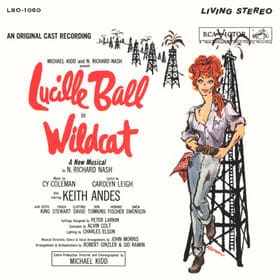
I don’t have any of those excuses. There were no blizzards in Wisconsin this weekend. But since I’m doing Sunday Brunch on Monday, I thought I’d collect some music videos where the artists are not as they seem. A couple weeks ago, I posted the new video by British techno-popsters Hot Chip, “I Feel Better”, in which a boy-band called Hot Chip and their audience (which includes the members of the real-life band Hot Chip) meets with random apocalyptic disaster… twice. It made me think of other videos in which the artists are played by other people.
I think the first time I ever noticed a video where the person lip-syncing the song wasn’t the actual singer was the video for “I Can Dream About You” by the late Dan Hartman. The song was from the movie Streets of Fire, which, being 10 years old at the time, I was mercifully disallowed from seeing. But had I seen the movie it might have cleared a few things up for me. (Another edit of the video shows Dan Hartman playing a bartender while this video plays on a TV screen in the bar.) “I Can Dream About You” was the first Dan Hartman song I’d ever heard, and for the longest time, because of that video (and from the song too, which is one of the 80s’ foremost chunks of blue-eyed soul), I thought Dan Hartman was black. So when he had another single out a little while later called “Second Nature”, with a video featuring a white guy singing, I was totally confused.
Less confusing (and more lovably absurd) was Paul Simon’s 1986 video for “You Can Call Me Al” which features the singer-songwriter as a taciturn multi-instrumentalist (serial mono-instrumentalist?) sidekick to a garrulously lip-syncing Chevy Chase, who, legend has it, learned the words to the song on his way to video shoot. This is one of those videos that came out at MTV’s mid-80s peak, just before non-music programming (like the game show “Remote Control”) were just starting to creep into the channel’s line-up. Also, it was a video that appealed to MTV’s younger audience and VH-1’s thirtysomething audience in just about equal measure – they both overplayed it – so that it was totally possible that you could flip from one music channel to the other only to find the same damn video playing. Watching it now, it looks like the great-grandfather of one of Andy Samberg’s SNL digital shorts starring two venerable SNL veterans.
Though its morphing effects look positively crude to our Black-Eyed Peas-accustomed eyes, the simply conceived and quietly moving video for (Kevin) Godley & (Lol) Creme’s 1985 single “Cry” was revolutionary for its time. This artsy duo had musical roots extending all the way back to the 60s British Invasion, but became most famous as members of the 70s art-pop band 10cc. In the late 70s, Godley & Creme started producing experimental pop albums on their own – records like the 1977 triple-LP set Consequences, a monumental concept album about environmental stewardship – an album which makes Stevie Wonder’s Journey Through the Secret Life of Plants seem absolutely commercially viable by comparison. Though the duo continued to make music (on a more modest scale) well into the 80s, they became far more successful directing music videos, many of which – Herbie Hancock’s “Rockit”, Duran Duran’s “Girls on Film”, The Police’s “Every Breath You Take” – advanced the notion of the music video as an artform long before even MTV recognized such achievements with an award show.
With its reactionary intent and its grandiose title, my gut feeling has always been that I should really not like George Michael’s sophomore solo album Listen Without Prejudice, Vol. 1, but 20 years later, the album’s second single “Freedom ’90” (titled so as to refute his not-at-all-distant past as a Smash Hits pin-up) still feels fresh and awesome, even if it doth protest too much. (Note to George: Make It Big and Faith are pop classics. Accept it.) Like the album’s first video “Praying for Time” (which is like one of those YouTube “lyrics” videos, only produced 15 years before YouTube existed – not exactly riveting television), George doesn’t appear in the video at all. He was, like, rejecting his stardom, like. Thankfully, unlike that first video, “Freedom ‘90” boasts actual, y ‘know, images – specifically lots of “past-self”-destructive images (Exploding jukeboxes!! Burning leather jackets!!) It also features supermodels lip-syncing. Which seemed a little cheap to my 17 year old eyes in 1990, but the video looks beautiful today.
By 1993, Annie Lennox had been an established international pop star for a full decade, with a powerful knack for not only interpreting a song with her voice – a breathy, ingénue coo one minute, a cathartic gospel wail the next – but also with arresting self-portraits in video. At her best, she didn’t just sing songs: she personified them, to the point where, for anyone my age, it’s virtually impossible to hear “Sweet Dreams (Are Made of This)” without thinking of the business-suit-clad Annie mercilessly wielding her pointer and staring us down in a darkened board room. In the video for her solo single “Little Bird”, a (both literally and, in the context of this video, metaphorically) pregnant Annie shares the stage – or, rather fights to command the stage – with/against a cattily competitive crew of drag queens impersonating Lennox’s greatest hits. I love the idea of Lennox fighting to stay in front of the images that she, as an artist, gave birth to, even as she’s got another bun in the oven. [I can’t find a decent embeddable version of this. It seems Vevo has every Annie Lennox video ever made except for this one. As Annie herself would sing, “Why”? Or rather: “Why-y-y-y-y-y-y-y-y-y?”] Here’s a link.
A couple years before The Killers (the Las Vegas alt-rockers led by Brandon Flowers) released their debut album, The Killers – a completely fictional band with an apparent penchant for both glam and garage rock – appeared in New Order’s video for their fabulous “comeback” single “Crystal”. At the time, it had been seven years since the band had released an album. Their 2001 record Get Ready was their rockingest album yet, matching powerful beats and their noisiest guitars ever with lyrics about relationships from an unabashedly fortysomething perspective. “Crystal” opens with a simple, definitive statement: “We’re like crystal. We break easy.” But the video tells an altogether different story, one of youthful rockstar abandon on a giant rockstar stage with a wall of flashing rockstar lights behind them.
That same fall, Elton John put out two videos from his Songs from the West Coast album, both of which felt intensely autobiographical – not only for Elton, but for the actors enlisted to “play” him. In “This Train Don’t Stop Here Anymore”, Justin Timberlake plays Elton circa 1975 when he was at the peak of his fame, but also at the precipice of personal disaster. It’s a great, funny period piece and it spoke to Justin’s own current place in the pop universe.
“I Want Love” is simpler, far less spectacular from a production standpoint. But it’s also nakedly emotional, and of the two videos, the more powerful by far. Here, Robert Downey Jr. sings Elton John‘s words as if they are his own (and they well could be, right?) – there’s no costume, no cast of thousands. Just a man, well aware of his own flaws, practically daring us to judge him. Probably one of my Top 10 favorite videos ever.