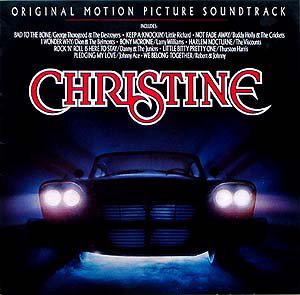
The other night, American Movie Classics ran John Carpenter’s 1983 movie adaption of Stephen King’s book Christine, the sweet, all-American story of a teenage boy and his car. Okay, so in classic Stephen King fashion, the story is a grimly hilarious subversion of the cars and girls and rock ‘n’ roll ideal romanticized not just in the songs of the Beach Boys and Jan & Dean in the 60s, but revived in the late 70s (a few years before Christine was written) in movies like Grease and the TV show Happy Days.
Christine is a “classic” car – 1958 Plymouth Fury in the book, though the car in the movie was played by a cast of cars not always the same model. The boy is a “classic” suburban kid named Arnie. Played by Keith Gordon (in a type he would take to college in Back to School), he’s a much-bullied nerd who can’t get a break with the girls, and who’s desperate to break out of the stifling stability of his home life and his controlling parents. When boy meets car, they’re both a little down and out, Arnie having just experienced a fresh humiliation at the hands of arch-bully Buddy, and Christine all junked out and selling for cheap (real, realcheap) following the death of her previous owner.
Against his best friend’s advice Arnie buys the car for $250, and from there, a love affair begins between the two of them – Christine granting Arnie hitherto un-dreamt-of mojo, and Arnie playing the devoted provider and protector of the over-sensitive, easily jealous, and mercilessly vengeful car.
One of the great devices of the movie is the way Christine’s radio communicates the car’s feelings and passions entirely in 50s rock ‘n’ roll songs (most of which actually date to the year of her manufacture), turning sweet doo-wop love songs into cues for murderous revenge.
We first meet Christine as she’s coming off the assembly line, before Arnie’s even born. She’s eager to be loved, but her nasty temper shows itself twice before she’s even made it to the showroom floor. As she parades past an audience of rapt factory workers, this song comes on the radio – alluding to her powers of self-restoration.
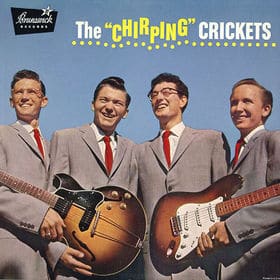
Buddy Holly: “Not Fade Away” (1957)
Though this song with its big Bo Diddley beat and “bop bop bop-bop” hook has become one of Holly’s best loved songs, his version was never released as a single – it first appeared on his 1957 album The Chirping Crickets. The fact that Holly died so young gives the song a poignant irony. True to its title, the song has never left us. The Rolling Stones would score one of their earliest hits with a cover of it in 1964, and three more covers have charted on Billboard‘s Hot 100 since.
The Bronx-based Italian doo-wop group Dion & the Belmonts scored their first hit, just missing the Billboard Top 20 with “I Wonder Why” in the summer of ’58. Though Dion DiMucci completely proves he’s the star of this group the moment he steps out to sing the lead, you have to give props to Carlo Mastrangelo for one of the most memorable doo-wop basslines ever. When I sing along to this song, it’s his part – not the lead – I have the most fun with.
Dion & the Belmonts: “I Wonder Why” (1958)

Since Dion went solo in 1960, he’s had a long and varied career, releasing more than 30 studio albums, and scoring early Top 10 hits with an R&B sound not far removed from his doo-wop days on songs like “The Wanderer”, “Donna the Prima Donna”, and his only #1 hit “Runaround Sue.” By the late 60s, he’d turned to folk music, notching one last top 10 single with the elegiac “Abraham, Martin & John” in 1968. In the 70s, he reinvented himself as a contemporary Christian singer-songwriter, but by the late 80s when he was inducted into the Rock & Roll Hall of Fame, he was starting to come around full circle, revisiting the rock ‘n’ roll and R&B of his youth. Just last month, the 72-year-old released his latest album Tank Full of Blues.
Originally written and recorded by Bobby Day, this pre-emptive cover of “Little Bitty Pretty One” became a top 10 hit for Thurston Harris, leader of a doo-wop group called The Sharps, before Day’s record company even released the original version as a single.
Ultimately it would prove Harris’s only big hit. Meanwhile, Bobby Day would establish himself as a one hit wonder in his own right when he scored an even bigger hit with “Rockin’ Robin” in the fall of 1958. The two men died within months of each other in 1990. A testament to the enduring loveability of this “Little Bitty Pretty One”: My son, born more than 40 years after Harris’s hit single, asked me to put it on his mp3 player after hearing it in the movie.
It hardly seems coincidental that some of the artists whose songs appear in the movie have tragic back stories of their own, adding some dark resonance to Arnie and Christine’s love story. Johnny Ace was an established R&B star in the early 50s. While on tour with Big Mama Thornton, at a party on Christmas Eve 1954, Ace was drunk and showing off a gun. Just playing around, he turned it on himself and pulled the trigger – the gun was loaded and the 25-year-old Johnny Ace died the next day. This single, released just weeks after his death, became his biggest hit.
Johnny Ace: “Pledging My Love” (1955)
So, okay, yes, the car’s name is Christine, and she gets awfully upset when Arnie lands himself a girlfriend. But you’ll notice she expresses herself entirely in the voices of virile young men. Do with that what you will.
The one exception comes in one of the sexiest – in a manner of speaking – scenes in the movie. A gang of teenage bullies led by the evil (you can tell by his wicked sideburns) Buddy breaks into the body shop where Arnie parks Christine (because his disapproving parents don’t want the car in their driveway), and vandalize the shit out of her. When Arnie sees the damage, he vows to defend the increasingly psychologically anthropomorphized vehicle’s honor. Hearing this, Christine offers a hint that, y’know, she’s tough and can take care of herself. Arnie, standing square in front of the car’s smashed-in windshield and mangled grille like a paying customer at a strip club, issues a dare: “Show me.” And she does. Oh yeah, she does. And this is the song she does it to:
The Viscounts: “Harlem Nocturne” (1959)