Three terrific new videos by just-barely-under-the-radar artists center around men doing what men do best: being boys. Approaching the similar subject matter from three distinct points of view, from the simply fun and nostalgic, to the tragic-comic-pathetic, to the reflective and hopeful, they’re all individually great in their own right. But taken together, it seems that Philadelphia alt-hip-hop duo Chiddy Bang, indie blues duo The Black Keys, and slam poet Sage Francis have inadvertently created a coming of age suite that John Hughes would have loved.
Already an international Top 10 hit, Chiddy Bang‘s debut single “The Opposite of Adults” (built around a sample of MGMT’s “Kids”) celebrates the carefree life of a kid – basketball, skateboarding, ogling girls at the playground – with rapper Chiddy (Chidera Anamege) promising (with apologies to Mommy) never to grow up. The video attaches cardboard cut-out looking adult faces to live action adolescent bodies as the duo relives all the various awesomenesses of their childhoods. Such as opening a box of cereal to find the prize (A Chiddy Bang 7″? Swwwweeet!).
Chiddy Bang “The Opposite of Adults”
The song may not be explicitly about childhood, but the video to the Black Keys‘s latest single, the Danger Mouse produced “Tighten Up” from their latest album Brothers, has to be one of the greatest videos about a lust triangle among the monkey bars. Singer Dan Auerbach and drummer Patrick Carney sit on a park bench watching as their sons (who, we learn in a hilarious exchange of dialogue before the song starts, may not be the best of pals anyway) compete for the attentions of an elementary school hottie. But their efforts to be the responsible, intervening grown-ups go horribly, horribly wrong.
The Black Keys “Tighten Up”
“It was the best of times. It was the end of times.” In this incredible new video from his latest album Li(f)e, Sage Francis sits among an array of chairs suggestive of a school classroom – only with a wooden coffin where the teacher’s desk might be. Taking a look inside, Francis finds a trove of snapshots and artifacts, and reflects variously on religion, media, and technology before drifting back to memories of his adolescence. His first crush. Discovering his passion for words. Discovering hip-hop. Contemplating suicide, and contemplating the things he wants from life. Contemplating the apocalyptic paranoia that is being a teenager, and contemplating the wisdom he’ll pass down to his children’s children if he’s lucky enough to live long enough to meet them.
As the classroom chairs around him fill up, he’s both teacher and student in what Prince once called “this thing called life”. His verses are loaded with richly specific details – like the love note written in code and wrapped up in ten layers of Scotch tape, but deposited in the wrong locker – and poignantly self-deprecating punchlines. The video has a familial intimacy to it that culminates in a sweet little moment between Sage Francis and the kid who plays the young Sage Francis. It’s the kind of song and video that makes me want to write a deeply personal thank you note to the artist. (Thank you, Sage Francis.)
With their self-titled debut last year, New York’s The Pains of Being Pure at Heart established themselves not only as one of the cleverest American indie pop bands to come around since Velocity Girl in the 1990s, but also, unquestionably, the cutest – in both sound and appearance. It was a noisy record, but the noise wasn’t abrasive so much as warm and fuzzy, and when you could hear the lyrics, they were full of puns (“Young Adult Friction”), alt-pop-cultural references, and coy tales of teenage ribaldry. Now, after releasing a more studio-polished EP (Higher Than the Stars) last fall, the band has returned with a new 7″ single (on “sea foam green” vinyl, even!) called “Say No To Love” b/w “Lost Saint”, both sides of which sport a jangly, retro-flavored melancholy that recalls 90s alterna-faves like the Lightning Seeds, the Cranberries, and Ivy. The band’s also put out a video for “Say No To Love” that delivers a 10,000 kiloton bomb of adorable on the viewer. Nibble on this, Suprised Kitty!
There are a lot of songs that reminisce fondly about a simpler time, when we were younger and nothing sucked quite as bad as everything sucks now. But twenty years ago, in the Summer of 1990, I was 17, my family was on the verge of homelessness, and I blamed myself for it. You see, a couple years earlier, my dad lost his job at a Chrysler (formerly American Motors) plant in Kenosha, Wisconsin. I’d gotten my first job, bagging and carrying out groceries at a local SuperValu, making $3.35 an hour plus the occasional tip. Aside from those tips – maybe five dollars in a six hour shift – I didn’t spend a penny of what I made. I deposited every check in the bank.
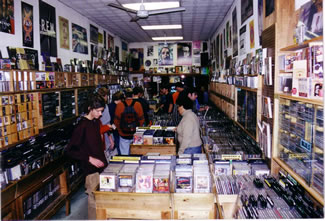
Now, these weren’t big checks, but after a year, I’d accumulated a sum that would have been enviable to most of peers. It was around that time that I started helping my parents make the house payment. Eventually I quit the grocery store job, due to a dispute with my boss about a time-off request (I’d asked for, and was denied, a Saturday off to go see a Chicago concert – which, just my luck, got postponed), and landed a snazzy new gig washing dishes at an eatery called the Edelweiss in the heart of downtown Paddock Lake. Needless to say, I didn’t make many tips there, so I started using parts of my paychecks for spending money, and the portions I devoted to savings got smaller and smaller. And as I watched the balance on my savings shrink by mortgage payments, my motivation to save shrunk even more. To the point where I didn’t save at all. But my CD collection was growing fast. Inside B-Side Records. It looked like this in 1990. It still looks like this in 2010.
I had a girlfriend back then. (Yes, I had a girlfriend back then.) And occasionally, we would take a day trip up to Madison (Mecca, as far as I was concerned), where the whole object would be just to blow all the money in our pockets, presumably on CDs, books, and, oh yes, fine Italian dining. One such day was July 11 of 1990. That also happened to be the day our house, which had earlier been foreclosed upon – the house I’d spent all my savings futilely trying to save – went up for auction. It was actually a great day, and I still remember a lot of the CDs I bought that day on Madison’s glorious State Street, which, at the time, boasted at least four or five record stores – chief among them being B-Side Records (one of the few survivors still open today), no more than a slit in a brick wall, but filled to brimming with the weirdest and wonderfullest music selection I’d ever seen and the weirdest and wonderfullest collection of people browsing those CDs practically ass-cheek-to-ass-cheek.
I had a mental list of songs and bands I’d seen on MTV’s 120 Minutes or read about in Ira Robbins’ Trouser Press Record Guides, and I was determined to find them. I think I spent close to two hundred dollars that day. It makes me light-headed even now to think about how it was to feel free enough to blow all that cash so quickly and recklessly, and on CDs I knew I’d never in a million years find at any record store closer to home – CD’s nobody else at my school even dreamed existed. CD’s like a Front 242‘s album Official Version on Wax Trax Records, or a Japanese import version of the John Foxx-era Ultravox compilation Three Into One. I’d recently become an Ultravox fan, after seeing Midge Ure play an opening set for Howard Jones. I knew that Ultravox had recorded three albums together with a different lead singer before Midge Ure joined the group in 1980, and that they were supposed to be really great (I can confirm this today), but I’d never actually heard them. (And in those days, you couldn’t just find them on YouTube.)
The CD I once spent 30 dollars on. Worth every damn penny.There in B-Side’s import case was Three Into One. It cost me about $30. Which was crazy, right? But being able to spend $30 on a single CD was kinda the whole point of the trip. So I bought it – no apologies – along with maybe 12 or 13 other CDs, both new and used, that day. (Used CDs? I’d never even knew there were stores for that!) I was thrilled, and I practically vibrated with expectation during the two hour drive back home, sitting with a pile of CDs in my lap most still packaged in those beautiful (but environmentally irresponsible, and not long for the world) cardboard longboxes. Rare CDs like artifacts brought back from an alternate universe. (They do call Madison “77 Square Miles Surrounded by Reality.”) I couldn’t wait to get home with them. I had my girlfriend drop me off at the bar my dad hung out (and where my brothers and sisters and I had often hung out with him since we were little).
By then, I’d left Edelweiss and was working in the same bar’s pizza kitchen. I sat down next to my Dad. He said, “So you spent your wad, huh?” I felt too ashamed to answer and soon left to walk home. The week after Labor Day, the first week of my high school senior year, we were evicted from our house, and we’d spend most of the next year squatting – first in my boss’s basement, and then in the summer cottage of a family friend. It was, to my mind, the end of the world. I took a lot of comfort in my CD collection. At the time, I had about 250 CDs which doesn’t seem like that many now that I’m pushing the 4,000 mark, but at the time it was an obscene number of CDs. As much as I enjoyed them still, I felt guilty that I’d spent money on them at a time when we were losing our house. Sure, all would be well again soon enough, but the following winter was the longest, coldest and loneliest of my life. When I remember that time, one of the prominent songs in my memory’s soundtrack is “Just for a Moment” by Ultravox, sung by John Foxx. Listening to the music the machines make, I let my heart break just for a moment…
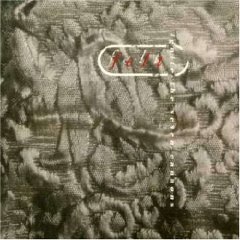
Another treasure I took home from B-Side’s import case that day was by the British band Felt. All I’d heard of Felt to that day was a single song called “Primitive Painters”. They’d played it on 120 Minutes once – only once that I’d ever seen, but I loved it instantly. In the captions at the end of the video, it named the album from which the song came as Gold Mine Trash and I spent months and months trying to special order that CD, all to no avail. But what I found at B-Side that day was even better: a two-fer CD of the band’s 1984 and 1985 albums Ignite the Seven Cannons and The Strange Idols Pattern and Other Short Stories, which included “Primitive Painters”. (I later learned that Gold Mine Trash was a U.S. only compilation – and was the band’s only U.S. release.)
Felt’s ‘Ignite the Seven Cannons’Led by Lawrence Hayward (he was just “Lawrence” in the CD credits), who didn’t so much sing as intone his lyrics, and guitarist Maurice Deebank, Felt made music of otherworldly beauty, with classically influenced guitars, churchy organs and watery atmospheres. They filled out their albums with delicate instrumental pieces with titles like “Sempiternal Darkness” and “Vasco da Gama”. It’s no wonder they never found much of an audience here, but there’s no question of their influence on the next generation of alterna-popsters including the Sundays and Belle & Sebastian. “Primitive Painters” was their crowning achievement, probably their most “rocking” song, a swirl of organ and cascading drums with Lawrence’s deadpan chant complimented by a soulful melody delivered by the Cocteau Twins‘ Elisabeth Fraser. (Cocteau Twin Robin Guthrie produced the track.)
One of my favorite albums of that time, and one that has continued to speak to me in new ways in the 20 years since it came out is Australian band Midnight Oil‘s Blue Sky Mining. After they shot to international stardom with their 1988 hit “Beds Are Burning”, Midnight Oil made a very Australia-centric album. Blue Sky Mining may not have impacted the U.S. charts all that much, but it remains one of my own two or three personal favorite records ever. I remember one day, during this last summer in our house, sitting out on the front porch listening to Blue Sky Mining turned up full blast from the livingroom stereo. At the end of a song called “Mountains of Burma”, singer Peter Garrett lets loose with these crazy wails: another essential part of the soundtrack of that summer. On our trip to Madison, I picked up Midnight Oil‘s then most recent CD single “Forgotten Years”, a song about not forgetting what was fought for, nor the people who did the fighting.
I did get some happy upbeat music that day too. For instance, I found a copy of Daryl Hall‘s 1986 solo album 3 Hearts in a Happy Ending Machine, which featured his terrific hit single “Dreamtime”, a personal favorite of mine. Incidentally, I just found the same album on vinyl last week, and I’ve been spending some quality time getting re-acquainted with it. But one of the albums I bought that I’d spend a lot of quality time with for the next several years was the self-titled one and only album by the Memphis art-pop quintet Human Radio, who had a small hit with a song called “Me & Elvis” before they broke up. Sad, really, because the rest of the album is full of really clever pop along the lines of Todd Rundgren or 10cc, with great melodies and lyrics that lampooned yuppie aspiration and tweaked the sensitivities of the trendy socially conscious and the fashionably environmentalist. 20 years later, it sounds like a time capsule of 1990.
Here’s a song that should have been a bigger hit and never fails to make me feel good listening to it. Ian Hunter and Mick Ronson were glam rock refugees at a time when glam had been co-opted by legions of tacky hair metal bands. Hunter, who was already in his 50s in 1990, had been the lead singer of Mott the Hoople in the 70s, and guitarist Mick Ronson had been one of David Bowie’s Spiders from Mars and would soon go on to produce one of Morrissey’s best albums Your Arsenal (1992) before dying from liver cancer in 1993 at the age of 46. The two had been playing together on and off for a decade or so, but in 1990, they released a really good rock and roll record called Y U I Orta, anchored by Hunter’s tribute to the music he grew up loving: “American Music”. I hear the sons of Memphis. I hear the brothers of Harlem. I hear the Nashville cats and the ragtime mamas out of New Orleans…
After six years playing culturally literate guitar pop with his band the Commotions, Lloyd Cole issued his self-titled solo debut in 1990, with the aid of drummer/producer Fred Maher (formerly of Scritti Politti), and guitarists Robert Quine and Matthew Sweet. This may have been the first CD I ever bought used, and I’ve put some serious miles on it. Its big single was a gloomy epic of moral decay in the big city called “Downtown”, but its opening number was this lightly swinging Chris Isaak-ish country crooner ballad – “Don’t Look Back”. I used to wake up early, I used to try to believe, but life seems never-ending when you’re young.
And just to show that it wasn’t all gloom and doom. One of my most treasured trophies of that big shopping day in Madison was the album Submarine Bells by New Zealand indie rock forefathers The Chills. This was the lead single and opening song of that album – a record that only gets more gorgeous with age. It’s a heavenly pop hit for those that still want it.