web analytics

Author: Paul Lorentz

  • Gaga and Beyonce in a Lez-ploitation Epic: “Telephone”

    As inspiration for a music video, you wouldn’t think much of the latest Lady Gaga single “Telephone”, a thumping Rodney Jerkins instant-club-hit with a feature spot by Beyonce (returning the favor after Gaga guested on a remix of Beyonce’s “Video Phone” for the reissue of I Am… Sasha Fierce).  The song’s lyrics virtually write their own screenplay (girl wants to dance; boy keeps calling girl; girl takes no calls cuz she’ll be dancing), and in any other hands, would probably get a very literal music video treatment.  But, as we’ve come to expect, Lady Gaga and director Jonas Akerlund (who directed her video for “Paparazzi” last summer) have come up with something altogether more menacing, and hilarious – a “lez-ploitation” sequel to “Paparazzi” which finds Beyonce bailing Lady Gaga out of jail, only for the two of them to hit the local diner, off all the patrons (including a Beyonce boyfriend played by Tyrese), and then do a big dance number for an audience of fresh corpses before riding off into the sunset.

    The long-anticipated  video – Gaga’s been tweeting about it for what seems like months now, and the song has already bulldozed its way up into the Top 3 of the Billboard Pop Chart – made a splashy premiere Thursday night on E! News, which also ran clips of an interview with Gaga (praising the E! network’s “courage” in running it in it’s glorious 9 minute entirety, and noting her and Beyonce’s shared love of women) who was almost certainly encouraging those (like me, admittedly) who would draw parallels between this particular spectacle and the ceremonious unveiling of Michael Jackson’s “Thriller” more than 25 years ago (before Gaga was born).

    Okay, so I’ll bite.  There won’t be another “Thriller” moment.  There can’t be.  In 1983, the music video was still a fledgling form – videos were cheaply made, poorly shot, and disposable – and with one grand gesture, Michael Jackson had turned it into a legitimate art form.  That kind of thing can’t happen now – the audience isn’t nearly innocent enough, which Jackson himself almost certainly had to have learned.   He never stopped making epic music videos (ahem, “short films”), but none came close to garnering the notoriety of “Thriller”, even when the actual quality of the videos (I’m thinking “Smooth Criminal” here) rivaled it for pure watchability while ditching the embarrasing dialogue and bad acting.

    But setting that singular moment aside, there are numerous parallels to be drawn between the videos for “Thriller” and “Telephone”.  Not the least of which is that they are both genre flicks with big-name directors.  Michael’s was a horror movie directed by John Landis of American Werewolf in London fame (and Twilight Zone infamy), while “Telephone” is a 70s-style exploitation flick with a decidedly meta twist and a pulpy lesbian plot line like a cross between Thelma & Louise and Natural Born Killers.  Like Jackson, whose song “Thriller” was actually the seventh (and final) single to be released from the album of the same name (a year and a half after that album’s release), “Telephone” – Gaga’s sixth consecutive top 10 hit since late fall 2008 – comes at a moment when the artist risks shark-jumping by sheer pop-cultural ubiquity.  Like Michael in 1984, Lady Gaga in 2010 needs no further exposure, and like Michael before her, she lunges for it, regardless, with a video that demands to be talked about.

    Both videos culminate in a menacing/comical dance sequence involving dead people (Michael’s are an undead dance army while Gaga’s are a still-warm flock of face-stuffers), and like werewolf Michael, lusty murderess Gaga is portraying herself (along with her oh-so-game partner Beyonce) as a monster – as in The Fame Monster, now on sale at iTunes for $7.99! – with a knowing nod to all the metaphorical implications of such.   If “Telephone” offers one major innovation, it’s a knack for wall-to-wall product placement that manages to be simultaneously witty and crass.   Half the fun of the video is spotting the shill.  Diet Coke cans for curlers?  Miracle Whip as murder weapon?  I didn’t even know that there was a real dating website called Plentyoffish.com.  I just thought it was a really good joke.  And just like Thriller when Michael confesses to actress Ola Ray that he’s “not like the other boys”, Telephone has at least one, great, defining, iconic, self-referential, media-tweaking one-liner.  But I’ll leave it to the prison guard to deliver it:
  • From the WTF Files: A Secret Stash of “Soviet Funk”

    For most of us, the most daring unauthorized use of company property we’ll ever commit is to print off our March Madness brackets for the department pool. Which is amazing given the relatively tame punitive consequences of committing greater corporate sins. I mean, yeah, I’d probably get fired (and deeply embarrassed) if I got caught doing something indecent – say, distributing internet porn, or watching highlights from Glenn Beck – on my work computer. But that’d probably be it. Maybe a misdemeanor charge here or there, a fine, some probation, a bad reference. Whatevs. I’m confident I wouldn’t get dragged out of my home and shot in a city square, or tossed in a jail cell for indefinitely. Maybe it’s the predictable leniency of the punishment that keeps most of us from doing anything brilliant or consequential (and therefore risky) with our acts of petty corporate theft. If we were going to stake our lives on it, it would have to be brilliant, right?

    Meet Pavel Sysoyev, Cold War-era Soviet government employee, and probably the closest thing to Herbie Hancock to ever emerge from the obscure Russian outpost of Abakan, a city of about 160,000 located just north of Mongolia in the Republic of Khakassia in extreme southeastern Siberia. Although to say he “emerged” from Abakan is a bit of a mis-statement. Mr. Sysoyev (who now lives in St. Paul, Minnesota) may, in fact, be more famous now in the American Midwest than he ever was anywhere in Khakassia where the fact that his recordings of his original, American-influenced funk and jazz compositions (and those of a burgeoning local underground he mentored and produced) were made after-hours on top-of-the-line government-owned equipment – and this at a time when American popular musical forms were as freshly and ambiguously legal in the U.S.S.R. as medicinal marijuana is now in the U.S., and far less respectable – made widespread release of his music in his home country a laughable impossibility.

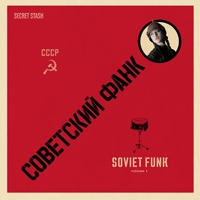
    It’s only more than 35 years after the fact that the underground jazz/fusion/funk scene Sysoyev grew under cover of night in his little Soviet-financed musical petrie dish is seeing the light of release, thanks to Minneapolis-based Secret Stash Records, who, just a couple months ago, released an LP called Soviet Funk – Volume 1 (on red vinyl, of course) with a second volume slated for release next week!   Soviet Funk – Volume 1 compiles ten instrumental gems (Look, Ma!  No language barrier!) from Pavel Sysoyev’s vaults (attic? closet? little cubby hole under the floorboards?), from sessions dating to the early ’70s, a few credited to Sysoyev himself, but also including bands Sysoyev produced like Pomogite and Da/N’et.   As startling as the mere existence of these recordings is (not to mention their sudden ready availability to schmos like me), it’s even more startling just how fricking great they are.  

    The songs themselves are smart and sophisticated, full of jaunty, stylish melodies, unexpected rhythmic twists, and harmonies that occasionally wink-nudge at the Russian classical music tradition the players came from, but the playing is incredible – and incredibly joyful – and the recordings sound as sharp as anything Creed Taylor set to tape in the same time period.  For all the musical sophistication behind it though, it’s an immediately groovable record with no shortage of catchy, accessible tunes like the opener “Gostiny Dvor” whose bubbly, flute-driven melody sounds like a forgotten hit single.  This is a record that compels you to keep flipping it over (and to keep doing that dorky little dance that you do when you’re fairly certain you’re alone with your record player) instead of browsing your shelves for what to listen to next.  [Note:  by “record”, I mean “not a CD”:  Secret Stash is a vinyl-only label, but their records do come with .mp3 download cards for those of us who love our iPods as much as our turntables.]

    In advance of the release of Soviet Funk – Volume 2, Secret Stash is now offering a free .mp3 download of a track by Pomogite, the seven-minute “Ubijcy v Belyx Xalatax” (did I mention it’s instrumental?) – an explosive saxophone-driven jam full of firework syncopations and out-of-nowhere time changes, bookended by a couple of elegant solo electric piano meditations.   Proof that Volume 1 was no fluke – in fact, it’s a strong suggestion that Volume 2 is even better.  I can’t wait.

  • CriticClash: The Crying Light by Antony & the Johnsons

    antonyA big box discount retailer is the last place I might have gone looking for the latest album by Antony and the Johnsons. But sure enough, on a recent trip to Target for a new pair of shoes, I stopped by the music section to make sure I wasn’t missing out on any “Target exclusives”, expecting to be completely disappointed in their selection, and had to do a double take.  It turns out that Target has been featuring Antony’s third album The Crying Light, in its new music displays.  Now, granted, the superstar of Bloomington, Indiana’s beloved indie Secretly Canadian label was sharing the racks with other up-and-coming indie critics’ darlings like MGMT and Missy Higgins…

    …but both those acts seem to come with the promise of future commercial success (our local Clear Channel affiliate is currently featuring a 2-year-old Higgins single as “new music”), where Antony’s sepulchral chamber pop ballads and his virtually genderless singing, all curdled cream and vibrato – an extraterrestrial amalgam of Sylvester, Maria Callas, on-her-death-bed Judy Garland and David Sedaris’s Billie Holiday impression – almost certainly inhibit any kind of mainstream, suburban embrace of The Crying Light or any future Antony and the Johnsons record.  To see it featured on a Target display – even among the moment’s “edgy” music – was a little like entering an alternate universe where American Idol is judged by a rotating cast of Pitchfork writers.

    Then again, the appearance of The Crying Light in such quaint, suburban, quintessentially Midwestern environs just as Fox is harvesting this year’s crop of hopeless Idol hopefuls works as a useful reminder that there’s a place in pop music for all comers – even the heavily bearded 18-year-old physics student who can manage to convey a sense of existential despair with his a capella rendition of “Walking on Sunshine”.  Yes, Bearded Physics Student, in this alternate universe, you too can be an American Idol.

    But I was careful not to fool myself.   I remember being astounded and moved by Antony (surname: Hegarty)’s previous record I Am a Bird Now, only to find it such a difficult listen that it has mostly sat on its shelf unplayed for the last four years.  Though, nevertheless, The Crying Light was a no-brainer must-purchase for me - it also took some girding of the loins before I could give it a listen.  The surprising thing is that, far more than I ever did for its predecessor, I find myself craving the songs of The Crying Light, and actually wanting to hear the record – so much so, that it hasn’t left my car stereo since I bought it.

    – – – – –
    The first thing that you notice about this new record – the first thing, that is, beside Antony’s quivering, otherwordly voice, which, for many (most?) will be an immediate dealbreaker – is just how sad it all sounds.  Though he recently unveiled his own Inner Latent Disco Diva via multiple guest spots on an album by Hercules & Love Affair, Antony’s own songs have a dark, hymnal quality to them, which, coupled with spare, simple lines and hints at Medieval song structures and chord changes make songs like “The Crying Light” and the monumental “Daylight and the Sun” feel almost like religious incantations.  Lead single “Another World” is a series of simple call and response verses – the melody is simple and unchanging like a steady prayer.  I need another world.  This one’s nearly gone.

    But on repeated listens, there’s also something beautiful and uplifting about the whole record, and it proves to be a far more diverse, far more self-contained, far more surprising, but also far more listenable piece of work than I Am a Bird Now.   The opening track “Her Eyes Are Underneath the Ground” opens with that immediate declaration of death.  But just a few lines in, there’s a note of hope:  No one can stop you now.

    It’s a fitting compliment to the portrait of Japanese Butoh performer Kazuo Ohno (to whom the record is dedicated – Antony has referred to Ohno as his “art father”) that graces the record cover.   Butoh is a form of conceptual and imagistic, theatrical dance performance which generally explores grotesqueries and taboo.  And you could pretty much use the same words to describe what Antony does here.  “Epilepsy is Dancing” sounds almost festive – with different words, it might have been a Christmas carol – but it’s imagery is positively hallucinogenic, and not necessarily in a “good trip” sort of way, a kaleidoscope of glammy drag (“Glitter is Love!”) and religious ecstacy, culminating in a cry for destruction:  “Cut me in quadrants!  Leave me in the corner.”  Likewise, the jubilant, lightly Celtic lilt of “Kiss My Name”, with its wooshing, rollercoaster violin scales which, to my mind, evoke the endless, careless spinning of a little girl dancing, effectively obscures a tale of murder and grieving.

    All of these songs seem to have secrets in them, but the record climaxes with a song called “Aeon”, a soulfully straightforward, full-throated declaration of love set to 70s-style hard rock guitar arpeggios (think Nazareth’s “Love Hurts”).   It’s a stark contrast to the delicacy of the rest of the record, and Antony’s usually carefully mannered singing is jettisoned in favor of something more raw (still otherworldy!), to the point where he’s literally shouting out the line “Hold that man I love so much!“  You get the feeling that everything about the record has led to the pure, emotional deluge of those two words, and everything that follows is a reflection of them.  “Aeon” sounds, simultaneously, like a song not of this album, but also the song that crystallizes the rest of this amazing record into a cohesive whole – the song around which the rest of the album revolves.  It’s Antony’s best song yet.  It’s Antony’s best album yet.  Still, no one’s likely to believe that you got it at Target.

    – – – – –
    NOTE:  This album is also available as a vinyl LP.  The LP also comes with a download code to get the album as mp3s.